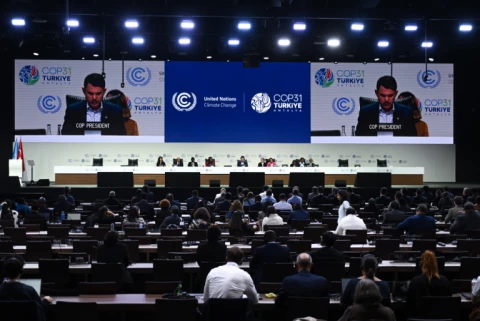
The 31st Conference of the Parties (COP31) in Antalya ended on 22 November, after talks that ran two days past the scheduled close. The cover decision, which was expected to be the summit's main political text, was not adopted at the closing plenary. COP31 President Murat Kurum stated that some parties opposed the text and that there was no consensus on the document. The European Union (EU) and some countries said they could not accept a text that did not mention fossil fuels. The African Group said it would not block consensus despite the shortcomings of the text. At the same plenary, decisions on the Adaptation Fund, the Green Climate Fund, the Fund for responding to Loss and Damage and the just transition work programme were adopted. COP31 President Kurum said that no new text would be prepared and that the adopted decisions would be carried out.
This piece assesses what the Antalya outcome means, how it may affect COP32, which will meet in Addis Ababa in 2027, and the risks and opportunities of the period ahead. It then offers recommendations for Türkiye's presidency year.
A Summit Where Energy Security Came First
COP31 is the first climate summit to meet since the disruption in the Strait of Hormuz. The disruption arose when the conflict that began in the region on 28 February essentially halted traffic through the strait. The International Energy Agency (IEA) described this disruption as the largest supply disruption in the history of the global oil market. At the end of April, the price of Brent crude stood more than 60 percent above its pre-conflict level. This crisis came after the global energy crisis that Russia's invasion of Ukraine triggered in 2022. Naturally, in such an environment the first question for governments is not emissions. It is continuity of supply and price.
The same crisis is read in two opposite ways. On one reading, the crisis is a reason to secure existing fossil fuel supply. On the other, it has shown the cost of dependence on imported fuel. The IEA's World Energy Outlook, published on 19 November, states that energy security and affordability have become guiding principles for energy decision making. The same report notes that the turn to domestic resources strengthens renewables, led by solar, as well as nuclear, and that coal has also gained ground in the short term.
The division in Antalya bears the mark of these two readings. Fossil fuel producing countries opposed including language on transitioning away from fossil fuels in the text. A group that included the EU did not accept the text without it. In a system where decisions are taken by consensus, the two positions could not meet in the same text.
The Absence of the United States and Great Power Leadership
The second defining condition of the summit is the absence of the United States. The US administration, which decided to withdraw from the Paris Agreement in 2025 and from the United Nations Framework Convention on Climate Change in 2026, did not send an official delegation to Antalya. It has thus stayed away from the climate summits for the second year in a row. This absence mattered in two ways. The burden of any new finance figure fell on the remaining developed countries. A diplomatic weight that had eased compromise in earlier periods was also missing from the table.
From an international relations perspective, this reflects a broader trend. When a great power does not put its weight behind the process, the influence of objecting parties grows and the text that everyone can accept narrows. COP31 President Kurum stated that a large majority had agreed on the text. Under the consensus rule, however, this majority was not enough for the decision to be adopted.
While the negotiated text narrowed, voluntary coalitions widened. The Presidency's electrification initiative covered more than 150 countries and the EU. This shows that the center of gravity of climate cooperation is shifting from consensus-based texts to initiatives joined by willing countries.
What the Unadopted Text Provided For
The Presidency presented three drafts during the summit. The first draft, dated 16 November, repeated the call to transition away from fossil fuels adopted in Dubai in 2023. The second draft, dated 19 November, did not mention fossil fuels. The final draft, dated 22 November, again made no explicit reference to fossil fuels. Instead, its preamble recalled the UAE Consensus, reached in Dubai, in its entirety. This formula was not enough to close the distance between the parties.
The final draft expressed deep concern that peak warming is expected to exceed 1.5°C within a few years and committed to limiting the magnitude and duration of the overshoot. The text states that warming is projected to reach around 2.6°C if national climate plans are fully implemented. The draft also provided for a high-level dialogue on overshoot science at the 2027 session.
The target of raising the share of electricity in final energy consumption to 35 percent globally by 2035 kept its place in all three drafts. The second draft mentioned this target together with the targets of tripling renewable energy capacity and doubling the rate of energy efficiency improvements by 2030. The final draft did not include these two numerical targets. Instead, it stated that electrification's contribution to the climate goal is maximized through the greatest possible use of clean energy. On carbon capture, the numerical options in the second draft gave way to an aspiration of reaching gigatonne scale by 2035.
On adaptation finance, the draft kept the call to at least triple adaptation finance by 2035. It did not include the figure of USD 120 billion a year sought by the African Group and the least developed countries. A timetable was proposed in place of the figure. The Standing Committee on Finance was asked for a report on the baseline against which the increase would be calculated, and an Antalya-to-Addis Ababa Roadmap on Adaptation and Resilience Finance was envisaged under the guidance of the two presidencies. The reports were planned for submission to the session in November 2027. As the decision was not adopted, these provisions did not take effect.
Implications for COP32
The issues left unresolved in Antalya pass to Addis Ababa. The first is fossil fuels. The debate has moved beyond whether a single sentence enters the text. It has become the issue that decides whether a cover decision is adopted. The course of next year's debate will depend largely on the state of energy markets at that time.
The second is adaptation finance. Since the demand for a figure came from the African Group and the least developed countries, this item can be expected to be one of the main topics of a summit held in Africa. As the roadmap was not decided, how the preparation is carried out now depends on the steps the two presidencies take.
The third is the practice of the cover decision itself. Antalya showed that adopting a single overarching political text by consensus is becoming harder. Whether the COP32 presidency will aim for such a text, and how narrow it will keep its scope if it does, will be one of the first questions of next year. The fact that the cover decision was not adopted does not remove the obligations undertaken at earlier summits or the rules in force.
Risks and Opportunities
Three risks stand out in the period ahead. The lack of consensus may weaken trust in the multilateral process. Persistently high energy prices may push some countries toward coal. The continued absence of the United States and budget constraints in developed countries may delay the increase in adaptation finance.
The opportunities lie in the area outside the negotiated text. Electricity today meets around 23 percent of final energy consumption. In the IEA's scenario based on stated policies, this share approaches 30 percent in 2035. This is a scenario, not a forecast. The 35 percent target therefore requires an acceleration beyond current policies. Since energy security concerns are steering importing countries toward domestic and clean electricity, the political support behind the target continues independently of the decision text.
The Presidency's lead initiative, the Climate Implementation Bridge (BRIDGE), aims to turn the priorities in developing countries' climate plans into investment-ready projects. Its implementing partner is the United Nations Development Programme. The first pilot countries were Ethiopia, Fiji, Indonesia, Pakistan and Uzbekistan, and new countries joined the initiative in Antalya. Since the electrification pledge and the Bridge do not rest on a decision, they are not affected by the fate of the cover decision. In a year when the figure and the roadmap were deferred, these are the concrete tools that can speed up the flow of existing resources to projects.
Assessment and Recommendations
The Antalya outcome showed the limits of consensus in a year when energy security came first and great power leadership weakened. The Presidency continued to seek compromise until the last moment. However, no common ground remained between the text that fossil fuel producing countries could accept and the text that the EU and the countries acting with it could accept. Nevertheless, decisions on Article 6 of the Paris Agreement, the least developed countries, the climate funds and just transition were adopted at the summit, and broad coalitions were formed under the Action Agenda. Türkiye's presidency continues until COP32. Against this background, three steps can be recommended.
First, it would be appropriate to carry the adaptation finance roadmap forward together with Ethiopia as a joint initiative of the two presidencies. A public work schedule and technical preparation on the baseline against which the increase will be calculated would raise the chances of agreement on a figure in Addis Ababa.
Second, it would be useful to set up a monitoring arrangement for the Action Agenda targets. Which countries have joined the electrification, buildings and waste targets, and how much progress has been made, could be reported annually. Since the targets do not rest on a decision text, this monitoring is what will give them credibility.
Third, addressing the electrification target together with the renewable energy target would strengthen it. Meeting the growth in electricity from renewable sources would increase the target's climate contribution and align energy security with climate targets. The clean energy language in the final draft is a starting point in this direction, and it may offer common ground before COP32 for the parties that diverged in Antalya.
The items on which no agreement was reached in Antalya remain on the negotiating agenda. The fossil fuel debate and the adaptation finance figure move to the agenda of Addis Ababa, while the electrification target continues as a voluntary pledge. The lasting value of the outcome depends on how much common ground the parties can build on these items in the year between the two summits.