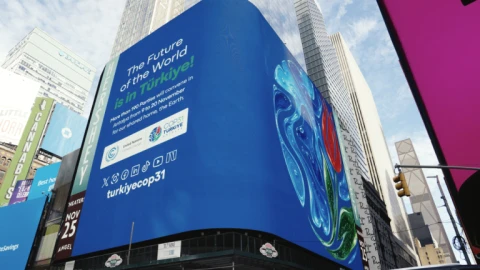
The meetings held in New York on the occasion of the 81st session of the United Nations (UN) General Assembly marked an important stage in Türkiye’s preparations for COP31, which will take place in Antalya in November. At the meetings held there, especially the High-level Event on Climate Action and the Just Transition convened by UN Secretary-General António Guterres on September 23, the question of how to put climate targets into practice came to the fore at a time when global warming is expected to temporarily overshoot the 1.5°C threshold.
The shared observation in New York was that countries are struggling to turn their climate targets into implementation. Türkiye went to New York with an agenda that responded to this at different levels. President Recep Tayyip Erdoğan set out Türkiye’s approach to COP31 at the leaders’ level. Murat Kurum, COP31 President and Minister of Environment, Urbanization and Climate Change, announced the COP31 Action Agenda and the initiatives under it. Emine Erdoğan, for her part, highlighted the societal dimension of the issue through the Zero Waste movement. This article argues that, taken together, these statements give concrete substance to the “bridge” approach often emphasized in Türkiye’s climate diplomacy, and that the COP31 Presidency has built its agenda on its own policy experience.
The Framework at the Leaders’ Level
In his speech at the summit, President Erdoğan stated that preparations for COP31 were being carried out with an approach that gives voice to the expectations of different regions, and called for bringing ambition and means, targets and implementation closer together. He also stressed that as long as inequalities in access to finance and technology persist, it is not realistic to expect all countries to progress at the same speed.
This approach is directly linked to “common but differentiated responsibilities and respective capabilities,” one of the core principles of the climate regime. Türkiye’s particular position within the regime is part of what gives it a voice on this issue. When the UN Framework Convention on Climate Change was adopted in 1992, Türkiye was included in the Convention’s Annex I list because of its OECD membership, yet its economic development followed a different path from that of the other countries on the list. As a result, for many years it did not fully belong to any of the negotiating groups. Today, the same position allows Türkiye to understand the concerns of both developed and developing countries closely and strengthens its capacity to mediate.
The summit highlighted the goals of providing developing countries with at least $300 billion per year in climate finance by 2035, and $1.3 trillion per year from all sources. According to figures Minister Kurum previously shared at the UN, global climate action requires between $7.5 trillion and $9 trillion in financing each year, while total climate finance today stands at around $1.9 trillion. These figures refer to different scales. The goals mentioned at the summit concern international commitments to developing countries, whereas Minister Kurum’s figures point to the total global need and current flows, including both public and private sources. Both, however, show how wide the gap is between what is needed and what is available. President Erdoğan’s emphasis on the gap between targets and means should be read in this light.
The Action Agenda and the Focus on Implementation
For Türkiye, the most concrete development in New York was the COP31 Action Agenda, which Minister Kurum unveiled at the UN. To assess the Action Agenda, it is worth recalling how roles are divided at COP31. While Türkiye holds the COP31 Presidency, the official negotiations are led by Australia. At the Bonn meetings in June, COP31 President of Negotiations Chris Bowen noted that the Action Agenda and the negotiations are separate processes that complement each other.
Within this division of labor, the Action Agenda essentially serves an implementation function. Decisions adopted in the negotiations set out which targets countries need to reach, but they usually say little about the means by which those targets will be met. In addition, the fact that decisions are taken by consensus among more than 190 parties slows the negotiation process down. The Action Agenda, by contrast, does not require such consensus and brings together only those countries and institutions that are willing to take part in implementation. This way, concrete steps can be taken even while negotiations continue. Minister Kurum’s description of COP31 as the “implementation COP” follows from this approach. In his words, the aim is “to turn climate targets into measurable, implementable actions.”
This division of labor carries strategic weight for Türkiye. In a structure where Australia leads the official negotiations, Türkiye has defined implementation as the main focus of its presidency. While outcomes in the negotiations depend largely on consensus among the parties, the presidency has more room to design initiatives and choose partners when it comes to implementation. Seen this way, Türkiye’s emphasis on an “implementation COP” can be read as a choice that fits both the climate regime’s need for implementation and the opportunities created by COP31’s structure shared between two countries.
The Action Agenda’s 2035 targets focus on electrification, waste, energy efficiency in buildings and the circular economy. Chief among these targets are raising the share of electricity in final energy consumption from 20 percent to 35 percent and cutting the projected growth in municipal waste by at least half. The choice of targets suggests that the presidency has built its agenda on areas where Türkiye has accumulated policy experience in recent years. The waste target can be read as taking the Zero Waste project, implemented nationwide, to the global level. Indeed, Zero Waste has been designated as one of the ten priority themes of the Action Agenda. Emine Erdoğan’s remarks at the opening of New York Climate Week, where she said the Zero Waste movement has made the individual the leading actor of the solution, further strengthen this link. Her point that the cost of consumption is borne mostly by developing countries and future generations adds a consumption dimension to the climate justice debate. The building efficiency target can be linked to Türkiye’s experience with large-scale, energy-efficient housing construction during post-earthquake reconstruction. The electrification target, meanwhile, is in line with Türkiye’s policy of expanding its renewable energy capacity. These choices lend credibility to the targets proposed by the presidency and create concrete areas where Türkiye can share its own experience with other countries.
Another feature of the targets is that they are measurable and designed in line with development goals. Given that 666 million people around the world still have no access to electricity, electrification also matters for access and prosperity. The implementation-focused approach extends to the private sector as well. At the COP31 Business Forum in New York, the aim was for the business community to draw up a roadmap for putting the Action Agenda into practice. This roadmap will be presented at the COP31 Business and Investment Summit, to be held in Antalya on November 12-13. Since this will be the first time in COP history that such a summit is held alongside the leaders’ summit, the business community’s proposals will be able to reach heads of state and government directly.
For Türkiye, these targets are closely tied to energy security. According to the Istanbul Policy Center report Turkey’s Decarbonization Roadmap: Towards Net Zero by 2053, under a net zero scenario the share of solar and wind in electricity generation could reach 73 percent by 2053, while grid reliability is maintained throughout this process. The report estimates that the decline in oil imports, resulting from reduced fossil fuel use in transport, will bring annual benefits of $3.6 billion over the next decade. An electricity system based on domestic and renewable sources increases Türkiye’s energy self-sufficiency and, in doing so, brings its climate goals and energy security goals closer together.
The Climate Implementation Bridge
One of the most striking initiatives of the Action Agenda is the Climate Implementation Bridge (BRIDGE), carried out jointly with the UN Development Programme (UNDP). During New York Climate Week, it was announced that Ethiopia, Fiji, Indonesia, Pakistan and Uzbekistan would be the initiative’s first pilot countries. According to UNDP, the initiative aims to turn the priorities in developing countries’ Nationally Determined Contributions (NDCs) and National Adaptation Plans into investable projects and to connect these projects with technical support, finance and implementation partners.
The initiative focuses on a key problem in climate finance. Many developing countries have climate plans, but the financial resources to implement them are limited. Development banks and climate funds, on the other hand, struggle to find well-prepared projects they can finance. By bringing these sides together, BRIDGE aims to turn plans into projects, and projects into investments.
The process is country-led. Governments set their own priorities, while the support provided focuses on making these projects finance-ready in terms of cost, risk and timeline. Fiji’s participation as a pilot country shows this approach in concrete terms. Under the initiative, Fiji will prepare an NDC 3.0 implementation plan that identifies and costs its priority climate projects. Access to renewable energy for rural communities is one of the main focuses of this process. In this context, Fiji’s Minister for Environment and Climate Change Lynda Tabuya cited as an example the opportunity to connect Kadavu Island, which is home to about 12,000 people and not connected to the national grid, directly to renewable energy. Rather than creating a new financial institution, the initiative aims to strengthen countries’ existing climate finance structures through partnerships with development banks, climate funds and the private sector. The experience gained from the pilots is then planned to be scaled up to small island developing states and least developed countries.
This initiative puts Türkiye’s bridge approach into practice. Within this structure, Türkiye takes on a facilitating role between countries that need finance and the institutions that provide it. The initiative’s country-led design is in line with developing countries’ demand to set their own priorities. The geographical spread of the pilot countries is worth noting as well. Selected from Africa, the Pacific, Southeast Asia, South Asia and Central Asia, these countries represent different levels of vulnerability and development. The fact that Ethiopia is both a pilot country and the host of COP32 could also make it easier to carry the work started in Antalya into the next COP presidency.
Three Key Factors in the Antalya Process
The initiatives announced in New York are a strong start for COP31. Three factors will determine whether they turn into lasting results in Antalya.
The first is the scale and terms of finance. BRIDGE aims to make projects finance-ready. However, the scale of the finance that will actually be provided depends largely on contributions from international financial institutions. In developing countries, the main factor driving the cost of clean energy projects is often the cost of capital, and banks’ risk assessments rely heavily on country risk. For this reason, guarantees, local currency loans and de-risking instruments matter alongside the amount of finance.
The second is the link between the Action Agenda and the negotiation process. Running the two processes separately can speed up implementation. Even so, COP31’s impact will be greater if the results achieved under the Action Agenda are also reflected in negotiated decisions. The Antalya Declaration to be prepared at COP31 and the leaders’ summit to be held on November 11-12 offer important opportunities to build this link.
The third is continuity and measurability. A COP presidency lasts only one year. For BRIDGE to have a long-term impact, there needs to be a transparent record of which finance reaches which countries, and in what form. In addition, it is important to give the initiative an institutional structure so that it can continue under the COP32 presidency.
Conclusion
The meetings in New York clearly showed how Türkiye is approaching COP31. President Erdoğan’s call to bring targets and means closer together, the implementation-focused Action Agenda announced by Minister Kurum and Emine Erdoğan’s emphasis on Zero Waste carried messages that complement one another. What these messages have in common is that they back Türkiye’s bridge approach in climate diplomacy with concrete mechanisms. This approach can also be read as an effort to turn Türkiye’s unique position between developed and developing countries into a diplomatic capacity geared toward implementation.
The Pre-COP meeting to be held in Fiji on October 5-8 will be the first major occasion to discuss these initiatives with the parties. In Antalya, turning climate plans into projects backed by finance will be one of the top items on the agenda. Following up on the same priorities in the COP32 process after Antalya could help developing countries’ demands for finance and implementation gain a lasting place on the international climate agenda.