
The debate over Syria's role in Lebanon has re-emerged amid profound geopolitical changes reshaping the Middle East. Yet the central question is no longer whether Damascus intends to restore the political and security influence it exercised before 2005. Rather, it is whether Syria's new leadership views Lebanon through the same strategic lens that guided Syrian policy for decades, or whether the collapse of the Assad regime and the emergence of a new regional order have fundamentally altered Damascus' calculations.
This debate extends far beyond bilateral Lebanese-Syrian relations. It reflects a broader competition over the future architecture of the Levant. On one side stands an Israeli vision that seeks to reorganize the region through bilateral security arrangements, fragmented diplomatic tracks, and the gradual integration of neighbouring states into a security framework centred on Israel and supported by the United States. On the other, an alternative regional approach is gradually emerging—one that prioritizes interstate cooperation, economic connectivity, and regional integration involving Syria, Türkiye, Saudi Arabia, Qatar, Egypt, and potentially Iran through renewed diplomatic engagement.
Within this evolving landscape, Syria has deliberately repositioned itself. Rather than seeking to reclaim its traditional influence in Lebanon, Damascus increasingly presents itself as a stakeholder in a broader regional integration project based on sovereign state-to-state relations rather than political tutelage. This strategic shift has become particularly evident since President Ahmad al-Sharaa assumed office, and was publicly articulated during Foreign Minister Asaad al-Shaibani's visit to Beirut in July 2026.
Contrary to expectations in some Western policy circles, Syria has consistently rejected proposals that could draw it back into Lebanon's internal political and security dynamics. This refusal is neither tactical nor temporary. Instead, it reflects a comprehensive reassessment of Syria's regional priorities, its national security doctrine, and its understanding of how influence is exercised in a rapidly changing Middle East.
This paper argues that Syria's rejection of renewed intervention in Lebanon should not be interpreted simply as a Lebanese policy. Rather, it forms part of a broader Syrian strategy aimed at repositioning the country within a new regional order built upon economic interdependence, political coordination, and collective stability instead of geopolitical competition and proxy influence.
Why Syria Re-entered the Regional Debate—But Not Lebanon
The renewed discussion of Syria's role in Lebanon did not originate in Beirut or Damascus. Rather, it emerged from a broader strategic reassessment taking place in Washington and other regional capitals following the latest regional war. As policymakers began considering post-war security arrangements for the Levant, Lebanon increasingly came to be viewed as part of a wider regional security architecture rather than an isolated domestic arena. Within this framework, Syria inevitably reappeared as a factor that could neither be ignored nor bypassed.
From an American perspective, the logic appeared straightforward. Syria shares Lebanon's longest land border, remains deeply connected to its economic and security environment, and has historically exercised considerable influence over Lebanese affairs. These realities led some policymakers to conclude that any durable security arrangement in Lebanon—particularly regarding border control, arms trafficking, Hezbollah's future, and the consolidation of Lebanese state institutions—would require some degree of Syrian involvement.
Yet this assumption rested on an outdated reading of Syrian strategic thinking. It largely reflected the legacy of the pre-2005 regional order, when Syria viewed Lebanon as a critical component of its regional influence and an extension of its national security doctrine. It overlooked the fact that both Syria and the wider Middle East have undergone structural transformations that have fundamentally altered the incentives shaping Damascus' foreign policy.
Israeli calculations further reinforced this perception. Since the outbreak of the regional war, Israel has sought to redesign the strategic landscape of the Levant through a series of bilateral political and security arrangements. Rather than encouraging regional coordination, this approach has relied on negotiating separately with neighbouring states while limiting the emergence of collective regional positions. Within this broader strategy, speculation surrounding Syria's possible return to Lebanon served multiple purposes. It generated uncertainty inside Lebanon, encouraged competition between Beirut and Damascus over future diplomatic tracks, and reinforced the perception that regional normalization could proceed through fragmented bilateral agreements rather than coordinated regional frameworks.
From Damascus' perspective, however, this represented precisely the strategic environment it wished to avoid. Syrian policymakers increasingly concluded that re-entering Lebanon's domestic political arena would neither enhance Syria's regional position nor strengthen its national security. On the contrary, it would risk drawing Damascus back into the very dynamics from which it has spent years attempting to disengage: domestic polarization, regional proxy competition, and open-ended security commitments.
This divergence between American expectations and Syrian calculations reflects a broader misunderstanding of Syria's evolving regional priorities. While external actors continued to evaluate Syria through the prism of its historical role in Lebanon, Damascus had already begun redefining its strategic identity. The question facing Syrian decision-makers was no longer how to recover lost influence, but how to reposition Syria within a regional order undergoing profound political and economic transformation.
It is within this broader context—not within the narrow confines of Lebanese politics—that Syria's subsequent decisions, including its rejection of renewed political or security involvement in Lebanon, should be understood. Far from representing tactical caution, they reflected a strategic choice rooted in a fundamentally different conception of Syria's regional role.
Why Damascus Rejected the American Assumption
Washington's assumption that Syria might be willing to reassert its influence in Lebanon underestimated the extent to which Damascus has redefined its strategic priorities since the collapse of the Assad regime. The Syrian leadership no longer views regional influence through the traditional lens of political patronage or security dominance. Instead, it increasingly measures strategic success by its ability to restore state capacity, attract investment, normalize regional relations, and reposition Syria as a platform for economic connectivity rather than geopolitical confrontation.
This transformation is rooted in a broader reassessment of Syria's modern political experience. For nearly three decades, Lebanon occupied a central place in Syrian regional strategy. Political influence in Beirut was widely perceived as an extension of Syrian national security, while military and intelligence involvement formed an essential pillar of Damascus' regional posture. That model, however, was built upon a regional order that no longer exists. The geopolitical environment that once enabled Syria to manage Lebanon through direct leverage has fundamentally changed, as have the priorities of the Syrian state itself.
For the new leadership in Damascus, the principal challenge is no longer preserving influence beyond its borders but rebuilding authority within them. Years of conflict have left Syria facing immense economic, institutional, and social pressures. Reconstruction, infrastructure rehabilitation, institutional reform, and regional economic reintegration now occupy the center of government policy. Under such circumstances, assuming responsibility for Lebanon's internal political dynamics would not strengthen Syria's regional standing; it would divert political capital and financial resources away from priorities regarded as essential to long-term national recovery.
This strategic calculation also reflects a broader shift in Syria's understanding of national security. Rather than viewing Lebanon as an arena that must be politically managed, Damascus increasingly sees stability in Lebanon as a strategic objective in itself. A functioning Lebanese state capable of controlling its borders, limiting illicit trafficking, coordinating security, and maintaining institutional cooperation serves Syrian interests far more effectively than any attempt to rebuild networks of political influence.
Equally important is Syria's assessment of the regional costs associated with renewed intervention. Returning to Lebanon would inevitably revive historical suspicions among Lebanese political actors, complicate Syria's rapprochement with Arab states, and expose Damascus to renewed international scrutiny at a time when it is actively seeking diplomatic normalization and economic reintegration. From the perspective of the current leadership, these costs substantially outweigh any limited strategic advantage that renewed political influence in Lebanon might provide.
This explains why Damascus has consistently rejected proposals suggesting a renewed Syrian security role in Lebanon, even when such proposals appeared compatible with broader American efforts to stabilize the Lebanese arena. Syrian policymakers increasingly believe that sustainable stability cannot be achieved by restoring external guardianship over Lebanon, but by strengthening the Lebanese state's own institutional capacity. Syria therefore seeks to contribute to Lebanese stability as a neighboring state rather than as a political arbiter.
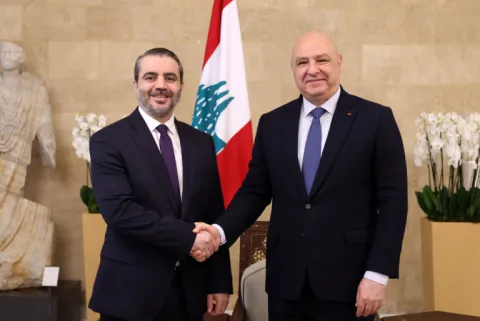
Foreign Minister Asaad al-Shaibani's visit to Beirut provided the clearest public articulation of this strategic shift. Rather than reopening historical channels of influence, the visit emphasized institutional cooperation between two sovereign governments. Discussions focused on border management, economic cooperation, transportation networks, energy connectivity, trade, and security coordination—areas where mutual interests converge without requiring Syria to assume responsibility for Lebanon's domestic political equilibrium.
Perhaps most significantly, Damascus also signaled its willingness to recalibrate relations with political actors that had previously stood on opposite sides of the Syrian conflict. Al-Shaibani's carefully worded remarks regarding the possibility of future dialogue with Hezbollah—should such engagement serve the interests of both states—illustrated a broader diplomatic approach aimed at managing differences without rebuilding the regional alliance structures of the past. This reflects a foreign policy increasingly driven by state interests rather than ideological alignments or historical loyalties.
Ultimately, Syria's rejection of renewed involvement in Lebanon should not be understood as strategic disengagement. Rather, it represents a deliberate redefinition of influence itself. Damascus has not abandoned Lebanon; it has abandoned the assumption that safeguarding Syrian interests requires shaping Lebanon's internal political order. Instead, it seeks to build a relationship based on institutional cooperation, economic interdependence, and shared security interests—an approach that aligns more closely with Syria's broader regional strategy than the interventionist model that defined an earlier era.
Al-Shaibani's Beirut Visit: The Public Launch of Syria's New Lebanon Doctrine
Foreign Minister Asaad al-Shaibani's visit to Beirut was more than a diplomatic milestone in the gradual normalization of Lebanese-Syrian relations. It represented the first comprehensive public expression of Damascus' post-Assad doctrine toward Lebanon. Rather than reopening a historical relationship defined by political influence or security oversight, the visit sought to establish an entirely different framework—one grounded in sovereign equality, institutional cooperation, and shared regional interests.
Its timing was particularly significant. The visit followed months of speculation regarding Syria's potential role in Lebanon's evolving security landscape and coincided with growing international discussions over post-war regional arrangements. Against this backdrop, Damascus appeared determined to communicate that it would not allow its emerging regional role to be interpreted through the prism of its historical experience in Lebanon.
Throughout his meetings with President Joseph Aoun, Speaker Nabih Berri, Prime Minister Nawaf Salam, senior political leaders, and religious authorities, al-Shaibani consistently emphasized a single principle: relations between Beirut and Damascus would henceforth be conducted exclusively on the basis of state-to-state engagement. This was not merely diplomatic language. It reflected a deliberate effort to replace informal political influence with institutional mechanisms capable of surviving changes in governments, domestic coalitions, and regional alignments.
The substance of the visit reinforced this message. Discussions focused primarily on practical areas of cooperation: border management, customs coordination, transportation corridors, energy connectivity, trade, transit, and the reactivation of bilateral institutional frameworks. Such priorities illustrate a significant shift in Syrian strategic thinking. Lebanon is no longer viewed as a political arena requiring management, but as an indispensable economic and security partner within a wider regional integration strategy.
Equally revealing was Damascus' handling of Lebanon's most sensitive domestic issues. Rather than positioning itself as a mediator among Lebanese factions or as a guarantor of internal political balances, Syria deliberately avoided assuming responsibilities that had once defined its regional role. Instead, Syrian officials repeatedly emphasized that questions such as Hezbollah's future, the implementation of the Taif Agreement, and the consolidation of state authority remain matters to be resolved by the Lebanese themselves through national dialogue and constitutional institutions.
This position also explains Damascus' nuanced approach toward Hezbollah. The Syrian leadership no longer frames the relationship through the binary logic that dominated the years of the Syrian conflict. Nor has it sought to revive the strategic alliance that previously characterized relations between the two sides. Instead, Damascus appears to be pursuing a more pragmatic formula—one that separates historical grievances from present-day state interests. Al-Shaibani's openness to future dialogue with Hezbollah, should circumstances require it, reflected this broader recalibration rather than any attempt to reconstruct previous political alignments.
Viewed from a regional perspective, the visit also carried a broader strategic message. Rather than accepting Lebanon as an arena for competing external influences, Syria presented bilateral cooperation as one component of a wider regional project centered on connectivity rather than confrontation. Improved transport links, integrated infrastructure, expanded trade, coordinated border management, and institutional security cooperation were presented not merely as bilateral objectives, but as building blocks for a more interconnected Levant.
In this sense, al-Shaibani's visit should not be understood as marking Syria's return to Lebanon. It marked Syria's departure from the political logic that had governed Lebanese-Syrian relations for decades. The visit publicly confirmed that Damascus now seeks influence through connectivity rather than patronage, through institutions rather than intermediaries, and through regional integration rather than geopolitical competition. That distinction represents perhaps the most consequential transformation in Syrian policy toward Lebanon since the withdrawal of Syrian forces in 2005.
Conclusion
The renewed debate over Syria's role in Lebanon has largely been shaped by assumptions rooted in an earlier regional order—one in which influence was measured by the ability of regional powers to shape the domestic politics of neighboring states. The evidence examined in this paper suggests that this assumption no longer reflects the strategic thinking of Syria's current leadership.
Damascus has not withdrawn from Lebanon, nor has it ceased to regard Lebanon as strategically important. What has changed is the definition of Syria's regional role. Rather than seeking political leverage inside Lebanon, the Syrian leadership increasingly views long-term stability as dependent upon institutional cooperation, secure borders, economic connectivity, and the gradual integration of regional economies. In this framework, Lebanon is not an arena to be managed but a partner in a wider regional strategy.
Foreign Minister Asaad al-Shaibani's visit to Beirut illustrated this transition in practical terms. It signaled that Syria intends to rebuild relations with Lebanon through government institutions rather than political patronage, while distancing itself from the interventionist model that shaped bilateral relations for decades. Equally important, the visit demonstrated that Damascus sees its relationship with Lebanon as part of a broader effort to construct a more integrated regional order rather than as an isolated bilateral file.
This strategic repositioning also reflects a wider contest over the future of the Middle East. Israel continues to promote a regional framework built around fragmented bilateral security arrangements and the management of regional divisions. Syria, by contrast, increasingly associates itself with an alternative vision based on regional connectivity, economic interdependence, and interstate cooperation. Whether this emerging framework ultimately succeeds remains uncertain, but it already provides the strategic logic behind Damascus' rejection of renewed political or security involvement in Lebanon.
Ultimately, the future of Lebanese-Syrian relations will be determined less by questions of influence than by questions of integration. The central issue is no longer whether Syria will return to Lebanon, but whether both countries can develop a sustainable model of cooperation that reflects the realities of a changing regional order. In that sense, Syria's refusal to resume its former role should be understood not as a retreat from Lebanon, but as part of a broader transformation in the way Damascus defines power, partnership, and regional leadership in the post-Assad Middle East.