February 28, 2026, marked the opening of a new chapter of war in the already stormy political climate of the Middle East. The declaration of war by the United States and Israel against Iran, disregarding the diplomatic negotiations with the country, has once again shattered global legal norms. The flagrant violation of Iran’s sovereign rights by these two actors, who have made a habit of systematically suspending international law, has the potential to drag our region into an irreversible spiral of instability. While Iran faces such a threat, Türkiye’s terror-free Türkiye process to establish internal peace is likely to be affected.
Türkiye’s decades-long determination to get rid of the burden of terrorism has turned into a concrete projection with the publication of the final report of the National Solidarity, Brotherhood and Democracy Commission established by the Turkish Grand National Assembly (TBMM) on the eve of this war. The report prepared by the commission, which has completed its term of office, emphasizes the need to implement an independent, temporary legal arrangement that will ensure social integration and harmony after the determination and confirmation by the relevant units of the state that the Kurdistan Workers’ Party (PKK) terrorist organization has laid down its arms. Adopted on February 18, this report sought to gain political legitimacy through briefing visits by Numan Kurtulmuş, the Speaker of the Grand National Assembly of Türkiye, to party leaders. Still, the outbreak of war in Iran became an external factor that directly targeted this healing process. Ankara’s efforts to ensure social cohesion are being tested by developments just across the border.
Türkiye’s expectation from the terror-free Türkiye vision is the end of the PKK’s presence inside Türkiye as well as the dissolution of all structures affiliated with the terrorist organization. This is because this process inherently includes the vision of a “terror-free zone”.
The New Positioning of Kurdish Armed Structures
Although the PKK publicly announced its decision to dissolve on May 12, 2025, the Free Life Party of Kurdistan (PJAK), the Iranian branch of the terrorist organization, declared that this decision did not bind them and that they would adopt an autonomous attitude. With the outbreak of the US/Israeli-Iranian war, the question of whether PJAK’s restraint against the PKK is a strategic maneuver or a real rupture has become more important. In an equation where the PKK has laid down its arms, PJAK’s failure to lay down its arms shows that terrorism will continue in the region.
Just before the US/Israeli-Iranian war, on February 22, five different Iran-based Kurdish political and paramilitary organizations (PJAK, Democratic Party of Iranian Kurdistan [I-KDP], Kurdistan Freedom Party [PAK], Kurdistan Workers’ Community [Komala], and Iranian Kurdistan Struggle Organization [Sazman-ı Xebat]) announced the formation of a strategic bloc against the central authority in Tehran. With the declaration of war, the Western media’s disinformation mechanism was quickly activated. The Israeli and US media reported that these structures had launched an active war against Iran. They claimed that pro-American Iraq-based Kurdish groups were preparing armed units to infiltrate Iran. Reports that the CIA had even provided light weapons to these forces in advance to destabilize Iran revealed how the chaos in the region was part of a deep plan. Media outlets’ reporting of a “Kurdish uprising” reflects wishful thinking rather than reality.
French President Emmanuel Macron’s statements that he would “keep his promises” to Kurdish groups and US President Donald Trump’s phone calls with the leaders of the Kurdistan Democratic Party (KDP) and the Patriotic Union of Kurdistan (PUK) in Iraq, as well as with some representatives of these five organizations in Iran, clearly reveal the Western powers’ intention to take their proxy war in the region to a new stage. Although at first glance, this diplomatic and military traffic gave the impression that these five organizations would launch an all-out attack against Iran, the developing process has shown that these allegations are mostly just fake news spread by the Israeli media. However, this does not mean that the danger has passed. On the contrary, the rhetoric of Macron and other Western leaders confirms that any manipulation is considered legitimate to ensure manageable chaos in the Middle East rather than lasting peace.
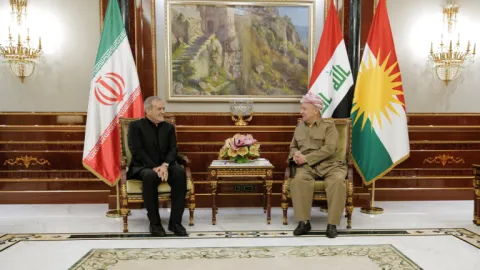
Despite the West’s provocative behavior, established Kurdish actors in the region are adopting a more cautious stance. Both the KDP and the PUK are seriously disturbed by this process. Massoud Barzani’s warning that someone is trying to drag them into an unjust war and Bafel Talabani’s emphasis on the need to open the door to dialogue rather than conflict reflect the fear that the Iraqi Kurdish Regional Government (KRG) will be the victim of a proxy war. In fact, the fact that many Kurdish citizens living inside Iran have reacted to the calls for uprising from abroad shows that the internal revolt scenario envisioned by the West does not yet have a social response.
On the diplomatic front, Xalid Azizi, the I-KDP spokesperson, clearly emphasized that the party is not part of the current war. However, between the lines of Azizi’s statements, there is a message that they will re-evaluate if the US and Israel carry out a possible ground operation against Iran or if there is a regime change in Tehran. This shows that the groups are adopting a wait-and-see policy for the time being but will activate their agenda when the window of opportunity opens. Ultimately, the goals of the organizations within this alliance are quite heterogeneous: Komala dreams of a socialist Kurdish state in Iran; I-KDP seeks federalism or autonomy; PJAK advocates the “democratic confederalism” model theorized by Abdullah Öcalan; and PAK wants full independence. The coming together of these groups, which have been ideologically and strategically dispersed for years, under the name of the Alliance of Iranian Kurdistan Political Parties, with the addition of the Komala Party of Iranian Kurdistan, points to the chaos that awaits the region at a time when Iran is weakened.
Possible Repercussions of the War on the Process of a Terror-Free Türkiye
Given these developments, although the KDP and the PUK are currently not in favor of an attack, the possibility of an attack on Iran is extremely strong if this new alliance finds a suitable ground. At this point, the war environment in Iran could directly affect the process in Türkiye. The most tangible reason for this is the risk that PKK militants, who are assumed to have laid down their arms, will now flow into the ranks of PJAK or this new alliance, just as they had previously joined the ranks of the YPG in Syria. A new battlefield just across the border for an element that has laid down its arms but retains its ideological commitment would be a major blow to Türkiye’s vision of a terror-free zone. Türkiye, on the other hand, wants terrorism to be eliminated from the region.
For Türkiye, this picture poses a risk. On the one hand, Ankara, which is trying to strengthen its internal structure and make social cohesion permanent through the terror-free Türkiye process, on the other hand, has to prevent this unlawful intervention and paramilitary mobilization in Iran from posing a threat to its security. Israel and the West’s strategy of fragmenting the Middle East along ethnic and sectarian fault lines is now taking on a new and dangerous dimension through Iran. If armed elements in the region use the authority vacuum in Iran to create a new terrorist space, this could damage the ongoing Türkiye Without Terrorism process.
The first and most proactive scenario for Türkiye in this complex equation is to use the principle of effective neutrality as a regional shield. By maximizing its influence over Erbil and Sulaymaniyah, Ankara can establish a diplomatic line to prevent the six-party alliance from becoming a Western project. The basis of this strategy is to convince the KDP and PUK that the destabilization of Iran would throw not only Tehran but also all Kurdish political structures into a ring of fire. In this scenario, Türkiye could take steps to prevent the PKK’s purged cadres from defecting to the ranks of PJAK to freeze paramilitary mobilization across the border in place.
The second, more inward-looking strategic scenario is to use the heat of the external conflagration as a catalyst to accelerate reform at home. Ankara could take steps towards social cohesion by quickly enacting the separate and temporary legal arrangement envisaged in the TBMM report, without waiting for an influx of migrants and militants that the war would unleash. If Türkiye fully resolves the internal issue at the legal and social level, the ideological pull of PJAK or other radical elements on Kurdish youth in the region will be minimized.
Beginning on February 28, the US and Israel’s attack on Iran, which disregards international law, is also closely related to Türkiye. The disinformation pumped by the Western media and the promises of the imperialist powers are once again trying to lure the peoples of the region into a bottomless pit. In the context of these developments, the terror-free Türkiye process will only achieve its ultimate goal by eliminating terrorism as a regional tool.