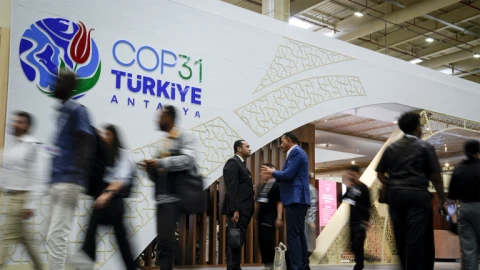
The second week of COP31 in Antalya opened with the draft cover decision, which is expected to be the summit’s main political outcome. The draft, dated 16 November and prepared under the Presidency’s consultations, runs to 18 pages and 144 paragraphs. It has been circulated as an unedited version. A cover decision is the text that sets out the summit’s overall political message, beyond the decisions taken under individual agenda items. For this reason, although the draft will change before the conference closes, it gives the first concrete indication of the message that will come out of Antalya.
A SETA Focus piece of 29 September, which assessed the initiatives announced in New York ahead of COP31, argued that three factors would decide whether these initiatives turn into lasting results in Antalya. One of them was the link between the Action Agenda and the negotiation process. Under the COP31 arrangement, Türkiye holds the presidency and Australia presides over the formal negotiations. Within this structure, the Action Agenda does not require consensus among Parties. It brings together the countries and institutions that wish to take part in implementation. If the results of the Action Agenda are also reflected in negotiated decisions, the impact of COP31 will grow. Another factor was whether the initiatives launched in Antalya can be sustained during COP32. This Focus piece assesses the draft cover decision against these two questions and discusses the issues that will matter on the way to the final text.
Traces of the Action Agenda in the Draft
The first element to enter the draft is the electrification target promoted by the COP31 Presidency. The draft calls on Parties to contribute to global efforts to increase the share of electricity in total final energy consumption to 35 percent by 2035. It mentions this target together with efforts to triple renewable energy capacity globally and to double the global average annual rate of energy efficiency improvements by 2030. A target set in a process that does not require consensus has thus found a place in a negotiating text. The draft also states that these are global efforts to which Parties are called upon to contribute in a nationally determined manner, and that the efforts do not establish specific targets or obligations for individual Parties. This flexibility may make it easier for countries with different national circumstances to take part.
The second element is buildings. The draft welcomes the COP31 Antalya Compact for Energy Efficient Buildings, developed by the COP31 Presidency with the support of the Global Alliance for Buildings and Construction secretariat hosted by the United Nations Environment Programme. The Compact aims to reduce the operational energy intensity of the global building stock by at least 25 percent by 2035, relative to 2020 levels. This target can also be linked to Türkiye’s experience of large-scale housing construction with attention to energy efficiency during post-earthquake reconstruction. The draft also welcomes the Presidency’s Climate Implementation Bridge (BRIDGE) initiative, run with the United Nations Development Programme (UNDP). Backing the initiative with a follow-up or reporting step in the final text would be useful for the continuity and measurability highlighted in the September Focus piece.
The Action Agenda’s 2035 targets for waste and the circular economy, by contrast, do not appear in the draft in numerical form. The text recognizes, in general terms, resource efficiency, sustainable consumption and production, waste reduction and circular economy approaches as important elements of climate action. Nevertheless, the Action Agenda is a process that works without consensus among Parties. The implementation of its initiatives, above all Zero Waste, one of the Agenda’s ten priority themes, therefore does not depend directly on whether they appear in the cover decision. While a cover decision gives such initiatives additional political visibility, Antalya’s contribution on waste can advance mainly through the Action Agenda.
A concrete answer to the continuity question is the Antalya-to-Addis Ababa Roadmap on Adaptation and Resilience Finance. The roadmap is to be launched under the guidance of the COP31 and COP32 Presidencies, in consultation with Parties. It aims to identify predictable and scaled-up public sources of finance for adaptation and loss and damage, including through innovative sources, as well as mechanisms for access. A report prepared by the Presidencies will be considered at COP32 in 2027. Ethiopia, the host of COP32, is also one of BRIDGE’s pilot countries. This offers a concrete channel for carrying the agenda launched in Antalya into the next presidency.
An Emerging North-South Divide
The second layer of the draft contains strong language on the responsibility of developed countries. The text acknowledges the historical responsibility of developed country Parties for climate change. It notes with deep concern the pre-2020 gaps in both mitigation ambition and implementation by these countries. A high-level ministerial roundtable on the experience and lessons learned from these gaps is to be convened in conjunction with each conference, starting in 2027. The draft also records that developed countries should take the lead, including the call to achieve net zero emissions by 2030 and net-negative emissions by 2040.
In the section on fossil fuels, by contrast, the positions of different Parties sit side by side. In one paragraph, the draft reaffirms paragraph 28 of the first global stocktake decision and repeats the call for transitioning away from fossil fuels in energy systems in a just, orderly and equitable manner. The very next paragraph calls for accelerated action to phase out fossil fuels. The same text also calls on Parties to contribute to global efforts to bring carbon capture, utilization and storage to at least 500 million tonnes of CO2 by 2035. On adaptation finance, the draft states that tripling finance for adaptation should reach at least USD 120 billion, and asks for the baseline of this target to be identified on the basis of Oxfam’s methodology.
The trade section reflects a similar divide. The draft expresses serious concern at the proliferation of unilateral climate-related trade-restrictive and regulatory measures with cross-border effect. It states that these measures transfer the economic burden of mitigation to other Parties, especially developing countries. The draft foresees advancing discussions towards developing common guiding principles in this area, and calls on developed countries to phase out such measures by the end of 2027. The text does not name any specific measure. Türkiye is listed in Annex I to the Convention, but its economic development has followed a different course from that of the other countries on the list. As a country familiar with the concerns of both developed and developing countries, Türkiye is in a position to contribute to the search for common ground between the two sides on issues such as trade.
This picture should be read with the dual presidency of COP31 in mind. Australia leads the formal negotiations, and the draft is being prepared as a Presidency-led, Party-driven text. It would therefore be wrong to read every statement in the text as the preference of a single presidency. Even so, the entry of the electrification and buildings targets into the negotiating text can be seen as a link between the Action Agenda and the negotiations.
Conclusion
The draft gives positive first answers to the two questions raised in September. The Action Agenda’s electrification and buildings targets have entered the negotiating text, and the Antalya-to-Addis Ababa roadmap envisages a channel for carrying the COP31 agenda into COP32. These gains, however, still sit in an unedited draft of 144 paragraphs. The draft can naturally be expected to become shorter on the way to the final text.
Three points should be watched in the final text. The first is whether the language on the electrification and buildings targets survives. If these targets remain in the final text, the link between the Action Agenda and the negotiations will become lasting. The second is the fate of the Antalya-to-Addis Ababa roadmap. The roadmap is one of the most concrete tools for carrying the COP31 agenda into COP32. The third is how the finance and trade paragraphs will be balanced. Either removing developing countries’ demands from these paragraphs altogether or ignoring developed countries’ objections could make consensus harder.
Two steps would be useful for Türkiye. The first is for the final text to welcome the Action Agenda targets. This would help turn the areas promoted by the Presidency into part of Antalya’s recorded legacy. The second is to tie the Antalya-to-Addis Ababa roadmap to a work schedule set jointly with Ethiopia. The implementation agenda launched in Antalya could then extend beyond a one-year presidency.