
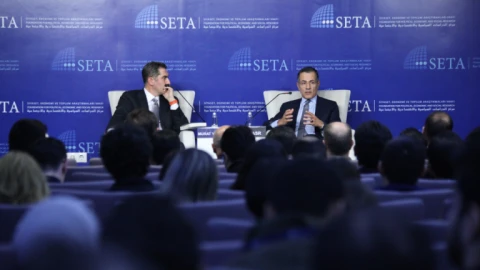
The Foundation for Political, Economic and Social Research (SETA) held a program titled “A Conversation with Vali Nasr: Iran and the Emerging Regional Order” on 20 November 2026. The program at SETA Ankara was moderated by Murat Yeşiltaş, Director of Foreign Policy Studies at SETA. Vali Nasr, professor at the Johns Hopkins University School of Advanced International Studies (SAIS), assessed Iran’s post-war grand strategy, the transformation in its domestic politics, the future of the Gulf and the Levant, the impact of the US elections on the war, and Turkey–Iran relations.
In his opening remarks, Yeşiltaş said the region has been undergoing a profound transformation since the Arab uprisings, but that today’s challenges are strategically far more important and have in effect changed the regional security order.
“The war confirmed Iran’s security logic”
Recalling that he wrote his latest book, also translated into Turkish, before the war, Nasr stressed that to understand Iran’s strategic thinking one must look at it “in terms of the way Iran sees it rather than the way it’s depicted outside.” He said Iran is perceived as a religious theocracy seeking to export its revolution, but that this perception does not reflect the actual strategic debates in the country.
According to Nasr, since the revolution “the main organizing principle for Iran’s national security has been the American threat.” The roots of this perception go back to foreign invasion, domination and loss of territory in the nineteenth century, and to the 1953 coup. The Islamic Republic sees itself as the first government that won Iran true independence, and protecting that independence is at the core of the regime’s identity.
Noting that the wars that began in June 2025 and February 2026 did not change this thinking but confirmed it in the minds of military commanders and the Revolutionary Guards, Nasr said: “It all confirms in their minds what they have believed for forty-seven years: that America will not tolerate the Islamic Republic.” According to Nasr, what has changed is “much more at the tactical level.” Iran’s assumption that it could maintain a “no war, no peace” situation and avoid a direct war no longer holds. Despite the killing of 135 military leaders, civilian leaders and the Supreme Leader, Iran did not change course; rather, it has become “much more vigilant in terms of how it’s going to protect its independence.”
“Victory is like beauty, in the eye of the beholder”
Asked who won the war, Nasr was cautious, saying the war “actually hasn’t finished” and “the final chapter hasn’t been written.” He said that, whatever Trump says, “the Americans don’t feel victorious,” and that voters did not think the war had brought anything “other than higher gas prices.”
Nasr explained that Israel entered the June 2025 war on the assumption that it was coming out of Gaza, Lebanon and Syria “like a triumphant army.” He said Israel aimed to collapse the Revolutionary Guards by killing commanders, to make the population rise up, to trigger Kurdish and Baluchi rebellions, and to have the regime collapse “as quickly as Bashar Assad collapsed in Syria,” but that it did not achieve these aims. According to Nasr, in June “Israel’s Napoleonic phase met the Russian winter,” and Israel realized it could not defeat Iran on its own. Returning in February with the same plan and bringing the United States in from day one, Israel again has not realized its aims nine months on.
Stating that Iran, for its part, went beyond survival, Nasr said Iran retaliated by “destroying eighteen American bases, closing the Strait of Hormuz, putting a global economy under enormous pressure.” Recalling that Khomeini aimed to expel America from Iran and Khamenei from the Middle East, Nasr said the Iranians are now in a position to say they have shaken the order in the Gulf and are making progress toward that aim. For this reason, Nasr said, “in their eyes, the glass is half full. In America and Israel’s eyes, the glass is half empty.”
The people united to defend the country
Turning to Iran’s domestic politics, Nasr pointed to generational change, the struggle against mandatory hijab, high inflation and the erosion of the middle class. Nevertheless, he stressed that in both wars “the population actually has united in defense of the country.” He recalled that “the same people who are in the streets in opposition to the government are the ones who also formed human chains around bridges and power plants when President Trump threatened them.”
According to Nasr, “the most important language between the state and society is Iranian nationalism, not Islamic revolutionary rhetoric.” This does not mean religion no longer matters. A new balance is being struck between religion and nationalism: “it’s not that Iranian culture is either Nowruz or Ashura, but it’s both Nowruz and Ashura.” Nasr added that the public space in Iran “has secularized considerably.” In his view, “the language of resistance to America now, ironically, is actually completely secular”: there is no religious language in Iran’s Lego videos and memes. This is also why the name “Axis of Resistance” has been so successful with young generations outside the Middle East: “It has no word Islam in it.”
“Leaders have changed, but the leadership hasn’t”
Asked who rules Iran after so many assassinations, Nasr said one of the greatest surprises of the war is that the system survived and functioned. Saying that “decapitation did not work,” Nasr admitted that he had previously thought of the Iranian government as “a lethargic, you know, huge bureaucracy that wouldn’t be able to get out of its own way.” He said that it acted “with a degree of speed and efficiency” that surprised him too.
According to Nasr, there are two reasons for this. First, the mindset within the Revolutionary Guards is so widely shared that “it doesn’t make a difference at some level whether this commander goes or the next commander.” Second, between the two wars Iran distributed decision-making and budgetary authorities all the way down to city mayors, and military command across thirty-one provinces, creating a structure “they call a mosaic government and a mosaic command.” Noting that the new Supreme Leader has been inside the system for thirty-some years and knows the commanders “very, very intimately,” Nasr said: “More important is how they’re managing and what’s their aim, as opposed to who’s actually in charge.”
A new era in the Gulf
Saying “I don’t think, at least in our lifetimes, the Middle East has been this much in the throes of change,” Nasr said it is a mistake in Washington to see the war “almost like a parenthesis in a sentence,” after which everything will look like what it was before once the parenthesis is closed. According to Nasr, the US’s old posture in the Gulf “doesn’t make sense anymore,” because the bases that were once a source of strength are now “not an advantage, but a vulnerability.”
Stating that the war could end in three ways, Nasr listed them as the United States defeating Iran, the two sides reaching a deal, and Trump finding a way to leave and “let things be.” He said the most likely outcome is “some kind of an agreement, secret, open, half secret,” which would mean the lifting of sanctions and the end of Iran’s containment in the Gulf.
Nasr said the Gulf countries are reacting to the new situation very differently: Qatar and Oman have “a much more pragmatic approach,” Bahrain and Kuwait are “highly resistant to any change,” and Saudi Arabia goes “sometimes this way, sometimes that way”: “There is no one Gulf anymore.” Describing the Gulf countries as “collateral damage in a war that they actually did not want,” Nasr said they are now “like somebody in a boxing ring that’s suffered a heavy blow and has fallen down and is still trying to get their bearing.” He added that “we don’t know what role China wants to play” in the region, and that the Chinese may not look at the chessboard the way Washington does, through military bases.
Mecca Agreement: “A very, very important first experiment”
Assessing the Mecca Joint Defense Agreement (Mecca Agreement) of Turkey, Pakistan and Saudi Arabia in this context, Nasr said its emergence is “an indication that the old order will not come back, that the Saudis are recognizing that the old order won’t come back.” He said that, as it stands now, the agreement “is not a substitute for the American bases.” He stressed that it will not be an alliance in the classical sense: “You don’t have an alliance unless everybody fights for everybody else’s cause.”
Nasr stressed that the agreement should not be thought of immediately as an end product, whether NATO or ASEAN: “I think it’s a very, very important first experiment in the region, because there is a vacuum that’s been created by the collapse of the American order.” He added that if the agreement countries were serious about inviting Iran into a regional process, “that would push Iran in a very different direction.” According to Nasr, of the three agreement countries that went to Tehran, Turkey was the only one Iran truly trusted.
Iran–Israel rivalry shifts to the Levant
Nasr pointed out that, though not on the agenda right now, “the future of the Levant is still up for discussion.” He said that Israel, having failed to defeat Iran, will try to keep Iran out of the Levant in order to finalize what it wants to do in Lebanon and Syria, while Iran will try to keep the US and Israel out of the Persian Gulf. Saying “the issue between Iran and Israel has just started, it hasn’t ended,” Nasr said he expects “a period of chaos” in the years ahead: “There’s not going to be a single order.”
“The Americans don’t want the war”
Turning to the US election results, Nasr recalled that the Republicans’ defeat was far larger than expected, with even states like Texas, South Carolina and Kansas going Democratic. Saying that the voters’ verdict was against the war, Nasr said that this is “the most unpopular war in modern American history from the get-go.”
According to Nasr, this puts Trump in a very tough position. For going back to war, “the mandate is not there,” and “the potential risks and costs are even higher.” A deal, on the other hand, will give him nothing to present as victory: “He has to go down as a defeat.”
Nasr said the US–China–Russia meeting in Shenzhen “happened, I think, in part because of the Iran war.” Noting that Iran decided very early on to fight the war “on the battlefield of the global economy” through the energy markets, and that the war exposed the “weaknesses of its military and its military industrial production,” Nasr said the United States “went in as one of the three, as opposed to the premier position.” According to Nasr, “there are certain guarantees that any kind of a deal between Iran and the United States needs that only China and Russia can get.”
The Strait of Hormuz: a more powerful leverage than the nuclear program
According to Nasr, Iran understood that “the Strait of Hormuz is a much more powerful leverage than the nuclear program ever was.” Recalling that the nuclear program neither prevented sanctions nor averted war, Nasr said: “You can’t bomb the Strait of Hormuz. You cannot take it away from them.” Nasr said that “Iranians are more resistant to giving up the Strait of Hormuz than they are resistant to giving up enrichment.” Nasr stressed that without a settlement, the strait “will always be a dangerous place,” raising the cost of insurance and shipping, and that “everybody will get hurt.”
Noting that the debate on the nuclear issue has also changed, Nasr said that although “there is no official decision,” a nuclear weapon as an “ultimate deterrence” is now discussed much more openly in Iran — in the media, in parliament and even among secular, anti-Islamic Republic Iranians.
The military value of the axis of resistance has declined
Answering questions on Iran’s allies in the region, Nasr stressed that it was not Hezbollah’s retaliation that determined the course of the war: “What has saved Iran in this war is not that Hezbollah could retaliate or was retaliating, it’s Iran’s missile defense and drones.” He said Iran will not abandon Hezbollah or the Houthis, but that “its military value has been devalued, which I think opens the door down the road for a very different conversation about them.”
Predicting that once containment ends “Iran’s priority will be actually to spend domestically,” Nasr said the assumption in Washington “that every dollar you give Iran is going to go to bullets” is wrong. He pointed out that of the seven points Iran put forward in the memorandum of understanding, the first three are economic: “war damages, unfreezing of frozen assets, and sanctions relief.”
Turning to Iraq’s place in Iran’s strategy, Nasr recalled that the border with Iraq has throughout history been one of “the two points of entry into the Iranian plateau.” Recalling also the eight-year Iran–Iraq War, Nasr explained that when Iraq fell in 2003, Iran had three priorities: getting the Americans to leave Iraq, making sure that the Shias close to Iran control the country, and ensuring that Iraq “doesn’t become a consolidated, powerful Arab state” that would again become a threat. According to Nasr, Iran feared that if America stayed in Iraq, “it’s going to come through that border into Iran pretty soon,” and that a powerful Sunni government would “pretty soon be a Saddam chapter two.”
Saying that whenever you stay somewhere too long, “it finds its own logic why you should stay that long,” Nasr noted that the same happened in Lebanon and Syria. According to Nasr, for over two decades the Iraq file has been managed on Iran’s behalf not by the Ministry of Economy, the Ministry of Culture or the Foreign Ministry, but by the Quds Force. “Militaries don’t like to give things up. I mean, pure and simple,” Nasr said. He said that issues such as Kataib Hezbollah giving up its weapons are therefore “partly a strategic conversation,” but that the Quds Force also sees this “as a concession.”
“Strategic common ground” between Turkey and Iran
On mediation, Nasr said Iran needs intermediaries because it does not talk to the United States directly, and that Pakistan and Qatar have stood out in this process. According to Nasr, Turkey “has been involved, has periodically conveyed messages, has cautioned President Trump about the decision of war,” but chose not to play “that kind of an intense role.” He added: “That doesn’t mean that it may not in the future.”
Assessing Iran–Turkey relations in the final part of the conversation, Nasr recalled that the border between the two countries is “probably one of the most stable, longest boundaries in history,” dating back to the Treaty of Qasr-e Shirin. He said the highest point of rivalry has been over Syria, but that this issue is now “water under the bridge.” Noting that both countries are “opposed to Israel eating up Syria,” Nasr said that “unlike with many other Arab countries, there is actually a strategic common ground between Turkey and Iran on the way they see the Middle East,” and that the two are “not direct threats to each other.”
Saying that relations “are stronger now than they were, let’s say, ten years ago,” Nasr stressed that this common ground gives Turkey “certain leverage in Iran.”
The program continued with questions from the audience and ended with Nasr signing his book.