Situation overview: what happened and how the war began
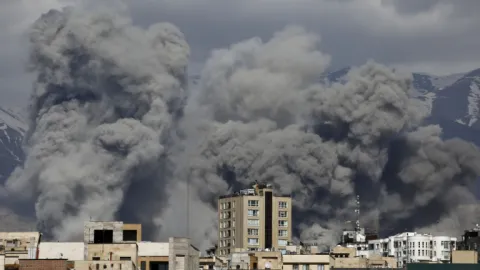
On 28 Feb 2026, the U.S. and Israel launched a coordinated strike campaign against targets inside Iran. The operation was publicly framed as a major military action; in parallel, Israel moved to a nationwide emergency posture and Iran executed same-day retaliation toward Israel and toward the Gulf states hosting U.S. assets. The operation also came while the U.S. and Iran were engaged in negotiations aimed at a diplomatic solution on Iran’s nuclear file. Reuters explicitly noted there was no breakthrough in U.S.-Iran nuclear talks that week, and other real-time reporting described the strikes as occurring amid ongoing diplomatic talks.
Media reports indicate civilian harm on Day One, although figures vary by outlet and remain fluid in the first 24 hours.
Day One immediate operational picture shows that:
- United States executed the strike phase and framed it as a major operation, while shifting the regional posture into force-protection and escalation-management mode. President Trump described the action as “major combat operations” (Operation “EPIC FURY”), and Day One dynamics show U.S. attention focused on degrading Iran’s missile-related capability while managing risks to U.S. bases and host nations across the Gulf (as reflected in Iran’s immediate targeting of Gulf hosts and the defensive posture across the region).
- The United States is focused on degrading Iran’s military capabilities, while Israel is concentrating on leadership and command targets.
- As part of the joint U.S.-Israeli decapitation strategy, precision strikes targeted the highest levels of the Iranian command structure. Following a massive assault on his Tehran compound, Israeli officials and intelligence reports indicate that Supreme Leader Ayatollah Ali Khamenei was killed in the operation. This claim has been confirmed by the Iranian state media afterwards.
- Iran responded with missile strikes into the Gulf and warnings that attacks would persist until “decisive victory”, indicating intent to widen costs beyond Israel.
Strategic meaning of the Day One
This is best read as an attempt to impose a fast escalation advantage: deliver shock (leadership/C2 disruption), degrade high-value capabilities (missiles and enabling infrastructure), and shape the political narrative immediately (deterrence framing plus regime pressure messaging), while also collapsing the diplomatic track by shifting bargaining from talks to coercion under fire. Compared to the June war, Iran’s response was faster, the target set was broader, it appeared more ready and willing to employ asymmetric tools, and it showed signs of preparation to manage the non-war domain as well.
Military assessment (strategic + operational)
a. The strike package: target-set classification
A disciplined first-day classification should group targets into two baskets, because each basket has a distinct operational logic and produces different second-order effects.
Decapitation / Command-and-control paralysis
Day One reporting suggests Israel’s opening move most likely aimed at decapitating Iran’s security and political apparatus. Multiple outlets reported that senior Iranian security figures were targeted, and that claims of senior commanders or officials killed surfaced quickly, but confirmation remains uneven by individual in early reporting. Israeli officals mentioned that Israel targeted the “entire Iranian leadership” including current, former and even potantial officals. Reports also suggest the targeting scope extended to the very top of Iran’s political leadership. While many Iranian sources initially reported that Khamenei and Pezeshkian were alive and well, Iranian state media subsequently confirmed Khamenei’s death. The status of Pezeshkian remains uncertain.
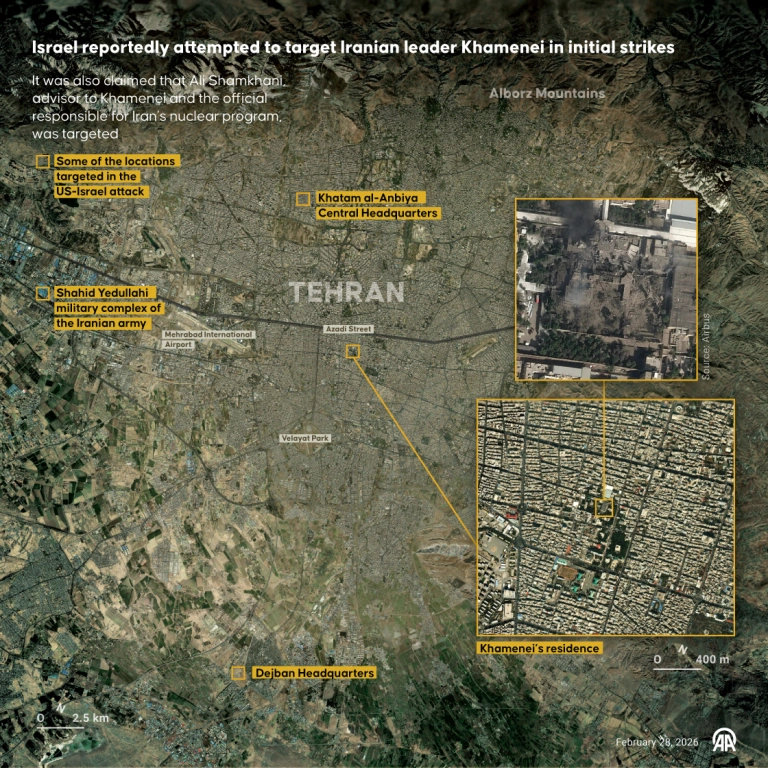
Source: https://www.aa.com.tr/en/info/infographic/50471
Different sources report that “several senior commanders” in the Revolutionary Guards and political officials were killed. This supports the assessment that the target set likely extended beyond symbolic leadership threats to an attempt to dismantle multiple nodes in the decision and security apparatus (IRGC command, security leadership, and political officials). In terms of named senior figures, Iran’s Defence Minister Amir Nasirzadeh, Revolutionary Guards commander Major General Mohammed Pakpour and and the Iranian “intelligence chief” were believed to have been killed in Israeli attacks. These reported deaths are consistent with a deliberate effort to degrade operational leadership capacity and disrupt retaliation coordination.
In terms of the Day One strategic assessment, partial decapitation can produce outsized effects in the first 24-72 hours by slowing Iran’s kill chain. At the same time, if Iranian leadership reads the strike pattern as existential, it will accelerate escalation incentives, shifting retaliation from symbolic punishment toward a broader, sustained campaign and widening the target set beyond Israel.
Missile force ecosystem
The US initial operational objective is to reduce Iran’s ability to sustain large missile salvos by degrading the full missile ecosystem (production and assembly, storage and depots, launch areas, command-and-control nodes, and logistics) because Iran’s missile arsenal is its main conventional tool of strategic coercion, and weakening stocks, launch tempo, and production directly limits its ability to impose costs, sustain escalation, and widen the war geographically.
The U.S. strike phase began in the early hours of 28 Feb 2026 as part of a joint campaign the U.S. labeled “Operation Epic Fury.” This is described as a large, ongoing operation rather than a single discrete strike. Reports describe U.S. strikes launching from both sea-based and land airbases, which matters for tempo because it implies multiple launch baskets and the capacity to generate repeated waves (aircraft sorties + standoff munitions) with shorter turnarounds. Day One reporting according to the U.S. Central Command highlights a pre-strike build-up (ships and aircraft surged to the region) and frames the assault as ongoing. U.S. Central Command released unclassified footage indicating that multiple Iranian targets across several locations were struck, including radar systems, missile launchers, and drone depots.
This supports an analytic expectation of sustained operational tempo beyond a single night, even if exact sortie counts are not yet public. Immediate effect marker that the missile contest is “active”. U.S. seeks to suppress Iran’s ability to generate salvos, while Iran seeks to demonstrate it can still launch regionally. Iran’s same-day retaliation involved missiles fired toward Gulf states hosting U.S. assets and Israel, reinforcing that the missile force is Tehran’s primary tool for immediate, scalable cost-imposition and signaling. Under the operational tempo and evolving regional military dynamics, if U.S. + Israel strikes are materially degrading the missile ecosystem, we will see a combination of reduced wave size, less consistent timing, and narrower target sets. If Iran retains depth, we should expect either stable salvos or deliberate widening (more Gulf host pressure), consistent with a strategy of stressing the U.S. regional network rather than only Israel.
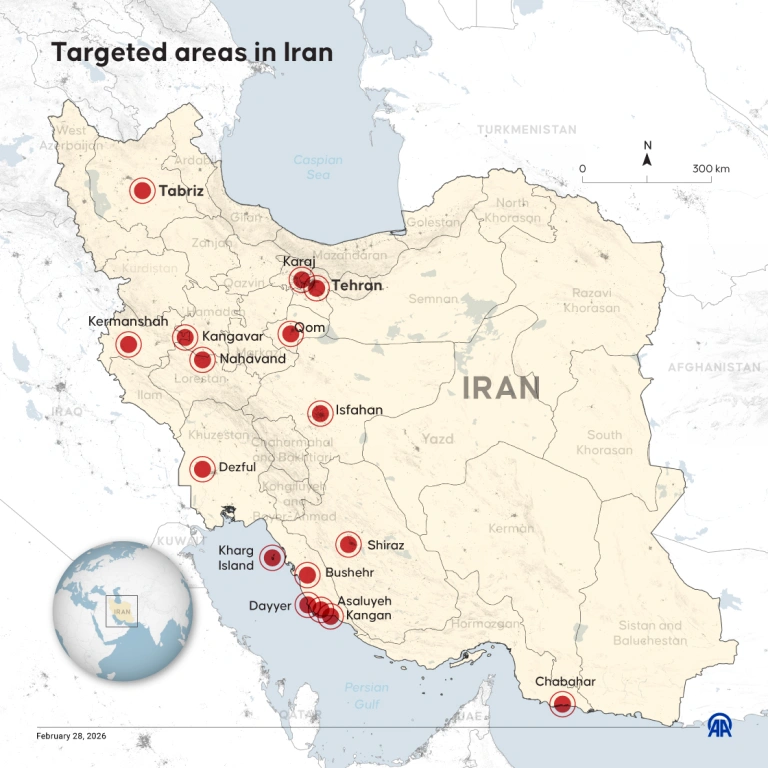
Source https://www.aa.com.tr/en/info/infographic/50473
b. Joint concept of operations
Based on public messaging and the shape of retaliation, the operation can be described as Joint Military Operation. The joint military operation initiated by the United States and Israel represents a shift from historical punitive strikes toward a comprehensive joint concept of operations aimed at strategic degradation and regime disruption. Under the U.S. moniker Operation EPIC FURY and the Israeli designation Roaring Lion, the first 24 hours have revealed a deliberate division of labor. Israel appears focused on precision disruption and C2 pressure, specifically targeting leadership compounds in Tehran and air defense nodes, while the U.S. is executing major combat operations to neutralize Iran’s wider missile ecosystem and naval assets. This coordination is evidenced by Israeli defense officials confirming months of synchronized planning and a pre-set launch date. Iran’s immediate retaliatory salvos against Gulf states hosting U.S. assets (including Bahrain, Qatar, and the UAE) further validate that Tehran perceives this as a singular, integrated regional offensive rather than parallel actions.
Battle Damage Assessment (BDA) remains highly uncertain as the operation enters its second phase. The initial four-day window suggests that Day One was designed to produce multi-domain simultaneity blending physical strikes with cyber and electronic warfare which naturally delays clear confirmation of destroyed targets.
This pairing relies on the complementary comparative advantages of the U.S. and Israel to maximize the operation’s disruptive potential. Israel’s strength lies in its capacity for rapid, high-tempo precision operations and the application of intense command and control pressure, which serve to generate immediate shock and temporary paralysis within the Iranian defense apparatus. In contrast, the U.S. comparative advantage centers on scaling a sustained strike campaign against critical strategic nodes, such as missile systems, enabling infrastructure, and broader operational depth, while simultaneously signaling escalation dominance through clearly defined, publicly declared objectives and the authoritative framing of the campaign as major combat operations.
From a strategic implication perspective, a coordinated design increases the probability of multi-domain simultaneity (integrating air and stand-off strikes with disruption measures such as electronic warfare, cyber attacks, and deception) which tends to produce overlapping effects including physical damage, communications disruption, and air-defense suppression, while generating contradictory early claims regarding targets being hit versus intercepted. This complexity inherently delays reliable battle damage assessment until imagery-confirmed geolocation and second-order indicators, such as follow-on strike penetration or shifts in Iranian salvo tempo and air defense activity, become available; consequently, the joint concept will be validated or falsified over the next 24 to 72 hours based on whether follow-on waves prioritize the missile ecosystem after neutralizing command and control, whether the Iranian launch cadence shows disruption consistent with leadership pressure, and whether U.S. strikes maintain a persistent focus on strategic infrastructure consistent with the EPIC FURY framing.
Iran’s Response
The Iranian retaliation demonstrated a high degree of operational synchronization, pairing ballistic missile strikes with the deployment of Shahed-136 loitering munitions to saturate regional defenses. Operationally, Tehran utilized its vast stockpile of Short-Range Ballistic Missiles (SRBMs) including the solid-fueled Fateh-110 and Zolfaghar series alongside waves of Shahed drones to achieve high-tempo, “pop-up” launches that challenged integrated air-defense networks across the Gulf. This kinetic effort was bolstered by sophisticated civil-defense messaging and psychological warfare, as official state-aligned channels amplified reports of explosions and shelter-in-place orders in Abu Dhabi, Doha, and Manama, successfully transforming localized strikes into a pervasive sense of regional vulnerability.
Iran military response is to achieve to deliberately expanding the theater of operations beyond a bilateral exchange, targeting the broader Gulf security architecture to challenge the U.S. regional military ecosystem. While the Islamic IRGC launched missile strikes were intercepted, Bahrain confirmed a direct hit on a U.S. Navy service center, and at least one fatality was reported in Abu Dhabi following explosions and shelter-in-place orders. Iran later escalated this strategy by targeting Dubai’s aviation hubs, leading to the suspension of all operations at Dubai International and Al Maktoum International airports.
Iran’s retaliatory doctrine extends beyond traditional kinetic military logic. Tehran’s strategic calculus is centered on inflicting systemic economic costs by globalizing the conflict. This includes the high-stakes decision to shutter the Strait of Hormuz and target premier global financial and commercial hubs like Dubai, aiming to leverage global market volatility as a form of asymmetric deterrence.
Tehran’s response is characterized by an “open-ended campaign” logic rather than a symbolic, one-off retaliation. The IRGC has stated that operations will persist until a “decisive victory” over U.S. and allied forces is achieved, signaling a commitment to a sustained war of attrition. By striking Gulf host nations, Tehran aims to degrade the political will of U.S. allies and complicate coalition cohesion by imposing direct costs on third-party stakeholders. The severity of the escalation was punctuated by the UK government, which urged its citizens across the Gulf to shelter in place, recognizing the event as a comprehensive regional security emergency.
Day One confirms that Iran’s retaliation is designed to shift the conflict’s center of gravity toward the U.S. forward posture and logistical network. By achieving hits on U.S. assets and causing civilian casualties in allied capitals, Tehran is signaling its willingness to impose distributed costs across the entire coalition architecture, forcing Gulf hosts into a high-stakes choice between continued support for U.S. operations or immediate de-escalation under threat.
|
Country |
Specific Targeted Location(s) |
Reported Impact |
|
United Arab Emirates |
Dubai: Dubai International (DXB) and Al Maktoum (DWC) airports; Palm Jumeirah (Fairmont The Palm). |
Airports suspended operations indefinitely. Fire confirmed at Fairmont The Palm. Multiple drones/missiles intercepted. |
|
United Arab Emirates |
Abu Dhabi: Al Dhafra Air Base and residential areas. |
1 fatality reported (Pakistani national) from shrapnel. Windows rattled by 5 successive blasts; airspace partially closed. |
|
Bahrain |
Manama: U.S. Navy Fifth Fleet Headquarters (Juffair district). |
Direct hit confirmed on a U.S. Navy service center. Heavy smoke reported; Juffair area evacuated; air-raid sirens activated. |
|
Qatar |
Doha: Al Udeid Air Base. |
Multiple missiles intercepted by Patriot systems. Authorities reported no structural damage or casualties. |
|
Kuwait |
Kuwait City: Airspace and military installations (Camp Arifjan / Ali Al Salem). |
Air defense sirens activated; military reported “dealing with missiles” in airspace. Airspace closed temporarily. |
|
Saudi Arabia |
Riyadh: Prince Sultan Air Base and capital outskirts. |
Loud explosions heard by residents; suspected interceptions by Patriot/THAAD batteries. Government issued a strong condemnation. |
|
Jordan |
Amman / Azraq: Muwaffaq Salti Air Base. |
Two ballistic missiles shot down. Sirens sounded across several cities; military increased aerial patrols. |
Table: 1 Gulf Countries and Locations Targeted (28 Feb 2026)
Early geo-political assessment: Day One strategic objectives and constrains
The joint offensive on February 28, 2026, has rapidly transitioned from a military strike to a transformative political campaign. U.S. and Israeli rhetoric indicates a three-layered objective: rolling back Iran’s strategic missile and nuclear-linked infrastructure, establishing coercive leverage to force new diplomatic terms, and applying direct regime pressure. This third layer is most significant, as President Trump’s call for Iranians to “take over your government” shifts the conflict from a “cost exchange” to a survival logic for Tehran. Netanyahu’s framing of the operation as the removal of an existential threat further narrows the space for de-escalation, as “mission success” is now tied to political transformation rather than just measurable military damage.
Tehran’s Day One response serves to restore deterrence and fracture the coalition by making U.S. basing a liability. By targeting Gulf hosts resulting in a hit on a U.S. Navy center in Bahrain and civilian alerts across Kuwait, Qatar, and the UAE, Iran is signaling its intent to impose distributed costs. Diplomatically, Iran is framing the strikes as unlawful aggression to mobilize international legal pressure, while the IRGC’s “decisive victory” narrative indicates a readiness for a sustained, rather than symbolic, confrontation.
The U.S. and Israel may seek to exploit the authority vacuum left by Khamenei’s death to incite domestic upheaval. Regardless of the outcome, Iran considers this a turning point, treating the post-Khamenei era as a fight for its very existence. The response is no longer about deterrence but about making the cost of “regime change” prohibitively high for the entire region. The next 24 hours will likely see whether the IRGC can maintain internal discipline or if the authority vacuum leads to a fragmentation of the security apparatus.
The international community has moved quickly to establish a constraint layer around the operation: Russia is leveraging nuclear-safeguard narratives, condemning the strikes as unprovoked and warning against strikes on atomic facilities to raise the procedural cost at the UN. While Germany, France, and the UK have urged Iran to cease regional attacks, they have also distanced themselves from the strikes and called for maximum restraint, prioritizing a return to negotiations.
Regional architecture on Day One has pivoted toward immediate risk management and diplomatic containment, serving as a primary operational constraint on the U.S.-Israeli campaign. Regional powers are moving to prevent a total collapse of the security environment through a mix of protective measures and de-escalation signaling. Türkiye is maintaining a diplomacy-first stance, Türkiye has consistently opposed military intervention and is evaluating contingency measures to mitigate regional spillover. In a practical sign of its high-risk assessment, Türkiye’s stance serves as a significant operational constraint for the U.S.-led coalition. By categorically opposing military intervention and highlighting the risk of regional destabilization, Ankara signals that it will not provide political or logistical cover for an open-ended campaign aimed at regime change. Erdoğan’s insistence that “common sense must prevail” reinforces the regional pressure for a limited military engagement and a rapid transition back to the negotiating table. The targeting of Kuwait, Qatar, the UAE, and Bahrain places these governments under immense domestic pressure. Their primary concern is no longer just the degradation of Iranian capabilities but the immediate protection of their own infrastructure and populations from Iranian retaliation.
One thing is clear: regional countries are now shaping their posture in direct response to Iranian strikes on their own territories, moving beyond their previous role as mere hosts for U.S. assets. This direct targeting has forced states like the UAE, Bahrain, and Qatar to prioritize their own sovereign defense and public safety, treating the Iranian response as an act of aggression against their own nations rather than a spillover of a U.S.-Iran conflict.
What Comes Next
The joint military operations launched by the United States and Israel represent a fundamental shift toward a coordinated strategy of strategic degradation and regime disruption. This joint concept of operations utilizes a clear division of labor: Israel focuses on high-tempo precision strikes and command-and-control pressure specifically targeting leadership compounds in Tehran while the United States leverages its comparative advantage to scale a sustained campaign against Iran’s missile ecosystem, naval forces, and strategic infrastructure. This level of synchronization is designed to create immediate shock and paralysis within the Iranian defense apparatus, moving the conflict beyond simple punishment toward systemic transformation.
The killing of Supreme Leader Ayatollah Ali Khamenei has introduced a post-Khamenei reality that is now the central gravity of the conflict. The first there will be a transition that involves a constitutional process managed by a Temporary Leadership Council under Article 111. This council, consisting of the President, the Head of the Judiciary, and a cleric from the Guardian Council (chosen by the Expediency Council), assumes all leadership duties. Meanwhile, the Assembly of Experts must convene as soon as possible to elect a permanent Supreme Leader. However, wartime exigencies may delay the appointment of a permanent successor, potentially leading to a prolonged reliance on a Temporary Leadership Council to maintain a semblance of constitutional order. The duration and outcome of this phase will depend entirely on the internal negotiations and power-sharing agreements among Iran’s political and military elite.
The second, more disruptive scenario, is the emergence of an IRGC military junta that bypasses formal processes to maintain internal order. The third scenario considers a political destabilization spiral where the news of Khamenei’s death serves as a catalyst for widespread civil unrest, as evidenced by reports of celebrations in some Tehran neighborhoods alongside mass panic and evacuations. A final, high-stakes “surprise” and highly unlikely scenario involves the remaining Iranian leadership opting for a survival-driven capitulation by accepting maximalist U.S. terms effectively sacrificing their nuclear program and regional proxies to prevent total regime collapse and internal state disintegration.
Initial rhetoric from SNSC Secretary Ali Larijani, allegedly designated by Khamenei as a key facilitator for the transition, suggests that the clerical establishment intends to maintain governance continuity despite the leadership vacuum. If the Iranian state cannot quickly project an image of continuity or “decisive victory,” the combination of external kinetic pressure and internal dissent could lead to a systemic collapse. The key indicator for this scenario will be whether the security apparatus remains unified or if fractures begin to appear between the regular army (Artesh) and the IRGC during the succession struggle. In this precarious landscape, Ali Larijani has emerged as the predominant interlocutor tasked with bridging the gap between Iran's political establishment and its military high command. His role is seen as critical for maintaining inter-institutional synchronization during the current crisis.
Iran’s military response has been characterized by a deliberate attempt to widen the conflict and fracture the coalition’s regional basing network. By launching missile and Shahed drone salvos against multiple Gulf states Tehran is signaling that hosting U.S. assets carries a lethal cost. This kinetic effort is bolstered by sophisticated civil-defense messaging and psychological warfare designed to transform localized strikes into a pervasive sense of regional vulnerability.
The military escalation and operational tempo are expected to follow a multi-phase campaign logic. While the first 24 hours focused on decapitating leadership nodes and neutralizing air defenses, the next phase is expected to shift toward the systematic annihilation of Iran’s naval assets and its distributed ballistic missile inventory. The expected escalation trajectory will be heavily influenced by the internal power struggle; the U.S. and Israel may accelerate the tempo to exploit the authority vacuum, while the IRGC maintains a high retaliatory cadence to prove its kinetic depth remains intact. With the declaration of a state of emergency in Israel and the suspension of regional civil aviation, all parties appear braced for a sustained high-intensity conflict.
Ultimately, the post-Khamenei militarization of the Iranian response marks a permanent shift in the regional security architecture. As the clerical pillar of the state fractures, the IRGC is transitioning into a decentralized, “security-first” entity that prioritizes regime survival through total externalization of the conflict. This shift fundamentally alters the calculus for neighboring states, as Iranian regional policy is no longer bound by the ideological pragmatism of a single Supreme Leader but driven by the survival instincts of a militarized junta.
The assassination of Khamenei is an event of profound consequence, with implications that extend far beyond the immediate tactical horizon. Khamenei was not merely a head of state but a Marja’ al-Taqlid (Source of Emulation) for the global Shia community. The absence of historical precedent for the assassination of a cleric of this stature renders current predictions regarding the Shia world’s response largely without reference. Undeniably, this will serve as a powerful catalyst for regional non-state actors, bound to Iran by ideological and religious ties, to accelerate their entry into the conflict. Furthermore, the future of the nuclear fatwa and whether Tehran will now undergo a radical shift toward weaponization remains a critical uncertainty. This strike has effectively initiated a return to a “state of nature” in the Hobbesian sense, the uncalculable and unforeseen consequences of which may ultimately alter the entire trajectory of the war.
For the Gulf states, Türkiye, and Iraq, this means moving from an era of managed proxy competition into a period of acute, direct risk, where Iranian behavior becomes more unpredictable.