
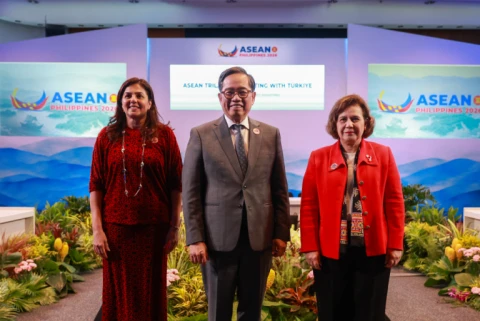
Institutions often formalize realities that have already been in existence. ASEAN’s decision on July 21 to establish a Dialogue Partnership with Türkiye is best understood in this way. The 59th ASEAN Foreign Ministers’ Meeting in Manila decision makes Türkiye the organization’s 12th Dialogue Partner. Yet it is les the beginning of a new relationship than ASEAN’s recognition of one that had already accumulated across Southeast Asia.
This distinction matters. Most established Dialogue Partners arrived with an inheretid claim to regional relevance: Asian or Pacific geography, territory and military presence, historical involvement, regional institutions, or exceptional economic weight. Even the European exceptions posse’s strong credential. The U.K. retain historical and security ties in the region, including through the Five Powers Defense Arrangements, while the European Union is a major market, regulatory actor, and source of integration experience. Türkiye’s position cannot be explained principally by these factors. It is the clearest case among the twelve of strategic relevance acquired in recent years rather than inherited.
A partnership earned, not inherited
The institutional chronology confirms that this was not an overnight promotion. Türkiye acceded to ASEAN’s Treaty of Amity and Cooperation in 2010, became a Sectoral Dialogue Partner in 2017, and applied for full Dialogue Partnership in 2024. In October 2025, Asean leaders recorded broad, in-principle support, but made approval conditional on reviewing the organization's moratorium on new Dialogue Partners. The condition was repeated in May 2026 before the final decision in Manila.
The moratorium gives the result additional weight. Türkiye’s application advanced while ASEAN was explicitly asking how many external partnerships its institutions could meaningfully sustain. Its admission should therefore not be presented as another name added to a diplomatic directory. It reflects a collective judgement that Türkiye offered sufficient value to justify permanent engagement at a time of institutional selectivity.
The real prize is consequently not the title but bureaucratic recurrence, including regular ministerial contacts, and agreed plan of action, sectoral conversations, and institutional memory that survives individual visits. The upgrade offers Türkiye an opportunity to turn an episodic Asian presence into a permanent presence.
Buit one capital at a time
The opportunity rests on a bilateral foundation. Türkiye-ASEAN relations did not descend from the regional level, they accumulated upward, one member state at a time. The network is uneven, but it is no longer narrow.
Indonesia and Malaysia constitute the relations principle anchors. Relations with Indonesia include a High-Level Strategic Cooperation Council (HLSCC), coordination in the G20, D-8, MIKTA, and defense-industrial cooperation extending from jointly produced armored vehicles, to missiles, to unmanned systems, frigates, and combat aviation. The agreement concerning 48 KAAN aircraft brought unprecedented scale to the cooperation, but its greater significance lies in the expectation of long-term industrial cooperation rather than a one-off purchase.
Malaysia combines comparable political breadth with a more mature economic architecture. The two countries have a comprehensive strategic partnership, inaugurated a HLSC in January 2026, and operate under Türkiye’s first free-trade agreement with an ASEAN member. Defense cooperation has developed over more than two decades, from Malaysian production of Turkish-designed armored vehicles to newer orders involving ANKA UAVs and three LMS Batch II naval vessels. These are not isolates sales. They create training, maintenance, and industrial relationships that can outlast the initial contracts and the governments that signed them.
Singapore performs a different function. Its strategic partnership and comprehensive free-trade agreement make it Ankara’s most sophisticated commercial and diplomatic platform in Southeast Asia, demonstrating that Türkiye’s position is not built on defense cooperation alone. Foreign Minister Hakan Fidan’s June tour helped bring these strands together, but it was a culmination of the bilateral architecture, not its starting point.
The Philippines further broadens the picture. Türkiye completed delivery of six T129 ATAK helicopters in 2024 and has supported the Mindanao peace process through the International Contact Group, third part monitoring, and chairmanship of the Independent Decommissioning Body. Security cooperation, development assistance, and peacebuilding give this relationship a depth that a pure defense-cooperation relationship would miss.
Vietnam, Thailand, Cambodia, and Brunei occupy different points on the same widening arc. Through trade ambitions, investments, development cooperation, and emerging defense contracts, Türkiye is building its relationship with these countries on solid ground. Religious and cultural affinities with Indonesia, Malaysia, and Brunei have undoubtedly facilitated engagement, but the close relations with Singapore and the Philippines, and the growing ties with predominantly Buddhist Vietnam and Thailand, show that the partnership has become pragmatic rather than identity bound.
From transactions to regional pattern
The economic ambitions are striking. Türkiye and both Indonesia and Malaysia have adopted bilateral trade targets of $10 billion. Yet their combined trade with Türkiye was only about $8.2 billion in 2025, and approximately $2.55 billion with Indonesia and $5.66 billion with Malaysia. Türkiye also recorded substantial deficits in both relationships. Targets involving Vietnam and Cambodia add to the sense ambition, but they were announced at different times, and often without deadlines, and should not be confused with forecasts. The trade volume goal for Thailand that was discussed in 2013 is close to being achieved, with trade hovering at $1.9 billion in 2025.
That gap identifies the partnership’s next task. Dialogue Partnership should help Türkiye move beyond treating Southeast Asia as separate national markets and engage it as an interconnected system. Agreements with Malaysia and Singapore can serve as entry points, but headline targets must become customs cooperation, compatible standards, better transportation links, sectoral road maps, and two-way investments.
Defense cooperation already displays a clear regional pattern. Indonesia, Malaysia, and the Philippines are politically different states facing different security environments. Nevertheless, each seeks greater supplier diversity and to varying degrees local production. Türkiye’s defense industry fits this demand unusually well. Its attraction lies not merely in comparatively affordable platforms with great price-to-performance metrics, but in a greater willingness to discuss co-production and technological transfers than almost any other supplier available.
While some Turkish platforms still rely on foreign engines, transmissions or subsystems, leaving exports to a degree vulnerable to third-country licensing. Türkiye can contribute to Southeast Asian strategic autonomy only to the degree that its own supply chains are dependable. But with each indigenous component and platform developed Türkiye pours a greater portion of profits into indigenous alternatives and solutions to foreign technology. Ultimately, timely delivery, lifecycle support, and industrial participation will be more decisive than the number of contracts announced.
Why ASEAN, why now?
The geopolitical environment helps explain why these bilateral relationships were institutionalized at this moment. Intensifying US-China competition has increased the value of partners that widen ASEAN’s choices without demanding or signaling strategic alignment. Türkiye is a NATO member, but it also pursues an autonomous and multilateral foreign policy. It has no territorial claims in Southeast Asea, no permanent military footprint, and little colonial baggage. This does not make Ankara neutral or free of its own interests, but it does make Türkiye a comparatively safe actor for cooperation in regard to ASEAN.
ASEAN centrality and Turkish strategic autonomy are not identical doctrines, but they share an instinct. Both aim to expand the room for maneuvering without aligning with any of the major geopolitical actors. Southeast Asian interests in Turkish defense technology, investment, and diplomacy therefore form part of a larger strategy of diversification. Türkiye’s interest is reciprocal. ASEAN offers Ankara economic opportunity and political relationships beyond its traditional Western, Black Sea, and Middle Eastern theatres.
But the separation between those theaters is becoming increasingly artificial. ASEAN foreign ministers’ engagement with the Middle Eastern crisis in 2026, including their July statement on renewed hostilities and disruption in the Strait of Hormuz, shows how Southeast Asia’s security depends on security in the Middle East and elsewhere. Energy, shipping, food supplies, and citizen safety connect the Gulf directly to the Strait of Malacca and ASEAN.
If Hormuz connects ASEAN to Gulf energy supplies, Bab al-Mandeb and the Suez Canal connect it to Türkiye and Europe. In normal conditions, the Red Sea-Suez corridor carries more than $1 trillion in goods annually and 22% of seaborne container trade. Türkiye’s position in Somalia thus adds a concrete connectivity dimension. Ankara has a military presence in Somalia, trains Somali Navy and Cost Guard (SNCG) personnel contributing to regional security and deploys naval forces to security in the Gulf of Aden region. It cannot secure the corridor alone, but it can reinforce security near a critical chokepoint.
The crisis around the strait did not cause Türkiye admission and should not be used to claim Turkish indispensability. However, it does give the upgrade in relations an additional meaning. The former defining phrase of Türkiye “bridge between East and West” is now shifting to become a node operating across several political spaces. From Europe to the Atlantic, from West Asia to the Black Sea, Central Asia, Africa and Southeast Asia. Dialogue with Ankara gives ASEAN another channel into regions whose crises increasingly reach their distant waters and shores.
Recognition is not completion
A skeptic could reasonably argue that ASEAN partnership statuses may be symbolic and that Türkiye’s trade remains modest besides that of China, Japan, the United States, or the EU. Dialogue Partnership does not automatically produce membership in every ASEAN-led mechanism. All these observations are valid. Türkiye has not become and Indo-Pacific great power, nor has ASEAN endorsed every element of Turkish foreign policy.
That is precisely why implementation will determine the meaning of the decision. Ankara should develop a focused ASEAN-Türkiye plan of action, aligned with ASEAN Vision 2045, prioritize balanced trade and move defense cooperation toward closer co-production. It should also offer at least one recognizable ASEAN-wide public good, including but not limited to disaster relief cooperation (AFAD), or student and higher education cooperation (YÖK, MAARIF).
The institutional upgrade does not replace bilateral diplomacy. It increases the need to sustain relations with all eleven ASEAN members. ASEAN’s methods reward patience, attendance and delivery more than large but singular spectacle. Türkiye acquired regional relevance through bilateral accumulation. Its next challenge is to convert that relevance into permanence, and its bilateral capital into value shared by Southeast Asia as a whole.