
Itineraries are arguments. When Foreign Minister Hakan Fidan moved through Singapore, Jakarta, Seoul and Dhaka between 1 and 6 June, the sequence itself made a claim: that Türkiye’s engagement with Asia is no longer a collection of bilateral files but a coherent strategic program. Seven years after the Asia Anew initiative was announced in 2019, the question is no longer whether Türkiye intends to be present in the Indo-Pacific. It is whether the presence has acquired structure: institutions, instruments and habits that outlast any single visit. The exchanges between Türkiye and Asia since last year suggests it has.
The tour did not arrive out of nowhere. It capped a dense, two-way cycle of exchanges. President Erdoğan’s February 2025 Asia tour took him to Malaysia, Indonesia and Pakistan in a single week, and within the year each capital reciprocated. Pakistan’s Shehbaz Sharif and Indonesia’s Prabowo Subianto visited Türkiye that spring, Malaysia’s Anwar Ibrahim arrived in January 2026 to inaugurate a new bilateral strategic council. The Indonesian track produced the most consequential result of a roughly $10 billion defense contract, signed in Jakarta in June 2025, for 48 KAAN fifth-generation fighter jets, becoming the largest defense export in the Republic’s history. South Korea runs on its own track, having sent President Lee Jae Myung to Ankara in November 2025 for agreements spanning defense and nuclear energy. Thus, Fidan’s six-day trip to Asia was more of a continuation of an already flourishing relationship than an opening.
Singapore: the doctrine
Fidan chose to articulate the tour’s intellectual frame not in a ministry but at a lecture, delivering the sixth IISS Raffles Lecture on Türkiye’s foreign-policy vision. Its pillars, strategic autonomy and multi-alignment, are by now familiar, but the venue gave them a specific address: an audience that thinks about Indo-Pacific order for a living, in a city-state that has made a national tradition of hedging between great powers. The implicit message was that Türkiye and Southeast Asia are reading the same map. In a fragmenting international system, refusing to be conscripted into a single bloc is not indecision but strategy.
The bilateral substance matched the setting. Singapore is one of the most developed economies partner in Southeast Asia, and a Strategic Partner of Türkiye since 2014, and Fidan’s meetings with Prime Minister Lawrence Wong, Foreign Minister Vivian Balakrishnan and security coordinator K. Shanmugam ranged across trade, investment, the defense industry, digital transformation, food security and renewable energy. The most valuable deliverable, however, was positional, with Singapore reiterating its support for Türkiye’s effort to deepen relations with ASEAN, a meaningful endorsement for Ankara’s pursuit of full dialogue-partner status with the bloc.
Indonesia: the anchor
Jakarta supplied the tour’s center of gravity. Foreign Minister Sugiono received Fidan personally at the aircraft; President Prabowo hosted him at his Hambalang residence. This choreography of intimacy reflects a relationship that has thickened with unusual speed: the first Indonesia-Türkiye 2+2 meeting of foreign and defense ministers convened in Ankara only in January, and the KAAN contract has given the partnership an industrial spine. The talks pressed forward on the $10 billion trade target set by Erdoğan and Prabowo, a fourfold leap from today’s roughly $2.5 billion, across defense, energy, transportation, artificial intelligence and the halal economy.
The leg’s emotional register came from elsewhere. Prabowo personally thanked the Turkish government for securing the return of nine Indonesian citizens detained by Israel after the Global Sumud Flotilla, and Fidan pledged continued coordination on Palestine. For two states whose international identities are partly built on advocacy for the Palestinian cause, this was not a courtesy but a confirmation that the partnership runs on moral solidarity as much as on contracts.
South Korea: the technology peer
Seoul shifted the register to high-technology pragmatism. The first visit by a Turkish foreign minister in roughly five years, and a direct follow-up to President Lee’s Ankara summit, opened with a wreath at the Seoul National Cemetery for the Turkish soldiers who fell in the Korean War. The “brother nations” memory is sincere, and strategically useful, supplying trust beneath a partnership otherwise governed by hard interests. And those interests are substantial. Bilateral trade reached $11.3 billion in 2025. The Altay MBT’s Korean powerpack anchors a relationship now widening toward unmanned systems, nuclear energy and advanced technology, alongside a prospective upgrade of the 2013 free trade agreement.
Bangladesh: the institutional leap
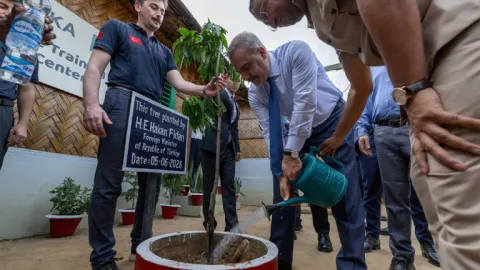
Dhaka produced the tour’s most striking institutional advance. Fidan’s first-ever visit, and the first by a Turkish foreign minister in nearly six years, yielded agreement on annual ministerial Foreign Office Consultations, an annual 2+2 of foreign and defense ministers, and a minister-level joint committee on defense and foreign affairs, which Fidan called a first step toward a strategic-level relationship. In the grammar of Turkish diplomacy, the 2+2 format is reserved for partners Ankara means to treat continuously and extending it to Dhaka places Bangladesh alongside Indonesia. The agenda ran from trade, targeted to grow from roughly $1.35 billion toward $2 billion, and defense-industrial cooperation to the humanitarian file, as Fidan toured the Rohingya camps at Cox’s Bazar and the Turkish-supported field hospital run by TİKA, AFAD and the Red Crescent, while Prime Minister Tarique Rahman extended an invitation to President Erdoğan.
Reading the tour: Five observations
What does the circuit add up to? Five things, in ascending order of consequence.
First, the defense industry has become Türkiye’s primary instrument of Asian statecraft. Every stop carried a defense-industrial component, and the KAAN contract reveals why the instrument works. Türkiye’s offer to Asian partners is not merely hardware but a model of technology transfer, co-production and industrial participation, extended without the political conditionality that attaches to Western platforms or the alignment costs of Chinese ones. For states seeking capability without clientage, this is a rare product. It converts commercial transactions into long-term strategic entanglement, since a fighter program binds buyer and seller for decades.
Second, the strategy works because the demand side has changed. Asia Anew succeeds in 2026 where it struggled in 2019 not because Türkiye’s pitch improved but because Asia’s appetite did. Indonesia, Malaysia, Bangladesh and even alliance-anchored Korea are all, to differing degrees, diversifying their dependencies amid the growing US-China competition. Türkiye markets itself as precisely the partner such hedging requires: substantial enough to matter, autonomous enough to be safe. Ankara’s multi-alignment and Asia’s hedging are the same logic running in opposite directions. A relationship that now feel less like courtship and more like recognition.
Third, the tour quietly serviced Türkiye’s Western portfolio rather than substituting for it. By raising July’s Ankara NATO summit in Asia, Fidan established an architecture beneath the optics. As part of the summit, NATO partner countries from Indo-Pacific are also likely to be invited to attend. Türkiye specifically is keen on inviting Japanese Prime Minister Sanae Takaichi. But reports from February suggested that the U.S. may request Indo-Pacific partners to only attend side events while staying away from the main summit. So, like some of them did last year, the four Indo-Pacific (IP4) may not necessarily participate at head of state level. Türkiye is positioning itself as the ally that can convene NATO’s Indo-Pacific partners, a hinge between the Euro-Atlantic and Asia rather than a defector from one to the other. The eastward turn, properly read, is leverage within the Western system, not an exit from it. The summit will be where that proposition is tested in public.
Fourth, the strategy is now wide enough to rehabilitate difficult relationships. From the Raffles podium, Fidan insisted Türkiye has no quarrel with India and urged New Delhi not to read Ankara’s friendship with Pakistan as hostility. The remark landed on a thaw already under way. After a year-long freeze following the spring 2025 crisis, India invited Türkiye to foreign-office consultations in April 2026, with shifting connectivity calculations, including doubts over the IMEC corridor, nudging both capitals back toward dialogue. A doctrine that can hold Pakistan and India simultaneously is no longer a slogan but a working method.
Fifth, and this is the necessary caution, ambition can easily run ahead of capacity. The gap between targets and volumes remains wide: $2.5 billion against a $10 billion goal with Indonesia, $1.35 billion against $2 billion with Bangladesh, a persistent deficit within the $11.3 billion Korean exchange. The KAAN program must deliver 48 aircraft over a decade with a still maturing engine. A slipped schedule would damage not one contract but the credibility of the entire defense-diplomacy model. And institutional density, councils, consultations, 2+2’s, is a promise of attention that a foreign policy stretched across widening geography with intense conflicts must keep. The honest assessment is that Türkiye is building an architecture fast but may overstretch.
Still, the direction of travel is unmistakable. Seven years ago, Asia Anew was an aspiration in search of instruments. Today it has flagship exports, functioning ministerial mechanisms, an ASEAN candidacy gathering endorsements and a reciprocal rhythm of visits that no longer require choreography to sustain. Fidan’s four capitals each tested a different face of the strategy. The intellectual case in Singapore, the strategic partnership in Jakarta, the technological one in Seoul, the institutional one in Dhaka. And in each, the structure held. Türkiye is no longer asking to be taken seriously in the Indo-Pacific. The more interesting question, which the coming years will answer, is whether it can afford the seriousness with which it is now taken.