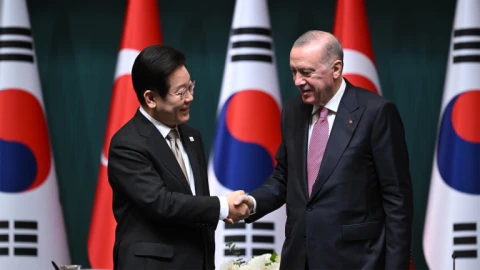
As part of a four-day visit to South Korea, President Recep Tayyip Erdoğan is set to hold official talks with President Lee Jae-myung in Seoul on November 3rd, his first since 2018. The visit reciprocates Lee’s official state visit to Ankara in November 2025, coming on the eve of the 70th anniversary of diplomatic relations in 2027. Among others, the visit is set to include Turkish Minister of Trade Ömer Bolat. It expected to produce several agreements strengthening the contractual basis of the relationship. Ties between the two countries are usually told through the shared memory of the Korean War. That memory matters, but it is no longer the most important part of their relations. Türkiye and South Korea are two middle powers that have built capable defence industries and only recently become major exporters, at a time when traditional partners are becoming less reliable. On their current trajectory, they are set to compete for the same customers in a already small market. If they pool their strengths instead, both can become a stronger force in the market, and this visit is a chance to start.
A Bond Forged in Blood
In 1950, Türkiye was the first country after the United States to answer the UN’s call, and Turkish soldiers fought alongside Korean, American and other UN troops to repel the North Korean invasion. More than 20,000 Turkish soldiers served in the war and more than 700 lost their lives, 462 of whom rest at the UN Memorial Cemetery in Busan. Turkish troops remained under the UN Command until 1971, and apart from the United States, which maintains its deployment to this day, Türkiye was among the last countries to end the deployment. This shared history has brought the two countries close, and South Korea has become one of Türkiye’s most important partners in Asia.
The visit also has to be read within Türkiye’s wider engagement with Asia. The Asia Anew initiative began in 2019 as a largely economic agenda. It has since become proactive, tied to Türkiye’s emphasis on strategic autonomy, and it is being put into practice through institutions and defence cooperation rather than trade alone. Since early 2025, President Erdoğan has exchanged visits with the leaders of Malaysia, Indonesia and Pakistan, Indonesia’s order of 48 KAAN fighter jets has become the largest defence export in Türkiye’s history, and ASEAN has made Türkiye its 12th Dialogue Partner. The Mecca Pact with Saudi Arabia and Pakistan and the Badr Memorandum on defence-industrial cooperation with Qatar, Pakistan and Indonesia have added new defence frameworks that function alongside Türkiye’s already existing treaties.
Competing in a Small Market or Pooling Resources
Relations with South Korea hav kept up with the pace. Since Lee’s state visit, the two foreign ministers visited each other’s capitals, the energy ministers met in Seoul, and Lee returned to Ankara in July for the NATO summit with his foreign and defence ministers. Seoul’s interest is clear: Türkiye was the largest buyer of Korean arms in the 2000s, accounting for more than half of Korea’s arms exports between 2001 and 2010, and some the Korean outlets regard Türkiye alongside Poland as gateways for Korean defence firms into the NATO markets. At the Ankara summit, President Lee suggested expanding the Korea-NATO defence industry partnership into joint research, production and operation of systems. South Korea’s ambassador in Ankara has gone further, describing Türkiye’s drone sector as world-class and pointing to KAAN and unmanned aerial and naval systems as areas for cooperation.
On their current trajectory, however, the two countries are heading toward competition. Between 2021 and 2025, South Korea and Türkiye ranked ninth and eleventh among the world’s arms exporters, with shares of 3 and 1.8 percent. These are small but fast-growing slices of a market in which the United States alone accounts for 42 percent, and as both move toward high-end systems, their offers increasingly overlap. Indonesia is a case in point. It co-developed the KF-21 fighter with Korea and in June decided to buy it directly rather than assemble it at home, while it awaits the KAANs ordered from Türkiye. Under the right circumstances, the two could instead pool their resources and become a stronger force together. With growing uncertainty in global politics, defence products are becoming more sought after, and the large suppliers usually attach political conditions or ask for other concessions on high-end systems. Türkiye’s model does neither, and it usually allows local and joint production and technology transfer, helping importing countries grow their own defence industries. South Korea has followed a similar path. The K9 howitzer deal with Türkiye in 2001 led to local production, ALTAY was developed with Korean technology transfer, and Poland will begin building Korean K2 tanks in its own factory in 2028. Two suppliers with the same model and the same customers will compete unless they decide to cooperate.
This is also why the partnership can be one of equals. Both countries have built capable industries, but as exporters they are newcomers, with only a few years of major sales behind them, while the established suppliers have decades. Both also know the cost of depending on others. In March, as the United States drew on its forces in Korea for the US-Israeli war on Iran, Lee said publicly that he opposed the withdrawal of some American air-defence weapons from the peninsula, while conceding that Seoul could not impose its view on its ally. Over-reliance on foreign support can prove costly at the worst moment. Cooperation can therefore run both ways. Korea brings proven strengths in armoured vehicles, power packs and shipbuilding, Türkiye in unmanned systems, and the 2025 summit already committed both sides to joint production, technical cooperation and training exchanges.
Drones are a natural place to start. They have become an integral part of warfare in Ukraine and in the war on Iran, and counter-drone systems have moved to the centre of defence planning. This is not irrelevant for South Korea. The war with North Korea is frozen but has never formally ended, and Ukrainian intelligence has reported that Russia agreed to help Pyongyang produce Shahed-type attack drones, which analysts warn could be launched in numbers large enough to strain South Korean air defences. Türkiye brings combat-tested experience on both sides of this equation, from its drones to counter-drone systems such as KORKUT, which Ukraine reportedly fields against Russian drones.
The Global Combat Air Programme of the United Kingdom, Italy and Japan shows how middle powers can pool resources to build a next-generation fighter. Pooling, however, is not enough on its own, and questions of development, production and sales have to be settled at the outset. The FCAS programme of France, Germany and Spain was meant to produce Europe’s next-generation fighter, but its crewed aircraft was abandoned in June after the partners failed to agree on industrial shares. The Eurofighter was built, but its exports suffered because each consortium member can veto sales. Germany blocked deliveries to Saudi Arabia from 2018 until 2024 and held up Türkiye’s own request until July 2025. Politics and foreign policy are a key part of defence exports, and both countries know this from experience. ALTAY’s production stalled when Germany withheld engines and transmissions, and the Korean firms that stepped in reportedly had to remove German components from their power pack. Any joint program between Ankara and Seoul will need clear rules on work share and third-country sales from the start.
Beyond Defence
Besides defence, energy is an other pillar. Türkiye aims for 20 gigawatts of nuclear capacity by 2050, which requires new plants at Sinop and in Thrace alongside Rosatom’s Akkuyu. Korea is not new to Sinop. Disagreements on electricity and government payment guarantees led to the talks being suspended in 2010, and while Japan later took over the project, it also withdrew in 2020 over its cost and timeline. Since then, Korea has built the Barakah plant in the United Arab Emirates and signed a contract for new reactors in the Czech Republic. Meanwhile Türkiye continued looking for partners beyond Russia and China, which is in talks for Thrace. The memorandum signed between TÜNAŞ and KEPCO during Lee’s visit has moved into pre-feasibility work on Sinop, including identifying components that Turkish industry could supply. Korea’s nuclear exports face their own third-party constraint, however. Under its 2025 settlement with Westinghouse, Korea’s reactor builder may reportedly still bid in Türkiye, but its designs must clear a Westinghouse review, and each reactor exported comes with around $650 million in contracts and $175 million in licence fees for the American company. Small modular reactors, around 5 gigawatts of Türkiye’s target, form a second track. Korea’s state-backed i-SMR developer signed an agreement with Türkiye’s Nuclean in June, and even Baykar has announced that it is working on SMRs.
Trade remains the weakest link. Bilateral trade grew from just over $6.5 billion in 2019 to $11.4 billion in 2025, but almost all of that growth came from Korean exports to Türkiye. Turkish exports to Korea have stayed at around $1 billion a year, and the deficit has passed $9 billion. The ongoing revision of the 2013 free trade agreement can help, but local production under the defence and nuclear projects would contribute in narrowing the gap.
Unlike Türkiye’s close ties with Pakistan or Indonesia, the bond with South Korea does not rest on a shared faith, but on history and, increasingly, on culture. Korean dramas and music are widely popular among young Turks, and rather than competing with Korean content, Turkish producers have given it a Turkish flair. 7. Koğuştaki Mucize, adapted from the Korean Miracle in Cell No. 7, became Türkiye’s Oscar entry, and Mucize Doktor, a remake of the Korean Good Doctor, aired across Latin America and in South Africa. As the world’s second-largest exporter of television series, Türkiye can carry Korean stories into markets where Turkish shows already have a following. Turkish producers have also begun copying the Korean model at home, building pop groups through auditions and idol-style training, seemingly with success.
What to Watch For?
As the two countries approach 70 years of diplomatic relations, the bond formed in the Korean War has grown into a broad strategic partnership. The visit should be judged by what it moves forward. On defence, the question is whether the two sides agree on a joint production frameworks, starting with unmanned and counter-drone systems, with clear rules. On energy, it is whether the talks on the Sinop power plant advance toward an intergovernmental agreement. On trade, it is whether the free trade agreement revision begins to narrow the imbalance. Each side also opens a door for the other. From the South Korean perspective, Türkiye is a gateway to NATO’s defence market, and Korea extends Asia Anew into Northeast Asia for Ankara. If the visit delivers on even part of this agenda, the two countries will enter their 70th anniversary year as partners in industry and technology as well as in memory.