
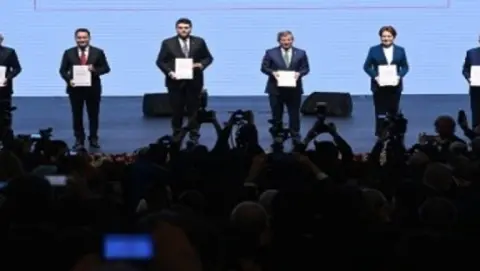
On January 30th, the Six-Party Table held a program in Ankara where they shared with the public the document they named the "Common Policy Agreement Text," which encompasses their election promises. The text consists of 9 headings and over 2,000 articles, covering 244 pages. However, an examination of the content clearly demonstrates that the comprehensiveness inherent in the diversity of topics is not qualitatively achieved. In other words, despite the technocratic detail and diversity of topics, the announced document lacks the necessary practicality for a political document.
At this point, a detailed analysis of the announced document reveals three fundamental issues. The first is the discrepancy between theory and practice regarding the document's actual meaning.
The second is the problems with its content. Finally, regardless of whether the text is a good or bad document, the flaws stemming from the existential problems of the Table of Six are noteworthy. The "COALITION TEXT" AND THE FUNDAMENTAL MISCONCEPTION
First, it should be noted that the Table of Six attempts to make the document it announces special by naming it the Common Policy Agreement Text. However, an examination of public reactions to the text, particularly from opposition groups, reveals a conceptual confusion. In this context, the text is given various names, such as "coalition protocol," "government program," "election manifesto," and "minimum commons."
On the other hand, when evaluated in terms of its content, the document in question can be defined as a "coalition text"1 encompassing all the aforementioned designations. However, this definition also reveals the text's ambiguous practice. In fact, the Table of Six has not yet officially formed an alliance, announced its presidential candidate, or established a clear coalition model or structure. Furthermore, the Table of Six is not yet in a position to win the elections. However, despite all these uncertainties, a document bearing the character of a coalition protocol and government program has been released. This situation fundamentally highlights the document's applicability. Both the released text and the Table of Six's operational style, which has spanned nearly a year, reveal that the opposition bloc's fundamental approach to the issue is also problematic. It is noteworthy that the Table of Six is focusing on how to govern the country if they win the elections, rather than working on how to win them. However, it is possible to say that this notion contains a grave error. While the Table of Six has not yet won an election, their chances of winning the elections are not as strong as they believe. The main reason for this is the intellectual arrogance of the Table of Six in terms of inclusiveness and representativeness.2
Despite all this, even assuming the Table of Six wins the 2023 elections, it faces the People's Alliance, which has a considerably broad representation. Therefore, it is a grave mistake for the Table of Six to believe that they represent this group, which consists largely of conservative and/or nationalist voters who did not vote for them, solely by claiming to share similar ideological positions or sociocultural identities. Ultimately, the idea that both the elections have already been won and the voters are being represented "ideally" beyond their vote share is the biggest problem and existential contradiction of the Table of Six and its products. What does the "Common Policy Agreement Text" announced by the Six-Party Table mean?
• What are the main problem areas in the text?
• Can the Six-Party Table implement these promises as a coalition?
On January 30th, the Six-Party Table held a program in Ankara where they shared with the public the document they named the "Common Policy Agreement Text," which encompasses their election promises. The text consists of 9 headings and over 2,000 articles, covering 244 pages. However, an examination of the content clearly demonstrates that the comprehensiveness inherent in the diversity of topics is not qualitatively achieved. In other words, despite the technocratic detail and diversity of topics, the announced document lacks the necessary practicality for a political document.
At this point, a detailed analysis of the announced document reveals three fundamental issues. The first is the discrepancy between theory and practice regarding the document's actual meaning.
The second is the problems with its content. Finally, regardless of whether the text is a good or bad document, the flaws stemming from the existential problems of the Table of Six are noteworthy. The "COALITION TEXT" AND THE FUNDAMENTAL MISCONCEPTION
First, it should be noted that the Table of Six attempts to make the document it announces special by naming it the Common Policy Agreement Text. However, an examination of public reactions to the text, particularly from opposition groups, reveals a conceptual confusion. In this context, the text is given various names, such as "coalition protocol," "government program," "election manifesto," and "minimum commons."
On the other hand, when evaluated in terms of its content, the document in question can be defined as a "coalition text"1 encompassing all the aforementioned designations. However, this definition also reveals the text's ambiguous practice. In fact, the Table of Six has not yet officially formed an alliance, announced its presidential candidate, or established a clear coalition model or structure. Furthermore, the Table of Six is not yet in a position to win the elections. However, despite all these uncertainties, a document bearing the character of a coalition protocol and government program has been released. This situation fundamentally highlights the document's applicability. Both the released text and the Table of Six's operational style, which has spanned nearly a year, reveal that the opposition bloc's fundamental approach to the issue is also problematic. It is noteworthy that the Table of Six is focusing on how to govern the country if they win the elections, rather than working on how to win them. However, it is possible to say that this notion contains a grave error. While the Table of Six has not yet won an election, their chances of winning the elections are not as strong as they believe. The main reason for this is the intellectual arrogance of the Table of Six regarding its inclusiveness and representativeness.2
Despite all this, even assuming that the Table of Six wins the 2023 elections, it faces the People's Alliance, which has a considerably broad representation. Therefore, it is a grave mistake for the Table of Six to believe that they represent this group, which consists largely of conservative and/or nationalist voters who did not vote for them, solely by claiming to share a similar ideological position or sociocultural identity. Consequently, the idea that both the elections have already been won and the voters are being represented "ideally" beyond their vote share is the biggest problem and existential contradiction of the Table of Six and its products.
PROBLEMS IN THE CONTENT
Even when the aforementioned misconception is ignored, numerous problems remain evident in the content of the text presented by the Table of Six. Although the text meets certain standards in terms of its comprehensiveness in terms of its use of simple language and diversity of topics, It has a very flawed structure due to its problems with its economic promises, its opposition to mega-projects, its timidity towards fundamental issues, the contradictions in its overall promises, and its overly technocratic spirit.
Problems with the Economic Promises
The text's economic framework and promises are highlighted by contradictions between some parties' own promises and those of others. For example, the more left-wing and public-oriented perspectives and promises, developed by many CHP economic experts and occasionally repeated by CHP Chairman Kemal Kılıçdaroğlu, find little room in the text. Kılıçdaroğlu's expropriation promises, in particular, appear to be in the background. Furthermore, the term "expropriation" is not mentioned even once in the entire text. Therefore, the text's economic promises can be characterized as a liberal economic program. It can only be said that some populist promises related to social policy are interspersed among the articles.
On the other hand, some promises are formulated in a generalized manner, with unclear implementation methods. For example, it is promised that inflation will be reduced to single digits within two years.3
However, both the Central Bank4 and President Recep Tayyip Erdoğan5 have repeatedly stated that inflation will be reduced to single digits by 2024. Therefore, the key dividing point in this matter is the methodology, but it appears that the Six-Party Table has avoided providing details on this matter.
Another economic issue is the opposition's opposition to megaprojects, based on rote reflexes that have been perpetuated by the opposition for many years and have become increasingly prevalent since the recent local elections. The opposition's opposition to city hospitals, the airport, and Kanal Istanbul is particularly striking here. However, the statement regarding city hospitals, "We will immediately halt the tenders of planned city hospitals and those that have not yet been built, and we will not build any new city hospitals,"6 is quite problematic for the opposition. The promise to halt a project that has positively differentiated Turkey during the coronavirus (Covid-19) pandemic and addressed a significant need in healthcare, and that has satisfied most citizens in terms of service and construction quality, reinforces the negative political perception associated with the opposition. Furthermore, it is particularly striking that individuals who previously served as ministers in the AK Party, such as Ahmet Davutoğlu and Ali Babacan, who designed, managed, and even implemented build-operate-transfer or lease models, have signed promises that contradict their own actions.
Reservations Regarding Fundamental Claims
The document either fails to address Turkey's fundamental issues or claims frequently voiced by the opposition to criticize the government, or offers tentatively worded, generic promises. For example, the document contains no direct reference to the "Kurdish issue," a topic frequently raised by the opposition. Furthermore, the text contains no sentence regarding the fight against the PKK. Similarly, no statement directly addressing Alevi citizens and their problems was included. The document only included the promise, "We will ensure that space is allocated for cemevis (cemevis) when zoning plans are prepared."7
In addition, the Istanbul Convention is one of the issues not directly addressed. Although Deputy Chairman Ümit Özlale, who presented the text on behalf of the İYİ Party, went beyond the text and addressed the convention in his speech, this remark drew criticism from the Gelecek and Saadet parties. Similarly, while the text contains ambitious promises about women and youth, it is also striking that these groups find no place on the stage.
No detailed and comprehensive promises or policies were proposed in areas such as foreign policy, security, and defense. At this point, it can be roughly said that existing and implemented policies will be strengthened. However, many arguments voiced by the parties on foreign policy, counterterrorism, and security issues, particularly Syria and Iraq, were not included in the text. The main reason for this is the six parties' inability to reach a consensus on these policies.
Consequently, the six-party table is unable to offer any other promises in these areas, other than some familiar slogans.
The text also appears to repeat some promises already bought by certain populist and opposition groups. Examples include the reopening of Atatürk Airport, the relocation of the Presidency to the Çankaya Presidential Palace, the opening of the Presidential Complex to the public, and the sale of aircraft. Furthermore, nothing new was mentioned, particularly on topics related to law and public administration, and promises contained in the two previously announced texts were repeated for the third time. Examples include lowering the election threshold and providing treasury aid to parties. Contradictions and Limitations
On the other hand, some contradictions in the text are also noteworthy. For example, in the sections regarding Syrian migrants, there are contradictions both within the text and between the CHP and İYİ Party's own statements and the text itself. Indeed, it is stated under the same heading that Syrian migrants will be sent back, while integration policies will be actively and comprehensively implemented.8
On the other hand, considering that Kemal Kılıçdaroğlu recently promised to send all Syrians back within two years9 and Meral Akşener by 2026 at the latest,10 it is clear that the text contradicts these promises.
While it is possible to exacerbate the contradictions within the text, the main issue here is that the text, along with the parties and potential presidential candidates, will be constrained and their own institutional or individual promises will be thwarted. For example, Kılıçdaroğlu has made populist promises, such as providing village headmen (mukhtars) with assistance, farmers with free electricity, and making some districts provinces if elected. However, these promises are not included in the coalition text. Therefore, Kılıçdaroğlu's promises will either be nullified, or the text and decision-making mechanism announced by the Six-Party Table will be rendered ineffective in fulfilling these promises. Similarly, "family support insurance," perhaps the most notable aspect of the CHP and to which the party attaches special institutional importance, is also missing from the text. Considering all of this, the promises that parties or potential candidates would share with the public during the election period and that are not included in the text will be nullified because they do not receive the approval of the Six-Party Table. Thus, the parties are directly restricting their own flexibility of action, institutional identity, and distinctiveness. The Problem of Excessive Technocracy
In addition to all these contradictions and limitations, the text possesses an overly technocratic character and is therefore quite weak politically. In this respect, it can be considered a work devoid of politics and ideology, lacking political depth and impact, apart from a return to the parliamentary system and the old ways. Although the subject matter appears comprehensive and detailed in terms of its diversity, it cannot be said that it has the structure to influence the preferences of voters whose votes are already certain or those in the gray area. Therefore, considering that its political impact is quite limited and the target audience is new voters, it is impossible to speak of a strong content aimed at this purpose.
Therefore, apart from a few populist or familiar promises, the text has failed to transcend into being more than a think-tank report, an internal report for its intended audience, or a technical policy recommendation. However, in general, this text, due to its lack of ideology, can be described as a set of promises that everyone can agree on, and that a significant portion of the AKP has either worked on or continues to work on.
So much so that the AKP, while not technically objecting to a significant portion of the promises in the text, can actually sign them. Furthermore, it is problematic that the drafters of the text proudly and joyfully expect praise and well-done before the promises are even implemented, believing, "We have prepared a very good text," while some opposition groups meet this expectation.
CONCLUSION: COALITIONS, THE CONFLICT OF WORDS AND ACTION
In conclusion, the fundamental assessment that can be made of the text is that it is a comprehensive document in terms of its subject matter but inadequate in terms of realpolitik. However, the real problem here stems from the excessive meaning attributed to the document by the Table of Six and the opposition groups that support it. Indeed, even if the text presented had the best-prepared content in the world, it would be far from winning elections. Because no single text, declaration, protocol, or program possesses the power and capability to win elections on its own.
Furthermore, the Table of Six must manage its expectations, which are concentrated in the text, effectively. Many candidates and parties, including those in the Table of Six, have previously possessed various documents prepared by highly skilled experts, technocrats, and academics, and a significant portion of the content contained within these documents is also included. However, no single text has succeeded in winning elections for those individuals or parties. This is, in essence, the point at which politics and technocracy diverge.
In addition, when the document presented is evaluated alongside the structure and functioning of the Table of Six, three main problems emerge. The first of these stems from the impossibility of the governance model the Table of Six claims to establish, at least during the transitional period. The Table of Six has constrained itself and its potential candidates with the coalition document and program it has put forward. The candidate nominated—if elected president—must be subject to the leaders of the Six-Party Table and this program, at least in terms of promises. Therefore, the voters are already presented with a narrowly defined, limited, and lacking political flexibility model of governance. It is impossible for someone elected with a 50%+1 vote share and responsible for governing the country to function under this model. The second problem is that, although the opposition uses the cliché phrase "six different parties have agreed on something for the first time in history, and that's enough" in every document released by the Six-Party Table, this has no practical application. In this context, the text in question contains content that many actors, including the AKP, beyond the Six-Party Table, can agree on most of the articles. These and similar issues are discussed in considerable length and detail in the text. However, critical issues such as the Istanbul Convention, the Kurdish issue, and the fight against the PKK terrorist organization are largely ignored, while important issues such as foreign policy and security are glossed over with slogans. It would be quite optimistic to consider the agreement of six parties with different ideologies, whose only political commonality is their opposition to Erdoğan, on non-ideological issues a success.
Furthermore, the text in question closely resembles the government programs announced during previous coalition governments and, structurally, is nothing more than a more detailed/expanded version of these efforts. The text describes the issues agreed upon in the programs of previous coalition governments in lengthy and elaborate sentences, while those on which there was disagreement are ignored. However, when the realities and demands of the day dictated the necessity of discussing issues on which there was disagreement, the procrastinating or controlling attitudes of past coalitions failed to prevent internal conflicts, leading to the dissolution of these coalitions. The text of the Six-Party Table, both in its content and structure, is reminiscent of the programs of coalition governments. Issues on which there was disagreement and disagreement were postponed to an indefinite post-election date. Thirdly, and finally, because the Six-Party Table failed to communicate its own views to the public and to establish its own agenda as a public agenda, the text's impact was quite limited. The main reason for this is that the Six-Party Table spent all its energy preparing for an election they assumed would be won. Consequently, the Table devoted inordinate time to projects that yielded no practical results, were futile if the elections were not won, and were overly idealistic. However, the vast majority of voters, especially the opposition, are more interested in who will face the People's Alliance candidate, Recep Tayyip Erdoğan, and what he will promise, rather than the documents and texts that have been released. Therefore, since all the efforts of the six-party table have failed to meet these expectations and the candidate issue has been continually postponed, it has naturally faded into the background, generating limited interest and impact.
