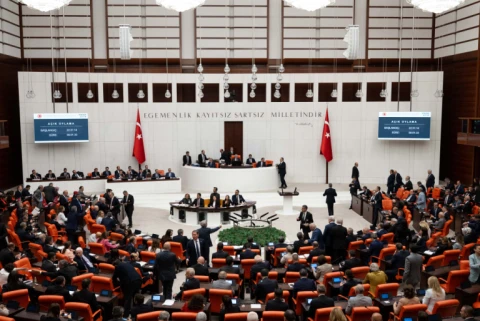
Türkiye has entered a new period in the problem of terrorism, which has produced heavy costs in every field, from security to the economy, from democracy to social life, for approximately half a century. The Law on Strengthening National Solidarity and Social Integration, which was adopted by the Grand National Assembly of Türkiye and signed by the President on August 18 and published in the Official Gazette of the Republic of Turkey, has completed the legislative pillar of the Terror-Free Türkiye process and paved the way for the implementation period. This regulation shows that Türkiye has entered a new strategic stage in its fight against terrorism. This article examines, within the framework of the adopted law, according to which principles and through which institutional mechanisms the Terror-Free Türkiye process will proceed in the next stage. The fundamental aim of the process is the complete dismantlement of the armed terrorist organization PKK and Türkiye’s permanent emergence from the cycle of violence.
Terror-Free Türkiye should not be read as a continuation of the solution attempts tried in the past. This process is a new model built upon the level reached by the state’s security capacity and whose legal basis has been established by the Grand National Assembly of Türkiye. The general justification of the law also clearly sets out this approach. The end of terrorism will contribute to Türkiye’s economic development, social peace, and common future.
The fundamental issue that should be discussed today is how this process is being carried out as much as what it aims to achieve. This is because assessments that are being promoted in the public sphere, such as “a bargain was made,” “a general amnesty is coming,” or “there will be impunity,” are consistent with neither the text of the law nor the process.
A Process Conducted by the State
The most distinctive feature of the Terror-Free Türkiye process is that it is not based on a negotiation or political bargaining conducted with the organization. The first article of the law leaves no room for any doubt on this matter. Legal proceedings are made conditional upon the security institutions determining that the PKK/KCK has ended its de facto existence and that all weapons and ammunition under its control have been surrendered. Following this, the decision of the National Security Council confirming this determination must be published in the Official Gazette of the Republic of Turkey. Until these two stages are completed, the judicial mechanisms stipulated by the law will not begin to operate.
This condition demonstrates that the state is at the center of the process. First, the dismantlement of the organization will take place, and then the other provisions stipulated in the law will come into effect. A declaration of laying down arms is not regarded as sufficient. It is required that this be verified on the ground by the security institutions and officially confirmed by the National Security Council. Therefore, the process is not an implementation initiated in return for any political commitment. As stated in the general justification of the law, Türkiye has developed a unique model suited to its own state tradition and social reality, drawing on its experience of struggle extending over more than forty years.
In this respect, the Terror-Free Türkiye process does not mean a period in which security policies have come to an end. On the contrary, it represents a new stage in which security measures continue and legal mechanisms are introduced in a way that supports these measures. The law accepts the protection of public security as a fundamental principle and ties the permanence of the process to this.
For this reason, assessments claiming that “the organization got what it wanted” have no basis. The precondition is clearly the surrender of weapons and the de facto termination of the organization.
A Conditional Legal Regulation Open to Supervision
The issue most widely debated in public is whether the regulation has the nature of an amnesty. The general justification of the law provides a direct answer to this debate. It is clearly stated that the proposal does not abolish conviction judgments, does not alter the legal nature of the offenses, and does not terminate criminal liability. Ongoing investigations, prosecutions, and final conviction judgments continue to exist together with their legal consequences.
Therefore, the mechanism introduced here is not an amnesty, but the postponement of investigations, prosecutions, and the enforcement of sentences for specified periods. Postponement does not mean that the legal file disappears. On the contrary, files, evidence, and records continue to be preserved. The statute of limitations does not run.
There are also important exceptions regarding persons covered by the law. Intentional killing offenses committed within the framework of organizational activity, as well as offenses committed before June 1, 2005 that require life imprisonment or aggravated life imprisonment, are excluded from the scope of postponement. For these persons, the mechanisms of investigation, prosecution, and enforcement of sentences will continue to operate. Here, it should be emphasized in particular that Abdullah Öcalan and the organization’s leaders fall within this scope and that their release is not possible.
In addition, persons who receive a postponement decision are subject to a certain supervision process. In other words, there will be no uncontrolled release. If any terrorist offense is committed again during the postponement period, the postponement decision is revoked. The investigation and prosecution continue from where they left off. In the event of conviction, the sentence imposed is not postponed and is enforced with all of its legal consequences.
This regulation does not produce impunity. On the contrary, it creates a conditional legal status. The individual is expected to remain bound by the legal order. If terrorist activities are resumed, the state activates all criminal mechanisms. For this reason, defining the law as a “general amnesty” is not legally accurate. The law covers certain offenses relating to establishing or managing the PKK/KCK, membership, assistance, propaganda, offenses committed within the scope of the organization’s activities, and the financing of terrorism. The scope is clearly limited to organizational activities.
For the process to operate, individuals are also required to submit an application. Persons who submit a written application to the Chief Public Prosecutor’s Offices or authorized institutions within six months following the publication of the National Security Council decision in the Official Gazette of the Republic of Turkey may benefit from the law. It is not envisaged that action will automatically be taken regarding everyone.
Road Map for the Implementation Period
One of the most important aspects of the law is that it defines the implementation mechanism in detail. After the legislative process has been completed, the main stage is the implementation period. This period will begin with the determination by the security institutions that the PKK has laid down its arms and the confirmation of this by the National Security Council. Until this stage is completed, the postponement of investigations, the postponement of the enforcement of sentences, or other legal proceedings will not come into effect.
The weapons surrender process will also be officially recorded. Weapons, ammunition, explosives, and other materials surrendered or declared by members of the organization will be formally registered, and the implementation procedures will be determined by the Ministry of Interior and the Ministry of National Defense. Following this, the process moves into institutional supervision. Pursuant to Article 7 of the law, a coordination board will be established under the chairmanship of the Vice President. The Minister of Justice, the Minister of Foreign Affairs, the Minister of Interior, the Minister of National Defense, the Secretary General of the Presidency, the Head of the National Intelligence Organization, and the Secretary General of the National Security Council will serve on this board. The board will monitor and evaluate implementation and may establish subcommissions when deemed necessary.
The board’s duty is not limited to this. It will periodically evaluate observation reports concerning the complete dismantlement of the organization and, if necessary, request judicial, administrative, or legislative regulations. In this way, the implementation process will acquire a structure that is continuously monitored and reported. The Grand National Assembly of Türkiye is not excluded from this process either. The law envisages the establishment of a Monitoring Commission within the Grand National Assembly of Türkiye. The Coordination Board will regularly inform the Grand National Assembly of Türkiye about its activities, while the Monitoring Commission will follow the implementation and make recommendations. This structure shows that the process has not been left solely to the initiative of the executive branch. The executive will provide coordination, while Parliament will perform its monitoring and oversight function. In this way, institutional transparency and political oversight will operate together during the implementation period.
The Terror-Free Türkiye process represents a new threshold in Türkiye’s security history. This process aims to bring to an end the period of conducting politics under the shadow of weapons. The legal regulation constitutes the road map for this. When the text of the law is read carefully, three fundamental principles stand out. First, the dismantlement of the organization and the surrender of weapons will take place. Then, legal proceedings will begin. Throughout the process, supervision and monitoring mechanisms will operate without interruption. For this reason, what needs to be done today is not to confine the regulation to a debate over amnesty or impunity. The real issue is to correctly understand Türkiye’s determination to end its period of terrorism, which has lasted for more than forty years, within the principle of the rule of law. The success of Terror-Free Türkiye will be possible through the complete silencing of weapons, the full fulfillment of the conditions set by the state, and the operation of the implementation mechanism within legal boundaries. Türkiye is entering the new century with the success of this model, which aims to strengthen social solidarity without compromising security.