
Stockholm International Peace Research Institute (SIPRI) is an independent organization that conducts research on armed conflicts, military expenditures, and arms trade worldwide. Acting with the mission of ensuring transparency in global security policies, the institute is one of the main pillars of defense industry analysis with the comprehensive reports and databases it publishes every year. The Arms Transfer Database used in this study was updated in March 2026 to include all official deliveries and transfers occurring until the end of 2025. The Military Expenditure Database is also expected to be updated on April 27.
The SIPRI TIV (Trend Indicator Value) used as an indicator in this dataset is a common unit developed by SIPRI to measure the volume of international transfers of major conventional weapons. This indicator measures the military capacity and the amount (volume) of weapons transferred rather than the financial value.
Statistics for the 2000-2025 period show that the Gulf region is a high-volume market in the defense sector. In the period examined, Saudi Arabia stands out with a total import volume of 40,237 units, the United Arab Emirates with 25,560 units, and Qatar with 16,183 units. Although there are periodic fluctuations in import figures, Gulf countries maintain their import-dependent structure in defense procurement.
Gulf Countries Arms Imports Volume
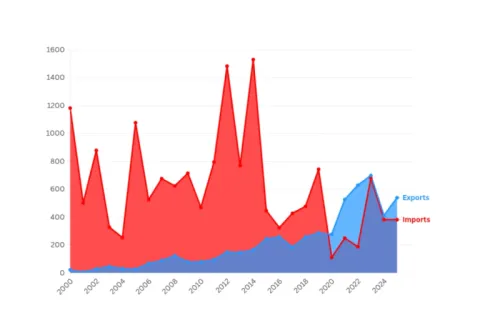
In contrast to the high import tendency in the Gulf, Turkey's data follows a different course. Arms imports, which were 1,181 units in 2000, declined to 187 units by the 2020s. Simultaneously with this remarkable decrease in imports, it is noteworthy that exports, which were only 21 units in the early 2000s, increased 33-fold to 698 units in 2023. This consistent increase in exports shows that Turkey has reached a significant production capacity in the defense industry.
Turkey's Arms Import and Export Transformation
After a general look at the import and export indicators, it will be useful to look at the countries Turkey trades arms with and the shares of these countries in mutual trade. Graph-3 shows the countries Turkey imported arms from between 2000-2025 with their weights. Accordingly, it is seen that Turkey has a serious import dependency on the USA with 57.6% throughout the 2000-2025 period, followed by France (15.7%) and Russia (10.2%). This situation shows that Turkey has intensive relations with the Western (NATO) bloc and partially with Russia in conventional weapon systems. However, the last 10 years of this 25-year period is also a period in which Turkey accelerated its "indigenization" moves to break this foreign dependency. Despite this outlook in imports, the effort to act independently in foreign policy has been a source of motivation for Turkey to establish its own defense ecosystem.
Turkey's Arms Import Suppliers and Shares
The graph of Turkey’s Arms Export Destinations (Graph-4) clearly reveals the direction of the Turkish defense industry. Turkey's two largest customers stand out as the United Arab Emirates (UAE) (20.5%) and Saudi Arabia (12.1%). With the shares of Qatar, Bahrain, and Iraq, it is seen that almost half of Turkey's total arms exports are made to the Middle East and Gulf geography. Turkey has started to use the systems it produces as a regional diplomacy and economic income tool, not only by equipping its own army with its domestic defense sector. It can be said that the political normalization experienced with the UAE and Saudi Arabia in recent years has reflected directly and very strongly on defense industry exports.
Turkey's Arms Export Destinations and Shares
Although Gulf Countries hold an important place for Turkey in arms exports, Turkey's share in the arms supply of these countries is quite open to development. To see the competition in the Gulf market and Turkey's position and competitors in this market, it is necessary to look at Graph-5. The share of the USA in the arms imports of Gulf countries is quite large. However, when looking at the color breakdowns in the graph (Turkey - Turquoise color); it is seen that Turkey has gained a visible place in the arms imports of Bahrain, Qatar, Oman, and the UAE in particular.
Gulf Countries' Arms Import Suppliers
Turkey has risen to the position of a "cost-effective, technologically competitive and politically flexible" alternative supplier for Gulf countries, alongside "traditional" suppliers such as the USA, France, or the UK. Especially the strategic alliance with Qatar and the increasing presence in the Oman/UAE market is an indicator that Turkey has started to break the monopoly of Western companies.
As a result, SIPRI data shows that the high import volume in the Gulf line continues; and Turkey's position has undergone a strategic transformation. The positive change in import and export data confirms that Turkey's regional role in the defense industry has settled into a new balance.