
The EU arrived in Antalya as the most determined advocate of the transition away from fossil fuels, and it left the conference without giving up that role. Yet COP31 showed that the real problem in the EU’s climate diplomacy was not a lack of ambition. The problem was that the EU did not bring to the table the tools needed to carry that ambition. Read together with its reticence about finance and its own energy record, the broad alliance it built around fossil-fuel language rests on fragile ground. The Parties could not overcome their differences on fossil fuels, and the conference closed without adopting a cover decision. This outcome also showed the cost of that fragility.
Fossil Fuels: Was a Red Line Enough?
The draft cover decision published on 16 November contained a call for accelerated action to phase out fossil fuels and for an immediate transition away from fossil fuels in energy systems. This language disappeared entirely from later drafts. Saudi Arabia and Russia, both fossil fuel producers, opposed wording calling for a move away from oil, gas and coal. The final draft of the cover decision did not mention fossil fuels at all. Instead, it set gigatonne-scale carbon capture by 2035 as a shared global target. The EU stood with small island states and least developed countries in a group of 126 countries that sought to anchor the text to the first Global Stocktake and to remove the carbon capture targets. At the close, it also formally objected to the text. It said the text failed to “meet the moment” and called its omission of any reference to fossil fuels “unconscionable”.
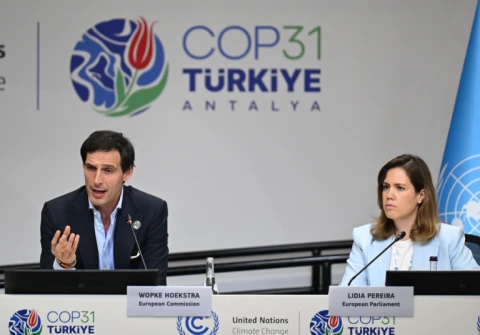
This position rested on a common stance within the EU. Darragh O’Brien, Minister for Climate, Environment and Energy of Ireland, which holds the Presidency of the Council of the EU, said they could not, and did not, endorse a cover decision that did not respond to the science. He stressed that the text did not acknowledge the role of fossil fuels in climate change. Wopke Hoekstra, Commissioner for Climate, Net Zero and Clean Growth, acknowledged that the final outcome was insufficient. The Commission stated that the EU and its member states could not accept a compromise that put the Paris Agreement at risk, and it presented the outcome as a stance in which the EU did not compromise on ambition. This framing records the defence of the red line as a success. It does little, however, to explain why this stance did not translate into a negotiated outcome.
The objection was consistent in principle. The EU did not endorse a text that would have rolled back the consensus reached in the Global Stocktake on transitioning away from fossil fuels. However, objection was the only effective tool at the EU’s disposal. The EU could stop the text, but it could not change it. The absence of a cover decision does not mean that the language on transitioning away from fossil fuels was preserved. It only means that weaker language was not put on record. The EU’s response to this deadlock was to move ambition outside the consensus rule. After Finland, France, Germany and the Netherlands, four more member states turned to national fossil fuel roadmaps. Ireland, which holds the EU Council Presidency, will co-host the second conference on transitioning away from fossil fuels with Tuvalu. These coalitions of the willing offer a way forward, but they also raise questions about whether the UN climate regime can deliver results on this issue.
This picture points to a division of labour in the EU’s coalition diplomacy. As a bloc, the EU joined voluntary initiatives launched by the presidency and other partners. Among them were the Global Sulfur Hexafluoride (SF6) Pledge, the Antalya Compact for Energy Efficient Buildings, Global Geothermal Ambition 2050, the Antalya Green Industrialization Compact, the Global Methane Pledge, and the Open Coalition on Compliance Carbon Markets, which the EU co-chairs. All of them fall within positive areas such as electrification, efficiency, industry and market instruments. The coalition on transitioning away from fossil fuels, by contrast, remained at the level of member states. Austria, Belgium, Denmark, Finland, Ireland, Luxembourg and the Netherlands were among the 24 countries that signed the Belém Declaration at COP30, which launched this process. At COP30, reservations from Italy and Poland had for a time prevented the EU from adopting a common position on the roadmap. At COP31, all 27 member states unanimously backed the transition away from fossil fuels. Still, the national roadmaps and the Belém–Santa Marta process remained limited to willing members. The EU can produce a common language on fossil fuels, but it arguably struggles to translate that language into a shared commitment to implementation.
Brussels’ top-level rhetoric did not fully reflect this determination either. Commission President Ursula von der Leyen used the disruptions in the Strait of Hormuz to highlight the cost of the status quo for climate and energy security, but she did not mention fossil fuels at all in her speech. The leadership chose the language of energy security and electrification, leaving the language of fossil fuels to the negotiators. This division of labour blurred the EU’s message. More importantly, the target von der Leyen supported, raising electricity’s share of final energy consumption to 35% by 2035, appeared in the final draft together with the energy security benefits of electrification. Fossil fuel language did not. Once separated from the transition away from fossil fuels, the EU’s positive agenda became acceptable. Electrification arguably entered the draft as a goal that replaced the exit from fossil fuels, rather than as a tool for achieving it.
Climate Finance: The Limits of the Alliance
The EU’s fossil fuel alliance quickly fell apart on finance. Before the conference, Climate Commissioner Wopke Hoekstra ruled out any discussion of new finance. In the negotiations, the EU argued for a “no text” option in the climate finance work programme. It also supported a “no guidance” option for the loss and damage fund. The overall outcome of the conference reflected this line. Against funding requests of $2.8 billion to the loss and damage fund, $342 million was pledged. The Commission signed a €25 million contribution agreement with the Fund for responding to Loss and Damage. This agreement, however, formalized earlier commitments rather than creating new resources. New European money for the fund was limited to Spain’s €15 million. The $120 billion adaptation finance target sought by the least developed countries did not appear in any final text.
The EU’s rationale arguably makes sense on its own terms. The Commission stressed that in 2025 the EU was the largest contributor of public climate finance, with €32.3 billion from public sources and an additional €9.3 billion in private finance, and said its priority was to make access to funds faster and easier. Yet this approach shows that the EU expects the island states and least developed countries it worked with on fossil fuel language to do two things at once: support its transition ambition and be patient on finance. Marshall Islands President Hilda Heine observed that the greatest security threat remains underfunded, even as war spending grows. Her remark sums up this tension. An actor who demands the transition without sharing its cost remains open to criticism on historical grounds.
The same tension was visible in climate security. EU members took visible steps in this area. Spain became a new donor to the UN Climate Security Mechanism with €250,000. Austria and Portugal announced that they would join climate, peace and security commitments when they take their seats on the UN Security Council in 2027. But defining climate change as a security issue is not the same as meeting it with adequate resources. For fragile countries, the real question is less about naming the threat than about providing the finance needed for adaptation and loss and damage.
Fossil Fuels at Home
Considered alongside its own energy record, the EU’s insistence at the negotiating table reveals a second gap. In 2025, the EU imported 146 billion cubic meters of LNG, a bridge fuel, and became the world’s largest LNG importer. Of these imports, 58% came from the United States. The EU agreed with the US on $750 billion of energy purchases, including LNG and oil. Fossil fuel subsidies in the EU stood at €97 billion in 2024, well above the 2015–2019 average. Member states that have committed to a phase-out have not set a concrete end date either. A significant part of this picture is arguably a result of the exit from Russian gas and of concerns over security of supply. Still, an actor that declared fossil fuel language a red line at the close is deepening its long-term dependence on LNG in its own market, and this weakens its position vis-à-vis producer countries.
Conclusion
At COP31, the red line the EU drew on fossil fuel language prevented the adoption of a text that would have rolled back the COP28 consensus. The finance and policy tools to back this line, however, were not on the table. The EU’s role in Antalya therefore arguably resembled that of an actor defending an existing norm rather than setting the agenda. The credibility of the EU’s call for a transition away from fossil fuels depends on aligning that call with its own policies. This requires the EU, while demanding the transition, to offer developing countries finance for it and to set a concrete end date for its own fossil fuel subsidies. The question facing the EU is no longer what it wants, but how far it is willing to share the cost of the transition it wants.