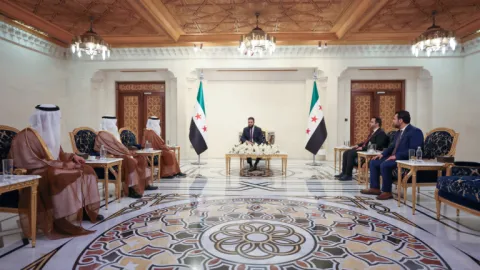
Fourteen months after the fall of Bashar al-Assad, Syria remains in a fragile and decisive post-regime transition. Under President Ahmed al-Sharaa, Damascus has pivoted sharply away from Iran, with Türkiye and the Gulf Cooperation Council (GCC) members—most notably Qatar and Saudi Arabia—emerging as the country’s principal external stakeholders. Today, Ankara, Doha, and Riyadh share a convergent interest in preventing Syria’s disintegration. The Assad regime’s collapse in December 2024 and the rise of a Hay’at Tahrir al-Sham (HTS)-dominated leadership created unprecedented openings for Arab Gulf influence, even as Syria’s unresolved internal fractures now threaten to test the limits of Qatar and Saudi Arabia’s ability to anchor stability.
GCC states have already translated influence into tangible gains, successfully lobbying the Trump administration to lift Assad-era sanctions and persuading Western governments to take concrete—and symbolic—steps to legitimize Sharaa and his associates in Damascus. Gulf investments have helped jump-start Syria’s redevelopment, though reconstruction needs remain immense after many years of gruesome war and economic strangulation. Early capital flows signal a degree of confidence, but the scale required for sustainable recovery far exceeds what has been committed thus far.
Gulf Leverage and the Limits of Reconstruction
Despite these advances, the Sharaa government continues to struggle to consolidate control nationwide. Although the PKK-linked Syrian Democratic Forces (SDF) are considerably weaker than at the start of this year, they retain control over parts of northeastern Syria. State authority remains thin elsewhere, such as in Alawite areas along the coast and Druze regions in the southwest near Israel, where sectarian tensions remain high and volatility persists.
Integrating the SDF, Alawites on the coast, and Druze communities in Suweida into a centralized Syrian state will be deeply challenging. This is in no small part due to the legacy of state violence and mistrust. An emerging Saudi-Turkish axis favors a political process that reconciles minority communities with the Sharaa government and preserves Syria’s territorial integrity. Other regional states such as Egypt, Kuwait, Oman, and Qatar support such unity in post-Assad Syria. This vision directly clashes with Israel’s strategy of weakening the Syrian state through military operations and by exploiting communal fissures, particularly among the Druze, to push the country down the path that Yugoslavia suffered in the 1990s.
From Israel’s vantage point, Western and “moderate” Arab states have moved too quickly to legitimize Sharaa and his government. Israeli officials cite Syrian soldiers’ expressions of solidarity with Palestine as evidence of a looming threat. Under the guise of countering such an alleged threat, Israel carried out more than 600 airstrikes in Syria during the first year after Assad’s fall and seized additional Syrian territory beyond the Golan Heights—territory it has occupied illegally since 1967. An underlying Israeli objective is to lock in a stark power imbalance at a moment when Syria is at its weakest in modern history, advancing Israel’s broader pursuit of absolute military dominance over its neighbors and the ambitions embedded in the “Greater Israel” vision.
For Riyadh and Doha, such Israeli actions pose a direct threat to prospects for durable stability in Syria. Pressuring the United States and other international actors to restrain Israel’s escalation will rank high on Gulf diplomatic agendas. Simultaneously, GCC states will continue backing efforts to bring the SDF into a negotiated settlement that entails disarmament and integration into the Syrian state.
Israel, the UAE, and the Politics of Fragmentation
The UAE’s Syria policy warrants close scrutiny through 2026. A central question looms: will Abu Dhabi align with fellow GCC states and Türkiye in supporting a unified Syria, or drift toward Israel’s vision of fragmentation? Analysts increasingly describe an Emirati-Israeli “Axis of Fragmentation,” pointing to Abu Dhabi’s alignment with Israel in backing separatist or state-weakening actors in Yemen, Somalia, and Sudan. Against this backdrop, Saudi Arabia has accused the UAE of engagement with Druze separatists in Syria.
Should the UAE move closer to Israel’s approach, Riyadh would increasingly view Abu Dhabi as a liability to Saudi objectives in the Levant. Saudi ambitions hinge on a stable, unitary Syrian state capable of attracting Gulf investment and reintegrating into regional and global systems. Fragmentation would risk prolonged instability—conditions that Israel and Iran alike could exploit—while opening space for further Daesh resurgence during Syria’s delicate transition. These concerns are widely shared across the Arab world and in Türkiye.
In the final analysis, Syria sits at the heart of Gulf visions for regional stability, economic integration, and post-conflict order. Aligning the “New Syria” with Saudi and Qatari interests serves both to limit Iranian re-entry into the Levant and to reconnect the Arab world from the Arabian Peninsula to the Mediterranean. The coming period will test whether Gulf states can shield Syria’s transition from external spoilers and internal fragmentation. A rare opportunity exists to anchor a viable, sovereign, and Gulf-aligned Syria—but only if Riyadh, Doha, and their partners confront head-on the destabilizing pressures emanating from an increasingly hegemonic Israel intent on normalizing its borderless aggression of the post-October 7 era.