
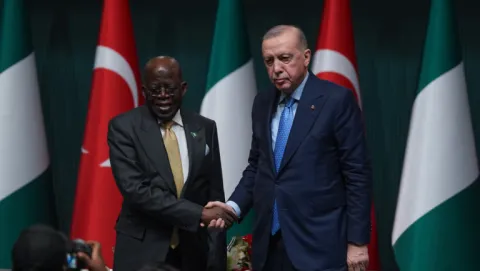
The study argues that, as unipolarity erodes and a multipolar order consolidates, the Nigeria-Türkiye relationship has shifted from conventional diplomacy to a strategic necessity between two middle powers. Nigeria-seeking security modernization, infrastructure development, and strategic autonomy-finds in Türkiye a third-way partner able to deliver technology, capacity-building, and flexible cooperation frameworks. Türkiye, advancing its Africa Partnership Policy, views Nigeria as a diplomatic and economic multiplier across ECOWAS and the African Union, while both countries share a reformist outlook on global governance captured by the doctrine "The World is Bigger Than Five."
Grounded in Middle Power Theory and South-South Cooperation, the study uses qualitative thematic analysis of policy documents, trade statistics, and defence industry reporting. It traces the historical trajectory from early diplomatic ties to acceleration under Türkiye's Africa Opening and the upgrade to a strategic partnership. A major turning point is identified in President Bola Ahmed Tinubu's Ankara visit on 27 January 2026, where nine memoranda were signed. These agreements are framed as a package logic that broadens cooperation beyond trade and defence into education, human mobility, standards, strategic communication, diplomacy academy coordination, and social policy-moving the relationship toward institutionalization. The report highlights JETCO as the key implementation engine that can translate summit momentum into sustained technical follow-up and raise bilateral trade toward a $5 billion medium-term target.
Defence cooperation is presented as the most dynamic pillar in 2024-2025. Facing insurgency, banditry, and maritime insecurity, Nigeria benefits from Türkiye's rapid procurement, training, maintenance ecosystems, and technology-transfer posture. Platforms and systems across air, land, and maritime domains are discussed as enabling a more autonomous Nigerian security architecture and reducing reliance on intermittent external interventions. Energy cooperation is framed around Türkiye's diversification needs and Nigeria's "Decade of Gas," emphasizing LNG flexibility, potential upstream joint ventures, and the strategic implications of contract expirations. The report also notes manufacturing investments by Turkish firms in Nigeria, AfCFTA-linked market access, large-scale construction projects, and financial reforms - while identifying risks such as logistics bottlenecks, currency volatility, visa and bureaucracy hurdles, and sensitivities surrounding FETO-related issues. It concludes with recommendations to institutionalize high-level coordination, deepen joint ventures in energy and defence manufacturing, build local-currency settlement mechanisms, expand agricultural technology transfer, and strengthen mobility and shipping corridors.