
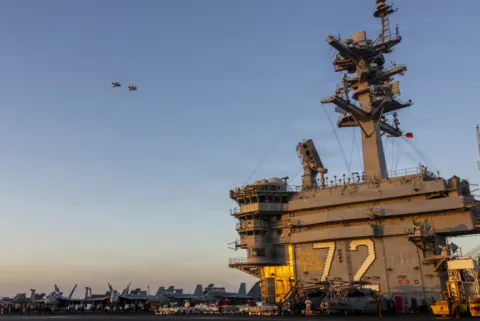
Operation Epic Fury, which began on Feb. 28 with large-scale airstrikes by the U.S. and Israel against Iran, quickly revealed the nature of modern warfare. In a short time, it evolved from a conventional air campaign into a war of attrition between missile systems and air defense networks. The situation that emerged in the first days demonstrates that the trajectory of modern high-intensity wars is determined not only by technology or tactics, but also, more fundamentally, by ammunition stockpiles, production capacity, and supply chains.
For the United States, the cost of the first 100 hours of the operation is estimated at $3.7 billion, or approximately $891.4 million per day. In the initial phase of the conflict, Iran carried out intense ballistic missile and kamikaze drone attacks targeting Israel, regional U.S. bases, and Gulf countries. Within the first few days, it is estimated that around 600-700 ballistic missiles were launched. According to claims by the Israel Defense Forces (IDF), Iran entered the war with an estimated inventory of approximately 2,500 ballistic missiles; thus, this usage corresponds to roughly 25–30% of the total stockpile.
During this period, Iran also made extensive use of Shahed-type kamikaze drones. It is assessed that more than 1,000 munitions and drones were launched by Iran within the first 36 hours of the war alone.
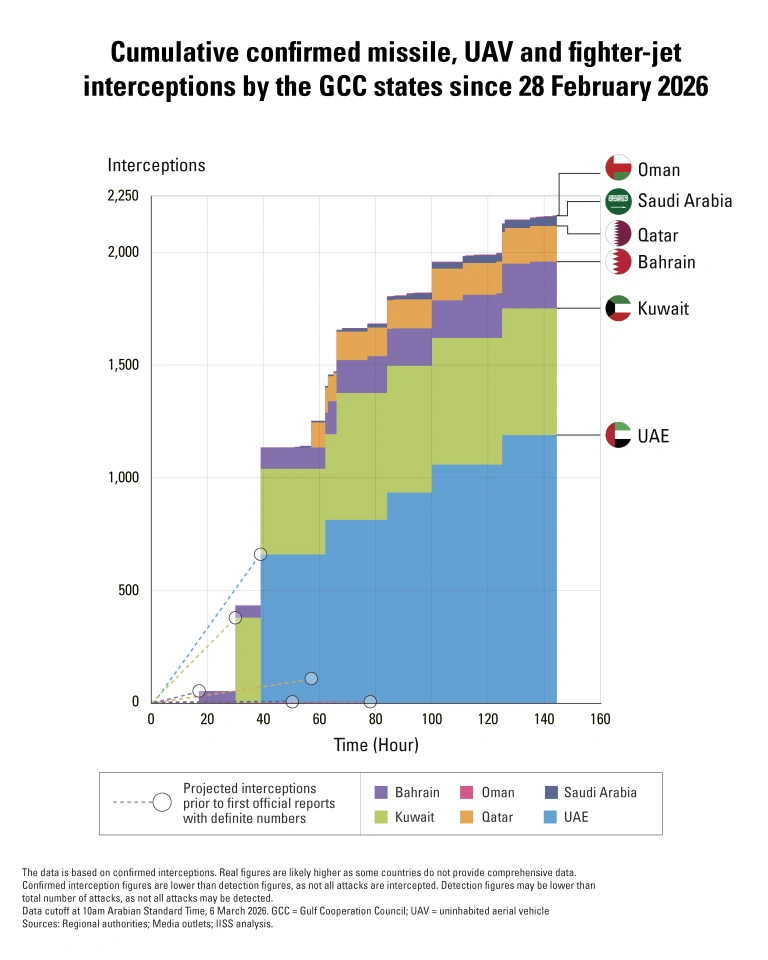
However, this intensity did not last long. According to data from the United Arab Emirates (UAE), Iran launched 165 ballistic missiles at the country within the first two days, while the number dropped to much lower levels over the following three days. Meanwhile, the U.S. Central Command (CENTCOM) announced that ballistic missile attacks decreased by 90% and drone attacks by 83%. This rapid decline can be attributed to three factors: the destruction of a large portion of Iran’s mobile missile launchers (TELs – transporter-erector-launchers), damage to its command-and-control network, or a deliberate reduction in the frequency of attacks to ensure that remaining stockpiles could be used over a longer period.
The Israeli air force’s announcement that it destroyed more than 300 missile launchers highlights the importance of the first factor. Nevertheless, Iran’s war strategy is based not only on causing direct damage but also on eroding allied air defense stockpiles, in other words, pursuing a classic asymmetric attrition strategy. In the early days, it is believed that around 400 ballistic missiles were used in attacks against the Gulf countries. According to modern air defense doctrine, two interceptor missiles are typically fired to reliably destroy a single ballistic missile. Based on this calculation, Gulf countries may have used around 800 Patriot or THAAD interceptors within just a few days.
The figure becomes even more striking when compared to the 1991 Gulf War, during which the United States used a total of 158 Patriot interceptors over six weeks, roughly the amount that may have been consumed in just the past few days. Although the actual interceptor stockpiles of Gulf countries are classified, U.S. sales records provide some indication. For instance, the UAE may have ordered more than 1,000 Patriot interceptors over the past 15 years. However, considering current consumption rates, such stockpiles might only be sufficient for a few weeks in a relatively intense conflict.
It is estimated that around 400 interceptors may have been used against the 165 missiles that struck the UAE during the first two days. According to this calculation, even assuming that U.S. systems were also engaged, it is possible that the UAE consumed 20-40% of its own interceptor stockpile within just a few days. Therefore, had Iran’s attack intensity not decreased, Gulf air defenses could have fallen to critical levels within a week.
Meanwhile, in Israel’s layered air defense architecture, Arrow-2 and Arrow-3 form the upper tier against ballistic missiles, while David’s Sling is designed to counter medium-range threats, and Iron Dome is used against short-range rockets and drone attacks.
Within the first 36 hours, the estimated interceptor usage of these systems was reported to be around 70 Iron Dome Tamir interceptors, 40 Arrow missiles, and 35 David’s Sling missiles. Although these figures may appear limited on their own, it should not be overlooked that in the face of prolonged and high-intensity attacks, Israel also depends on U.S. production capacity to sustain its interceptor supply.
At this point, U.S. President Donald Trump’s claim of “almost unlimited ammunition stockpiles” does not align with strategic reality. It is estimated that the United States and Israel used more than 3,000 munitions and interceptors in total during the first 36 hours of the war. These included Tomahawk cruise missiles, JDAM guidance kits, JASSM cruise missiles, ATACMS and PrSM long-range rockets, as well as a large number of air defense interceptors. Maintaining such an operational tempo means consuming hundreds of high-precision munitions per day.
Although it is theoretically possible for the U.S. to sustain this pace for months, given current production rates, the rapid depletion of stockpiles would be unavoidable. The meeting convened by Trump with major defense industry manufacturers, including BAE Systems, Boeing, Honeywell Aerospace, L3Harris Missile Solutions, Lockheed Martin, Northrop Grumman, and Raytheon, highlights both the urgency and the significance of the issue. The core problem lies precisely here: the gap between production capacity and wartime consumption is widening rapidly.
For example, the annual production of Patriot PAC-3 interceptors is around 600 units, and Lockheed Martin aims to increase this to 2,000 by 2030. Meanwhile, THAAD interceptor production stands at approximately 96 units per year. These figures demonstrate that the number of interceptors consumed in just a few days of combat can equal the entire annual production output.
Beyond this, the real bottleneck is not the production line itself but the supply of critical minerals. The manufacturing of modern munitions depends on materials such as tungsten, cobalt, rare earth elements, gallium, and germanium. Some of these raw materials are almost entirely dependent on a single country at the global level; for instance, around 98% of the world’s gallium production takes place in China. Therefore, accelerating ammunition production is not simply a matter of increasing budgets; physical constraints such as supply chains and refining capacity play a decisive role.
Moreover, Iran’s attacks on U.S. radar systems during the early days of the war further underscored this vulnerability. Several AN/TPY-2 radars linked to THAAD systems and the AN/FPS-132 long-range early warning radar were targeted. These systems cost hundreds of millions of dollars, and their reproduction could take years. The loss of such systems would represent not only a financial setback but also the creation of a prolonged blind spot in the regional air defense network.
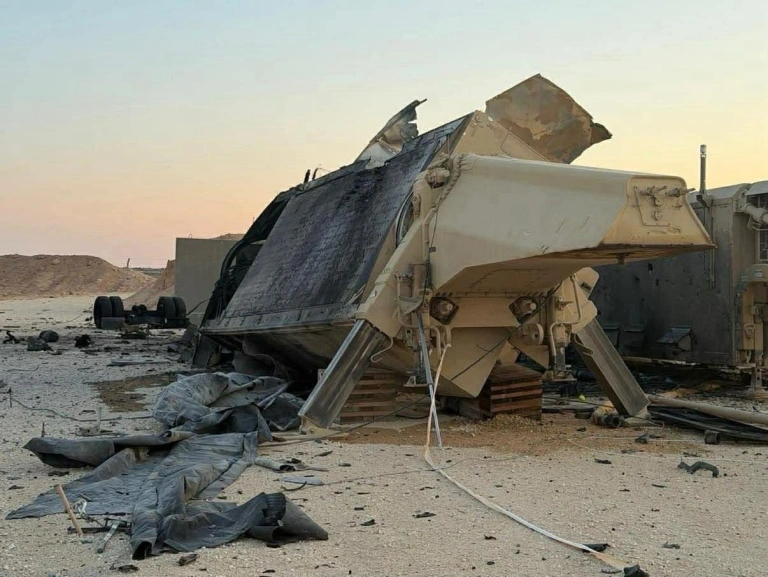
Source: AN/TPY-2 Forward Based X-band Transportable Radar https://x.com/sentdefender/status/2030094977997402583
When all these data points are considered together, the military balance of the war becomes clearer. Iran’s missile capacity has not been completely exhausted, but its ability to conduct high-intensity salvo attacks is rapidly declining.
At the same time, it appears that although the United States and Israel possess technological superiority, they will not be able to sustain their current rates of ammunition consumption for an extended period with the existing industrial production capacity.
Situation Assessment and Possible Operational Trajectory
The coordinated U.S.-Israel air-naval campaign (Operation Epic Fury and Roaring Lion) was built upon a classical concept of strategic air superiority and command-and-control paralysis (decapitation strikes). In the initial phase, Iran’s air defense systems, ballistic missile infrastructure, naval forces, and IRGC command centers were targeted with intensive precision-guided munitions, destroying hundreds of targets. Through attacks directed at Iran’s senior leadership and large-scale air assaults, the aim was to weaken Iran’s air defense network and missile production chain while disabling naval platforms and military facilities. It was also stated that U.S.-Israeli air operations significantly reduced Iran’s missile and drone launch capacity, and that Iran’s attack volume dropped by more than 90% after the first days of the operation.
In response to the rapid erosion of its conventional military capacity, Iran has adopted an asymmetric and regionally expansive strategy. Rather than engaging in a large-scale conventional front war, Iranian forces have turned to ballistic missile and UAV salvos, targeting maritime trade routes, and activating regional proxy forces. During the first days of the conflict, hundreds of missiles and thousands of drones were launched, targeting not only Israel but also Gulf countries, U.S. bases, and energy infrastructure. This approach demonstrates Iran’s intention to maintain strategic deterrence while stretching the logistical depth of the U.S.-Israel coalition. Moreover, Iran’s shift toward attacking Gulf states and energy infrastructure suggests that the war could evolve into a strategic attrition campaign aimed at imposing regional economic pressure and disrupting energy corridors.
Current trends indicate that the conflict is progressing as a high-intensity campaign dominated by air and naval power, but with limited ground engagement. As U.S.-Israeli forces move into a second phase of strategic bombardment targeting Iran’s missile production capacity and underground infrastructure, Iran may turn toward a prolonged attrition strategy based on dispersed firing units, proxy militia networks, and cyber or terrorist sabotage operations. This dynamic suggests that while the coalition may maintain tactical superiority in the short term, the conflict could expand regionally and increasingly take on the characteristics of hybrid warfare in the medium term. Furthermore, Russia’s potential intelligence support and the possible military involvement of Gulf states could increase the risk of the war evolving into a multilateral regional power competition.
At the same time, the strategic rationale of Epic Fury is gradually transforming into an industrial competition. If Iran can continue missile production despite the loss of TEL launchers, it will likely attempt to prolong the conflict. The United States and its allies, meanwhile, will try to systematically destroy Iran’s missile infrastructure while preserving their own air defense stocks. However, the ultimate determinant will most likely not be the physical depletion of ammunition stockpiles, but political decision-making mechanisms and the policies produced by them. Given current consumption rates, it is not very realistic for the parties to sustain a fully intensive missile war lasting for months.
For this reason, what will determine the course of the war is less the speed of production lines than the risk tolerance of political leaders and their willingness to accept further escalation. In other words, Operation Epic Fury once again reminds us of a fundamental reality of modern warfare: strategic superiority is measured not only by the quality of weapons systems, but also by how long and under what conditions they can be used. Ultimately, the true limit of this war will not be the bottom of ammunition depots, but the boundaries of political will.
