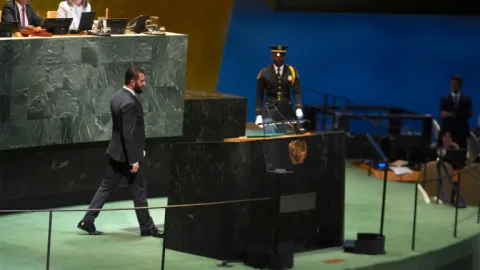
Syria’s return to the United Nations General Assembly (UNGA) after 58 years was a historical step forward for the country. For decades, it was associated with war, sanctions and isolation. Now, by raising its flag again at the U.N., Damascus wants to show on the world stage that it is reclaiming sovereignty and global legitimacy. This moment signals a turning point, not just for Syria’s internal politics but how the international community views its role in maintaining regional stability.
However, key challenges remain as Syria attempts to end isolation, improve ties with Arab and European partners, lobby Washington, and seek the removal of U.S. sanctions. Deeply entrenched problems, such as ethnic and sectarian division, economic collapse, and unresolved security issues with Israel still shape the country’s future.
Distinguished analysts and experts were consulted to evaluate the episode from a range of vantage points. The following presents their nuanced analyses and reflections.
Prepared by Sibel Düz, SETA
 Murat Aslan
SETA & Hasan Kalyoncu University
What does Syria’s return to the UNGA symbolize for the international community? How does this visit reshape Syria’s diplomatic posture vis-a-vis Western capitals, particularly Washington, after decades of sanctions and isolation?
People initiating and succeeding in a revolution usually reflect a complex reality, and Syria is no exception. After half a century of corruption, crime, and insecurity under the Assad regime and its allies, the Arab Spring brought change. Yet the cost was immense: loss of life, collapse of institutions, destruction of infrastructure, disruption of social balance, foreign interventions, and the rise of terrorist organizations. This process left the regime dependent on Russia and Iran, while isolated internationally. The greatest damage inflicted by Assad was the destruction of the state mechanism, making reconstruction of both the state and a self-sufficient system on solid foundations imperative.
Restructuring requires reinforcing social cohesion and addressing ethnic and sectarian sensitivities. Al-Sharaa’s approach toward the Druze, Nusayris, and PYD/YPG has been based on compromise. For instance, during Israeli-backed separatist actions in Suwayda, he withdrew security forces and engaged with community leaders. Politically, transition requires revitalizing political life, elections, and a new Constitution. However, challenges remain with Sheikh Hikmat al-Hijri and the PYD/YPG, who, backed by external actors, pursue autonomy fueled by drug or oil revenues rather than Syria’s integrity. Former Assad militias in coastal regions further complicate the picture.
Syria’s institutions will act against divisive forces, but strength depends on restoring services and building a viable economy. Millions of displaced Syrians are vital human resources, so solutions to welfare and security must accompany political transition. For this reason, al-Sharaa advocates a middle-ground strategy of appeasement.
A unified Syria demands inclusive governance that guarantees civil rights and ensures provision of state services. Alongside political reforms, economic, social, and legal measures are essential. Security must also be managed effectively against both internal and external threats, with even negotiations with Israel considered within that framework.
In parallel, creating a self-sufficient Syria is key to restoring normal life. External support in financial, political, and technical areas must be directed toward this goal. Over the past eight months, many countries, officials, and businesspeople have signed agreements with Syria. Yet fully lifting sanctions, currently only suspended, remains a prerequisite for responsibility, sharing and genuine recovery. Al-Sharaa’s participation in the U.N. General Assembly thus highlights integration into global markets as a top priority.
His visit to the U.S. for the Assembly, and his interview with David Petraeus, former director of CIA, mark a turning point. The message is clear: Syrians who fought for over a decade now want to live as a civilized nation. At the U.N., al-Sharaa seeks to confirm that the revolution’s heirs are now leading Syria. The Syrian flag raised at the Assembly symbolizes recognition of a unified state.
Talks with the U.S. secretary of state and other officials suggest momentum toward lifting sanctions and global economic integration. Yet figures like Marco Rubio, known for their unwavering support for Israel, are expected to push for normalization between Syria and Israel and demand concessions.
 Ömer Özkızılcık
Atlantic Council
President Trump lifted sanctions in May and met Sharaa in Riyadh, yet Congress has not repealed the 2019 Caesar Act sanctions. How does Damascus plan to navigate this tension between executive actions and legislative constraints in the U.S. system? Beyond the U.S., which Arab and European partners are most critical for Damascus’ reintegration?
When it comes to lifting sanctions, the U.S. legal and political system imposes certain constraints. The American president cannot unilaterally repeal legislation passed by the Senate. However, he does have the authority to issue waivers that suspend the application of sanctions for six-month periods, provided certain conditions are met. In practice, this means that President Trump could, if he chose to, renew such waivers every six months. Yet, in the specific context of the Caesar Act, this mechanism is not a sustainable solution for Syria. Washington has already removed all sanctions that the executive branch is legally empowered to lift. The Caesar Act, however, can only be altered through congressional action.
At present, there is meaningful activity within the Senate regarding this issue. Some lawmakers have recently taken steps toward easing or lifting sanctions on Syria. During visits to New York and Washington, Syrian representatives, most notably Asaad al-Shaibani, carried out significant lobbying aimed at securing the repeal of Caesar sanctions. The current debate centers on whether to insert a provision into the annual defense authorization bill that would roll back these measures. Preparations for such an amendment are already underway. Senators Jeanne Shaheen and Joe Wilson, among others, have expressed support.
Syria enjoys a relative advantage in this process through the role of Qutaiba Idlbi, who oversees Syrian affairs in Washington. Having lived in the U.S. capital for many years, he has cultivated long-standing ties with members of Congress on behalf of the Syrian diaspora. This allows Damascus quick and direct access to key lawmakers. The Syrian diaspora in the United States also plays a pivotal role, possessing substantial lobbying capacity and actively mobilizing to support the push for sanctions relief. By leveraging diaspora networks, long-standing personal relationships, direct congressional engagement, and signaling a more constructive posture on Israel, the Syrian government seeks to persuade U.S. lawmakers to reconsider the Caesar framework.
In the Arab world, Syria views Saudi Arabia as its most important ally, given Riyadh’s weight and influence within the Arab League. Yet the partner Damascus trusts most is Qatar. Alongside these two states, the United Arab Emirates (UAE) is also considered a valuable partner, while Syria is eager to deepen and improve its relations with Egypt. Jordan, likewise, occupies a critical place, both in terms of southern border security and as a key conduit for trade.
Within Europe, the United Kingdom has emerged as the most significant interlocutor. London’s engagement with Syrian figures such as al-Sharaa dates back to the period of Hay’at Tahrir al-Sham (HTS), providing a foundation for continued dialogue. France is also a central actor, both because of its historical mandate over Syria and its influence within the European Union. Italy, meanwhile, has taken on particular importance as it exerts pressure to facilitate the return of Syrian refugees, thereby strengthening ties with Damascus.
In summary, Syria’s primary Arab partners are Saudi Arabia, Qatar, the United Arab Emirates, Egypt, and Jordan. Among European countries, the U.K., France, and Italy occupy the most prominent positions in Damascus’s external strategy.
 Harun Türker Kara
SETA & Ankara Medipol University
Beyond sanctions relief, what concrete mechanisms is Damascus pursuing to attract FDI (foreign direct investment), given Syria’s track record of poor investor protections? How will Syria balance reconstruction needs? Is there a risk that reconstruction becomes another arena of foreign competition?
A key component of recent developments in Syria revolves around legislative reforms aimed at facilitating investment and business ecosystem. These legal changes pave the way for a series of measures ranging from intellectual property rights protection to the establishment of new institutional frameworks. As these reforms are implemented, Syria is expected to attract increasing levels of foreign direct investment, thereby enhancing the Syrian government's position in reintegrating into the international economic and legal system.
From a macroeconomic perspective, fiscal policy, particularly in the area of taxation, is under close scrutiny. While specific rules are yet to be finalized, authorities have signaled the introduction of a more investor-friendly tax regime. Additionally, regulatory reforms and steps in the financial sector are being pursued to accelerate the mobilization of capital through FDI.
One of the most significant developments in Syria’s financial markets has been the resumption of trading on the Damascus Securities Exchange. This step has been interpreted as a strong signal of the government's commitment to revitalizing capital markets and attracting future investments, including FDI. Complementing this step, the Central Bank of Syria signed a memorandum of understanding (MoU) aimed at introducing modern electronic payment systems into the domestic financial landscape. The MoU marks a critical milestone in Syria’s efforts to reintegrate into the global financial system. It includes key initiatives such as the development of digital payment infrastructure, the issuance of both local and international payment cards, and the eventual integration of Syrian financial institutions into global payment networks.
Furthermore, efforts to improve logistics and infrastructure are seen as critical steps toward creating an investment-conducive environment. The Syrian government has also moved swiftly to sign several international agreements, reflecting a proactive approach toward compliance with international arbitration mechanisms and regulatory standards. Declarations of intent in this area are of particular importance, as they underscore the government’s commitment to fostering a transparent and stable investment climate aligned with global norms.
Last but not the least, the measures taken on both the macroeconomic and financial fronts are expected to contribute significantly to Syria’s reconstruction process. Enhancing transparency in the investment agenda and increasing the frequency of international investor meetings are critical steps toward positioning Syria not as a superficial element of competition, but as a platform for cooperation in addressing humanitarian issues.
 Muhammed Hüseyin Mercan
SETA & Ankara Yıldırım Beyazıt University
How does Damascus envision a security arrangement with Israel? Does al-Sharaa believe Syrian sovereignty over the Golan Heights will return to the agenda?
Damascus’s top priority is to construct a stable and sustainable regime in Syrian territory. President al-Sharaa and his team are aware that they have no option but to sign a security agreement with Tel Aviv, as the Zionist administration is trying to destabilize Syria’s transitional process and mobilize minority groups to take a stance against Damascus. Considering the fragility of the country's political, social, and economic structure, the question of survival is the most critical issue for al-Sharaa. Therefore, he should follow a reasonable dialogue strategy toward Tel Aviv, rather than exacerbating the security risks in Syria.
It appears that both Damascus and Tel Aviv have reached a mutual understanding regarding the de-escalation of tensions, facilitated through the supervision and advice of the U.S. administration, despite some disputes and difficulties in the parties' shared vision for their security deal. The Zionist administration expects to benefit from the opportunities that have arisen in Syria’s transition to pursue its aggressive expansionist strategy. On the other hand, Damascus wants Tel Aviv to return to the status quo of 1974, to avoid any legitimacy problems within the Syrian society. As the recognition of Israeli sovereignty over the recently occupied areas in Syrian territory will cause a deep crisis in domestic politics, Damascus is seeking a way to envision a security deal with Tel Aviv that the Syrian people will welcome. In this regard, the most crucial issue for the agreement is about the status of the Golan Heights.
The Golan can be regarded as the red line for the Zionist administration’s security agreement conditions. Expectations that Tel Aviv will withdraw from the occupied part of the Golan are not realistic. Damascus should take its steps toward a security deal with Tel Aviv, considering this reality. Besides this, Damascus should definitely demand guarantees that Israel will stop its illegal and unlawful actions in Syrian territory, including encouraging the Druze and PYD/YPG. Otherwise, the conflict will deepen in the region, and the Zionist administration will use all arguments to destabilize Syria and to deligitimize al-Sharaa’s presidency and his efforts for a peaceful transition.
 Can Acun
SETA
With internal violence erupting in Suwayda earlier this year, how will the government manage Druze, Kurdish, and tribal grievances while claiming to unify the nation? What institutional reforms are being pursued to distance Syria from its authoritarian past?
The long-standing autocratic minority regime of the Assad era ended after a 13-year civil war and revolutionary process. The opposition, once an organization, has now transformed into a state, but it faces immense challenges and the burdens of the past. Among them, ethnic and sectarian fault lines are particularly difficult to manage. The Syrian branch of the PKK terrorist organization, the PYD/YPG, and the separatist agendas of the Druze community have begun to surface. At the same time, Syria’s history of foreign interference persists. Israel’s disruptive role, especially through direct military interventions, poses a major obstacle to stability. It openly opposes a strong Syrian central government, instead seeking a fragmented and weakened Syria by provoking Druze and Kurdish groups.
Under President al-Sharaa, the central government is attempting to address political, military, and economic challenges while carefully managing ethnic and sectarian divisions. On March 10, an eight-point agreement was signed with the PYD/YPG, outlining a road map for the integration of northeastern regions and military structures under government control. Though implementation has yet to begin, Damascus has shown flexibility by allowing local governance models in Kurdish-majority areas while ensuring equal constitutional rights and responsibilities for the Kurds.
Meanwhile, tensions with the Druze in Suwayda have escalated into serious clashes. Israel has intervened directly, including launching airstrikes in support of Druze factions. Yet, the Druze themselves remain divided: one faction aligns with Damascus, while another, backed by Israel, pursues independence, threatening Syria’s territorial integrity. In response, the Syrian government has engaged the United States and Jordan to contain Israeli influence. Most recently, on Sept. 16, a “Joint Roadmap Agreement for the Restoration of Order in Suwayda Province” was signed. It provides for investigations into attacks on civilians, compensation for victims, and a domestic reconciliation process aimed at restoring order and reintegrating the province with Damascus.
Despite these challenges, Syria is navigating a transitional period that requires time and patience. Alongside security concerns, institutional reforms and the creation of a new constitutional order are priorities for managing ethnic and religious divisions. Important steps have already been taken. On Feb. 25, a National Dialogue Conference in Damascus brought together diverse religious and ethnic communities. Its final declaration laid out a framework for the transitional period, including a provisional constitutional document, the formation of a representative parliament, a commission to draft a permanent Constitution, and the disbandment of all non-state armed groups.
On March 13, President al-Sharaa signed a 53-article declaration, accepted as the provisional Constitution, formally launching the drafting of a permanent one. Both the government and the constitutional commission were structured to reflect Syria’s demographic and sectarian diversity.
Ultimately, Syria remains in transition. The success of its revolution depends not only on overcoming external pressures and divisive agendas, but also on building inclusive institutions capable of guaranteeing unity, stability, and legitimacy.