
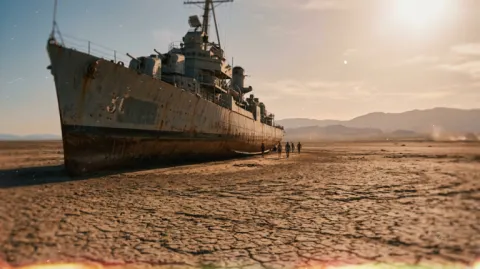
Europe is sweltering this summer under one of the most severe heatwaves on record. France has recorded its hottest day since measurements began, red alerts cover most of the country, and Britain broke its June temperature record three days running. The World Health Organization reports more than 1,300 excess deaths across the continent since 21 June, with transport disrupted and hospitals overwhelmed. At first glance this reads like ordinary summer news, a passing seasonal spell. Yet science has established that this same continent is warming twice as fast as the global average. What tends to get overlooked is this. These temperatures are not a civilian nuisance but the very operational environment in which the armies meant to defend that continent will have to move. What is at stake, far beyond comfort, is security.
For a long time, NATO circles treated climate change as a soft item on the margins of the real defence agenda, a matter of environmental sensibility. The reality on the ground has long since rendered that distinction meaningless. Climate change erodes defence capability itself. Extreme heat limits the endurance of personnel and constrains training, rising seas and intensifying storms threaten coastal bases, ports, radar and communications, and the melting Arctic opens a theatre once thought unreachable to great-power competition. Heat wears down machines as much as people, as engine efficiency drops, electronics lose reliability, and fuel and munitions demand more delicate storage. Wildfires force training grounds to evacuate, while operational demand for water and energy multiplies. The issue reaches beyond infrastructure, since military mobility, supply lines and deterrence itself are all directly affected. By NATO’s own assessment, the alliance carries out many of its missions and operations in regions exposed to extreme weather. To treat climate as a heading separate from defence is to ignore the very ground on which defence must function.
Yet the link between climate and security does not stop at heat and infrastructure. Its most unsettling effect is as a force that magnifies existing threats, what the security literature calls the threat multiplier. Rather than producing terrorism or conflict directly, climate change enlarges, accelerates and spreads what already exists. When drought collapses livelihoods, floods displace communities, and food and water insecurity deepen, an already fragile social fabric cracks further, and those cracks become fertile ground for terrorist organizations and criminal networks. Central America’s Northern Triangle (El Salvador, Guatemala and Honduras) is one place where this effect is visible to the naked eye. Gang violence, poverty and displacement are already entrenched there, and climate layers onto that picture as a multiplier. The devastation disasters inflict on livelihoods can push young people toward gangs, keep the displaced from returning, and deepen the risk that relief aid falls to the control and extortion of armed groups. The same logic runs far sharper in the Horn of Africa. Somalia, for decades among the regions hardest hit by climate change, swings between torrential rains and severe drought, and the al-Qaeda-linked terrorist group al-Shabaab both feeds on that instability and feeds it. In droughts the group sets up local drought committees and repairs irrigation canals, filling the vacuum left by the state, while it also blocks aid convoys, burns relief deliveries and targets aid workers. Identified by the United Nations as the principal author of the calamity that engulfed the region, it has gone so far as to deliberately poison water sources in retaliation against communities recovered from its control. By a projection from the United Nations’ climate adviser for Somalia, by 2080, perhaps as early as 2060, much of the country could become too hot to sustain human life. Nor is this confined to local networks, as climate-driven displacement triggers mass migration that pushes pressure beyond borders and exports instability. In the Sahel, shrinking pastures set herders against farmers, and competition over land and water prepares the ground for armed groups, another link in the same chain. Neighbouring Senegal shows a similar picture, where prolonged droughts, heatwaves, bushfires and rising seas strain agriculture, fishing and livelihoods, deepening the root causes of radicalization. This dynamic is not confined to one geography. The Middle East, North Africa and the Sahel that make up NATO’s southern neighbourhood face the same picture on a far larger scale. The alliance itself describes this zone as a single belt in which terrorism, irregular migration and instability intertwine. Climate invents no new threat here. It makes every existing one worse.
The most striking part is that NATO already knows this. It adopted a Climate Change and Security Action Plan in 2021, its 2022 Strategic Concept called climate change a defining challenge of our time, and the assessment published that year branded it an overarching challenge of our time and called for a fundamental transformation in how defence is conceived. The real problem is that this awareness has stalled at the level of words, never turning into funding, budgets and concrete capability. According to a recent study, there is a serious gap among the thirty-two members in folding climate risk into defence planning. With the exception of two members, almost all allies address climate in their national security documents, yet a significant share fail to translate that awareness into concrete adaptation. This raises the risk of a two-tier NATO, in which only some members can operate under climate-affected conditions while the rest fall behind. This is more than a technical mismatch, as it fuels disputes over burden-sharing, erodes interoperability, and eats away from within at the cohesion that is the alliance’s true deterrent strength. For this reason climate has ceased to be a peripheral environmental heading and now touches the very heart of the alliance.
The contradiction sharpens at the moment the alliance is trying to deliver on its pledge to reach 5% of GDP in defence spending. How that 5% is divided reveals the heart of the matter. At least 3.5% goes to core defence such as troops, weapons and combat power, while the remaining 1.5% is set aside for broader security, such as protecting critical infrastructure, civil preparedness and resilience. Climate adaptation falls squarely within that second category. Resilient bases, energy and water security, disaster preparedness and managing climate-driven migration are natural parts of the 1.5% resilience share allies have already agreed to. Folding climate into that share means using an already committed resource with climate in mind, without weakening core defence. An alliance that fails to seize so clear an opportunity neglects the foundation on which it builds its security.
There is no reason to think NATO cannot manage this shift. It has survived since its founding because it reinvents itself as the threat map changes. A line of transformation runs from the Cold War’s conventional front to counterterrorism after 9/11, and on to cyber and hybrid warfare. Each time, a new threat was first deemed to lie outside real defence, only to settle at the centre of doctrine. Climate change stands at exactly that threshold, and it must move without delay from an environmental footnote to an ordinary part of planning, exercises, procurement and budgets. This is nothing foreign to the alliance. It is a repeat of what it does best, adapting to a changing threat.
Seen this way, the days ahead matter. NATO leaders gather in Ankara on 7-8 July, and the agenda is already largely set. Raising defence spending, expanding defence-industrial production, sustaining support for Ukraine and managing tensions in the Middle East are among the headline items. All matter, and they reflect the alliance’s current priorities. Even so, one cannot help asking a question. At this table, convened as the continent is scorched by record heat and defence budgets climb to historic highs, will anyone address the force that is melting the ground on which that budget is meant to stand? For now the answer appears to be no. Had it been on the table, the summit might have become one that genuinely looks to the future.
For a defence that takes climate into account is nothing less than a way of making defence itself more solid. Hardening base infrastructure, building the capacity to operate in the Arctic, reducing the military’s dependence on energy and anticipating climate-driven instability on the southern flank earlier are all direct investments in deterrence. Every resource devoted here buys a readier, more resilient and more united alliance. There is a cost, but the far heavier cost is looking away. A defence budget that leaves climate out of the equation is, in the end, like pouring concrete onto melting ground, for however great the labour and money spent, the structure on top cannot stand once the ground beneath gives way. NATO has other, more urgent items on its list. Sooner or later, though, it will face this question. Will it secure that ground deliberately and in time, or only through an awakening that comes too late?