
In a global conjuncture where the impact of geopolitical risks on energy markets continues to intensify, Türkiye is repositioning its national oil company within the landscape of global energy competition. The National Energy and Mining Policy, announced in 2017, established the discovery and economic integration of domestic oil and natural gas potential as a primary objective to reduce external dependency in hydrocarbons. Today, Ankara is poised to take this ambition further through cross-border strategic maneuvers. While gas discoveries in the Black Sea and oil finds in the Gabar region demonstrate this domestic resolve, they also elevate the Turkish Petroleum Corporation (TPAO) as a visible and experienced partner in the international arena.
In Türkiye’s energy discourse, energy security is often debated through the lens of import contracts and pricing, assuming that managing dependency is merely a matter of financial indicators and trade balances. However, true energy security encompasses not only the procurement of resources but also the diversification of access channels to those resources. Therefore, TPAO’s recent agreements with foreign entities must be evaluated from this broader perspective—one that transcends simple supply dynamics.
TPAO has been operational in over 10 projects across Azerbaijan, Iraq, and Russia for many years, spanning the value chain from exploration and production (E&P) to hydrocarbon transmission. Recently, various fields from a wide range of regions were added to this portfolio. The 2024 agreement signed with Somalia for hydrocarbon exploration and production in maritime jurisdictions was of strategic significance, marking TPAO’s inaugural footprint in Africa. Following seismic surveys completed late last year by the Barbaros Hayrettin Paşa and MTA Oruç Reis, significant discoveries are anticipated as the newly commissioned deep-sea drilling vessel Çağrı Bey continues operations. This momentum is expected to accelerate with the April 2025 agreement extending cooperation to onshore areas. This partnership serves as a concrete manifestation of Türkiye’s "win-win" policy in Africa, which distinguishes itself from traditional colonial approaches. Consequently, with additional Memorandum of Understanding (MoUs) signed in 2025 with Angola, Gabon, and the Gambia, the number of African nations partnering with Türkiye in the energy sector has approached 20.
April 2025 marked another milestone for the Turkish oil and gas industry. An agreement between the Hungary-based MOL Plc. and TPAO paved the way for TPAO’s first-ever upstream activities in Europe, specifically in Hungary’s Buzsák and Tamási fields. Furthermore, this collaboration strengthens TPAO’s profile as an international partner by positioning it alongside European companies with high institutional and technical capacities.
In addition to these milestones, 2025 witnessed further developments that expanded TPAO’s upstream footprint through diversified international collaborations. In March, a partnership was forged with U.S. producers TransAtlantic Petroleum and Continental Resources for the development of shale gas and oil reserves in Diyarbakır, prioritizing technology and know-how transfer. As the U.S. remains the world’s leading shale producer, this cooperation has the potential to open a new chapter in Türkiye's hydrocarbon industry. Following this, in June, TPAO expanded its Caspian operations by signing a partnership agreement with SOCAR and bp for offshore production in Azerbaijan. Finally, in October, the company took steps to diversify its upstream portfolio across a broader geography by joining consortiums for production in Pakistan’s offshore blocks.
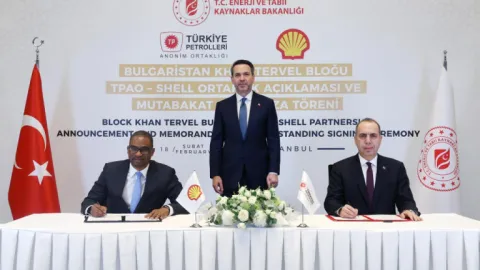
The momentum of these strategic developments has carried into early 2026. On January 8, an MoU was signed with ESSO Exploration International Limited (an ExxonMobil subsidiary) covering new exploration areas in the Black Sea and Mediterranean. This cooperation is expected to bolster TPAO’s technical capacity and know-how, particularly regarding production increases in the Sakarya Gas Field—which reached production in record time—and the realization of new discoveries. Subsequent MoUs were signed with Chevron on February 5 for joint overseas E&P, and with bp on February 12 for cooperation in Iraq (specifically Kirkuk) and other potential regions. Most recently, on February 18, a partnership agreement was reached with Shell for exploration in Bulgaria’s offshore fields.
Through these concerted efforts, TPAO has rapidly established a robust, exploration-and-production-oriented cooperation network spanning diverse geographies. Türkiye’s targeted outcome is not merely increasing the probability of new discoveries; it is the creation of a business model that shifts the energy security paradigm from "supply-centric" to "access-centric," positioning the national oil company as a more effective player in global competition. In this framework, international partnerships offer two strategic advantages: first, the mitigation of risk and investment burdens in high-cost, high-uncertainty E&P activities; and second, the acquisition of operational speed and standardized process management through collaborative projects with majors.
Ultimately, while domestic production targets support national supply security, TPAO’s institutional capacity and project execution capabilities are fortified through these overseas operations. This approach aims to support Türkiye’s goal of becoming a regional energy hub—not only through infrastructure investment and market design but also by generating diversity and flexibility on the resource side. The integration of expertise gained from successful Black Sea operations into neighboring maritime jurisdictions and international alliances stands as a key dynamic, transforming TPAO into an increasingly assertive actor in the offshore arena.