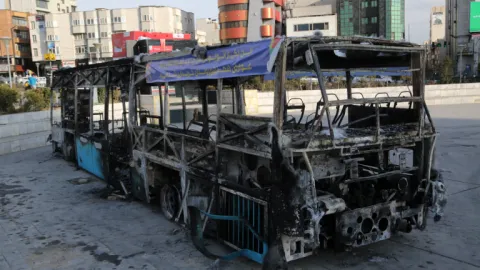
The protests that began on 28 December 2025 as a reaction to the worsening economic conditions in Iran gradually expanded, spreading beyond Tehran to other cities, most notably Isfahan, Mashhad, Kermanshah, Lorestan, Fars, and Karaj. The protests initially started when shopkeepers in Tehran closed their businesses and, in the following stages, expanded to broader segments of society with the participation of students from Beheshti University and Tehran University.
Although the Iranian authorities initially stated that they were willing to listen to the protesters’ demands, they adopted increasingly harsh measures as the protests deviated from their original purpose, turned violent, and raised concerns about possible U.S. and Israeli interference.
The rapidly spreading demonstrations and the escalating violence came to dominate Iran’s political agenda entirely. As violent incidents began to define the protests, security measures were further intensified. Since 8 January, internet access has been completely shut down, and even Starlink satellite connections have reportedly been blocked. Amid rising tensions and heavy-handed security responses, many international organizations have stated that the death toll has exceeded 2,000.
With the aim of providing a comprehensive perspective, we have examined this issue from multiple angles with distinguished experts in the field.
Prepared by: İsmet Horasanlı
Experts:
Serhan Afacan, İRAM
Mustafa Caner, SETA
Dania Koleilat Khatib, Research Center for Cooperation and Peace Building
İsmail Numan Telci, Sakarya Üniversitesi
Giorgio Cafiero, Gulf State Analytics
Gökhan Çınkara, Necmettin Erbakan Üniversitesi
Bilgehan Alagöz, Marmara Üniversitesi
Kadir Temiz, ORSAM
Gökhan Ereli, Uluslararası İlişkiler Uzmanı
 Serhan Afacan
İRAM
What factors have driven the protests in Iran, and how has the Iranian state and government responded to them?
The developments in Iran are driven by a combination of short-term triggers and long-term structural causes. In the short term, the country’s deteriorating economic conditions –most notably the sharp rise in the exchange rate and its effects– served as the immediate catalyst. The protests that began in Tehran on December 28, 2025 and quickly spread across the country were initially led by shopkeepers and small business owners who were directly affected by currency volatility and rising costs.
The long-term causes, however, are far more deeply rooted. Years of comprehensive sanctions –above all the unilateral sanctions imposed by the United States– have severely constrained Iran’s economic capacity. These external pressures have been compounded by persistent weaknesses in economic governance and policy implementation. Iran’s national income has been declining for years, and the ambitious targets set out in the Seventh Development Plan announced in 2023 –including an average annual growth rate of 8 percent, reducing inflation below 10 percent within five years, and achieving a 3.5 percent increase in employment– are widely regarded as unrealistic under current conditions. In this context, addressing Iran’s broader economic trajectory, particularly the worsening living standards of low-income groups, appears unattainable within existing policy frameworks.
Beyond economics, Iran has experienced prolonged periods of political unrest. Regardless of their initial triggers, repeated waves of protest have increasingly contributed to heightened tensions on the streets. A central structural problem lies in the political system’s limited capacity to channel societal demands through legitimate and institutionalized mechanisms. Although this issue has deep historical roots, it became especially pronounced after the 2009 Green Movement. In the years since, numerous officials –including former presidents– have publicly acknowledged this deficit and repeatedly emphasized the need to restore public trust and expand political participation.
In response to the current protests, Iranian authorities initially adopted a relatively conciliatory posture. From the outset, senior officials –most notably President Masoud Pezeshkian–recognized the legitimacy of public grievances and sought to ease tensions through symbolic and practical measures, including the replacement of the Central Bank governor and the announcement of a short-term subsidy package. In this early phase, Supreme Leader Ali Khamenei’s position broadly aligned with this approach.
The turning point came with Khamenei’s speech at the Qassem Soleimani memorial on January 3, in which he drew a clear distinction between “protesters” (mu‘teriz) and “troublemakers” (i‘tishashgar). While calling for dialogue with the former, he dismissed engagement with the latter as futile. Following the sharp escalation of protests on January 8, the state’s approach hardened considerably: internet access was shut down nationwide, and security forces resorted to far more coercive measures.
During this period, Israel and, in particular, U.S. President Donald Trump adopted an overtly inflammatory tone in their public messaging. Once Iranian authorities reframed the protests not merely as a domestic issue but as a national security threat, both street violence and the intensity of the security response escalated sharply.
 Mustafa Caner
SETA
Where Might the Protests Evolve, and What Are the Possible Scenarios?
After reaching their most intense and violent phase on 8 January, the scale, intensity, and geographical spread of the protests began to decline. The nationwide internet shutdown made the flow of reliable information virtually impossible, preventing a clear assessment of the protests’ overall impact and an accurate analysis of developments on the ground. However, there is broad consensus that the death toll has reached into the thousands. Iranian official sources have stated that this figure includes a significant number of security personnel as well as civilians who were not directly involved in the protests.
Following such heavy losses, life and politics in Iran are likely to unfold very differently from the pre-protest period. Efforts will be made to restore the eroded trust between the state and society. Although the protests do not, by themselves, possess the capacity to overthrow the Iranian system, they will inevitably have a transformative impact, compelling the authorities to adopt urgent measures. The process of reassessment will also shape power struggles among different factions within the political system, with actors repositioning themselves accordingly.
The most critical point to consider, however, is that these protests cannot be interpreted solely within the framework of Iran’s internal dynamics. The growing possibility of U.S. and Israeli intervention may pave the way for a new conflict dynamic with Iran at its center. The protests have already become a determining factor in Iran-U.S. relations, with President Trump shaping his rhetoric accordingly. Moreover, international pressure on Iran continues to increase. Thus, while the protests may not lead directly to systemic change, their external dimension raises the risk of deepening instability, chaos, and a governance crisis. This, in turn, fuels regional instability and draws the attention of neighboring states more intensely toward Iran.
In particular, the judicial proceedings that are likely to begin once the situation calms down, the broadcast of confession videos on state television, the way the public processes these developments, and the framing adopted by international media will all influence the scale of the next wave of protests and the level of international pressure exerted on Iran.
 Dania Koleilat Khatib
Research Center for Cooperation and Peace Building
How would the region be affected by the possible outcomes of the protests in Iran?
A number of scenarios may be outlined, including the possibility of regime collapse. If the regime collapses: US/Israel conduct a war on Iran which will make the regime collapse. This scenario is looking less likely however a collapse of the regime will result in chaos on two levels.
The first level: In the absence of a viable credible opposition in-fighting will emerge. The disintegration of the security apparatus will result in several groups fighting among each other for power and looking for patrons. They will probably become guns for hire ready to create disturbance in neighboring countries.
The second level: If Israel succeeds in toppling down the regime they will be encouraged to become more active and increase its destabilizing activities in Türkiye and Saudi Arabia
If the regime survives: If regional countries namely Türkiye, Saudi Arabia, Egypt, Pakistan oppose the American strike and work against it, they can stimulate a change from within the system. This can change the attitude of the Islamic republic of Iran towards its neighbors from nuisance to cooperation. Iran can change from a threat to regional security to an asset.
However, if regional countries collude with the US and support the strike, the regime's sense of insecurity towards neighboring countries will likely increase. As a result, the surviving regime will likely increase its destabilizing activities and work on rebuilding its network of proxies.
 İsmail Numan Telci
Sakarya Üniversitesi
How does Turkey interpret the protests, and what risks does instability in Iran pose from Turkey’s perspective?
Türkiye maintains a position that, while not denying the existence of social and economic problems in Iran, emphasizes that the solution to these problems must come from within Iranian society's own internal dynamics and national will. The fundamental principle for Türkiye is that external intervention in the internal developments of a neighboring country would plunge both Iran and the region into deeper crises. For this reason, Türkiye is clearly distancing itself from scenarios of chaos, regime collapse, or prolonged political/economic instability that could result from the protests in Iran.
Another sensitivity in Türkiye's official discourse is the possibility of intervention and provocation by external actors, particularly those originating from Israel/the US. While Türkiye acknowledges that the protests in Iran are rooted in real socio-economic causes, it warns that these accumulated social reactions could be instrumentalized by Iran's regional rivals. Therefore, Türkiye is making policy choices taking into account not only its own interests but also the stability of the region as a whole.
Türkiye is holding talks with Iranian, American, and other regional counterparts to resolve the crisis and is positioning itself as an active mediator. In this context, it should be noted that Türkiye emphasizes negotiation and diplomatic solutions to the relevant protests and pursues a policy of keeping channels of dialogue open between the parties. Türkiye is therefore pursuing a policy that does not take sides, prioritizes regional stability, and encourages diplomatic solutions.
 Giorgio Cafiero
Gulf State Analytics
Which instruments and objectives stand out in the Trump administration’s Iran policy?
The Trump administration views Iran’s internal unrest as an opportunity to further destabilize the Islamic Republic of Iran after Tehran’s significant regional setbacks in 2024. The regime is grappling with a deepening legitimacy crisis, driven by worsening economic and environmental problems that have pushed many Iranians into the streets to voice their grievances and demands for fundamental political change. The Iranian government’s vulnerabilities are not lost on Washington, which appears intent on exploiting them to America’s advantage. While the administration continues to weigh its options, including military ones, it remains unclear whether regime change in Tehran is Trump’s ultimate objective. What is clear, however, is the administration’s determination to see the Islamic Republic further weakened by domestic turmoil. As a presidential candidate in 2024, Trump pledged to secure a “better” nuclear deal than the 2015 Joint Comprehensive Plan of Action, which his administration effectively sabotaged during his first term. In pursuit of such an agreement, Trump may opt for limited military strikes designed to try to convince Iran’s leadership that the costs of refusing negotiations outweigh those of returning to the table—even on terms that Tehran would find deeply humiliating (i.e. zero enrichment). At this stage, however, any assessment of the Trump administration’s likely course of action remains somewhat speculative. Unpredictable developments inside Iran could rapidly reshape conditions on the ground and, in turn, alter the White House’s strategic calculations.
 Gökhan Çınkara
Necmettin Erbakan Üniversitesi
What is Israel’s role in the protests, and what are its objectives?
It is a fact that Israel closely monitors the protests in Iran. This is because the political elite in Israel, who are most eager for potential political change in Iran, are currently in power. During the 12-Day War, there were expectations in Israel that change might occur in Iran, but this did not happen. The rhetoric of Israeli officials emerged as one of the key factors preventing such a development. Now, the main actors are seen as Iranians dissatisfied with the country's economic situation. However, Israelis can develop certain collaborations with local actors through their field dominance in Iran. Whether this becomes visible or not, it may further reinforce the accusations by Iranian power holders that activists are extensions of Israel and the US. For this reason, the ruling elites are currently paying close attention to statements and actions in Israel. On the other hand, Israel's psychological operations are drawing attention on social media, in think tanks, and most importantly, in new AI-centered videos. Prince Reza Pahlavi, who is prominent in perspectives on Iran's future, has also established close ties with Israel in recent years, particularly developing an understanding with Netanyahu and his circle. These factors can be interpreted as significant developments indicating Israel's direct involvement in the Iran file.
Israel's fundamental strategic goal is to enable the emergence of new political systems that are compatible with itself. Relations with Somaliland can be cited as an example of this trend. Iran, on the other hand, is viewed by Israeli officials as an extension of the hegemony which Israel has been trying to establish in the region since October 7. This leads to new blocks forming, as it will narrow the maneuvering space of countries in the region. The rapprochement between Saudi Arabia and Turkey can be cited as an example of this. It can be said that protests in Iran will be addressed by the system from a security perspective, while the US and Israel will provide technical and logistical support to ensure the process expands.
 Bilgehan Alagöz
Marmara Üniversitesi
How is the U.S. approach to the protests in Iran taking shape?
The protests in Iran have become a hot topic of debate in the US foreign policy. The Trump administration has not completely ruled out military intervention in its policy toward Iran; however, compared to June 2025, the US military capacity is now significantly limited. The troops and ships deployed to the Middle East last year on Trump's orders have largely been shifted to the Caribbean (particularly as part of operations in Venezuela). Similarly, the Patriot missile defense system sent to the region has been returned to South Korea. These developments have significantly reduced the U.S.'s effective power in potential military operations against Iran. Officials emphasize that no large-scale military movements are planned at this time. Furthermore, the US's recent intensive military operations in the Red Sea, Iran, and Venezuela have rapidly depleted its weapons stockpiles. This situation poses the risk that there may not be sufficient capacity to protect the approximately 10,000 U.S. troops stationed at Al-Udeid Air Base in Qatar and in Iraq, Syria, and Jordan against Iranian rocket and missile attacks, particularly if a serious Iran crisis erupts.
On the other hand, the Trump administration is resolutely pursuing its policy of “maximum pressure” against Iran. A key reason for this approach is the effort to maintain a certain balance in relations with Israel. During the Trump-Netanyahu meeting in the US in December 2025, Netanyahu expressed his discomfort with the US taking a closer stance toward Turkey in light of recent developments in Syria. Therefore, the US's tough stance on Iran also serves as a balancing factor for Netanyahu. The policy generally aims to corner Iran through economic sanctions, political isolation, and diplomatic pressure. In this context, the US may bring back to the table a precision air strikes against Iran's nuclear and ballistic missile programs in the coming days. Additionally, operations directly targeting Supreme Leader Khamenei and his inner circle remain on the table, albeit with low probability.
It should also be emphasized that Trump's Middle East vision attaches special importance to three countries: Saudi Arabia, Qatar, and Turkey. These three countries also point to the severe negative effects that a possible military intervention against Iran would have on the region's economy, energy security, and overall stability. Considering its close relations with these countries, it seems possible that the US may delay or limit any military intervention.
 Kadir Temiz
ORSAM
From what perspective do Russia and China approach the protests in Iran?
Russia and China view the protests in Iran not primarily through the lens of social demands or regime-public relations, but rather from the perspective of sovereignty, state capacity, and global power balances.
From China's perspective, the protests are defined as “Iran's internal affairs.” China consciously avoids commenting on the causes or legitimacy of the demonstrations; instead, it emphasizes stability, order, and the preservation of state authority. Iran is strategically important to China in terms of energy security and the Belt and Road Initiative. Therefore, China prefers stability over regime change. Furthermore, following the US intervention in Venezuela, Iran remains one of two countries from which China has access to cheap oil through non-dollar trade. From this perspective, Iran's stability is also important for China in terms of global economic competition.
Russia's approach, however, is harsher and carries a more geopolitical tone. Moscow often interprets the protests in Iran as part of US foreign intervention and views this process as a continuation of the global polarization that emerged after the war in Ukraine. According to Russia, mass protests are one of the tools used by the West to weaken regimes it dislikes. Therefore, Russia is firmly opposed to the internationalization of the protests and, in particular, to them becoming a basis for pressure or intervention led by the US.
Although they use different tones, Russia and China converge on one point: both actors oppose external intervention in Iran, regime change scenarios, and military options. The protests in Iran are more than just an internal political issue; they are a testing ground for sovereignty and power balances in the international system.
 Gökhan Ereli
Uluslararası İlişkiler Uzmanı
How do Arab countries approach developments in Iran, and which parameters shape these approaches?
Although it is difficult to identify the points on which Arab states are in complete agreement regarding their policies toward Iran, recent developments, particularly the geopolitical tension between Israel and Iran, have demonstrated that Iran is an actor that should not be excluded from the Middle Eastern state system. In fact, Arab states' policies have been shaped not only in response to the protests in Iran, but also in international issues with political/economic dimensions that concern Iran (US-Iran relations, Israeli aggression, the Iranian nuclear issue, the missile program, the Iranian economy, etc.), with the aim of not excluding Iran from the system -without knowing the outcome- from the system.
Regarding the protests, it is evident that Arab states have consciously refrained from making statements that either fully support or condemn the protests, unlike Western countries. The official discourse suggests that developments in Iran are viewed as internal matters of a sovereign state.
Secondly, the concern that a sudden regime collapse in Iran, either in the context of protests or following an unexpected and sudden Israeli-US-Western intervention, could create uncontrolled chaos and expansionist instability is a parameter that determines the policy of Arab states. Therefore, it can be seen that Arab states are currently viewing the issue in terms of “regional stability.”
A third point is that Iran's Gulf neighbors, in particular, appear extremely reluctant to see the protests in Iran used as a pretext for external military intervention. The atmosphere of anxiety created in the Gulf by the 12-day war in June is still fresh. Therefore, the message the Gulf is sending to Washington is clear. The Gulf does not want military escalation and believes that the effects of possible escalation on energy markets and regional security would be extremely negative.
Fourth, it relates to the political economy of the crisis and protest environment. Neither the Gulf states nor the Arab states possess the political/economic power to counter the equation that a potential deepening crisis would pose a direct threat in terms of price fluctuations and trade routes for products such as oil and natural gas.
Fifthly, Arab governments are aware that taking strong normative positions on the protests in Iran could trigger similar demands in their own societies. Therefore, it is possible to say that Arab states have pursued an extremely cautious policy up to this point.