
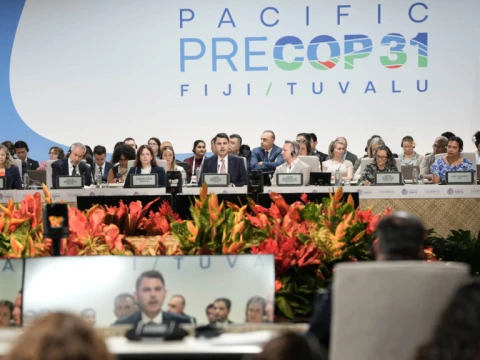
The Pre-COP is the formal preparatory meeting at which ministers and negotiators discuss contentious issues with the COP presidency. This year’s meeting was held on 5-8 October in Fiji and Tuvalu, co-hosted by Fiji, Tuvalu and Australia. Officials from around 50 countries met at ministerial level in Fiji after the leaders’ event in Tuvalu. COP31 President Murat Kurum also presented the priority headings of the COP31 Antalya Action Agenda in Fiji.
Two developments at the meeting bear directly on Türkiye’s two proposals. First, it was announced that COP31 will conclude with a cover decision prepared by the presidency. The instrument through which the 35x35 target, which began as a voluntary commitment under the Action Agenda, can enter a text adopted by the Parties thus became clear before the summit. Second, Pacific countries set out the problem of access to climate finance with concrete examples. These examples also define the need that the Climate Implementation Bridge (BRIDGE) has to answer. This Focus assesses the two proposals in light of these developments and proposes three steps for Antalya.
Two Outcomes from Fiji
COP31 President of Negotiations Chris Bowen announced at the close of the ministerial meeting on 7 October that Australia and Türkiye had agreed on a decision to be prepared under the presidency’s lead. Cover decisions are not negotiated word by word. They are usually summaries drafted by the presidency during the summit, but they still have to be adopted by consensus. Bowen said they did not want to negotiate a long political declaration, and that the decision could also reflect two findings of the latest UN report. The report now regards an overshoot of the 1.5°C limit as unavoidable, but states that temperatures could be brought back to that level by the end of the century if climate action is accelerated. Last year in Belém, the Brazilian presidency did not say whether it would prepare a cover decision until the second week of the summit. This year the same question was answered a month before the summit, which gives the presidency a longer period to work on the text.
On the finance side, a large part of the problem the Pacific raised concerns access. According to a figure given by Fiji’s Ministry of Environment and Climate Change, only three institutions across 14 Pacific island countries are accredited to receive funding from the Green Climate Fund. With the roughly 15 million dollars that Fiji, Ireland, the Netherlands and Denmark announced at the Pre-COP for the region’s own fund, the Pacific Resilience Facility, total pledges approached 200 million dollars. The facility’s target is 500 million dollars by the end of COP31, however, and its long-term target is 1.5 billion dollars. On 8 October Australia also launched a finance access plan for small island states and the poorest countries that prioritises grants and highly concessional finance and envisages an annual high-level forum to track access. Minister Kurum, for his part, said at the leaders’ plenary that the 1.5°C target has become a matter of survival for countries such as Tuvalu. He repeated the call for contributions to the facility and stated that resources must reach those in need without getting caught in bureaucracy.
35x35: From the Action Agenda to the Decision Text
Minister Kurum announced Türkiye’s first proposal, the 35x35 target, in Bonn in June as one of the Action Agenda’s six targets for 2035, and the proposed text of the related Global Electrification Pledge was released in September on the margins of the UN General Assembly. The joint letter that Minister Kurum and Bowen sent to the Parties before the Pre-COP defines the target as raising electricity’s share of global final energy consumption to 35 percent by 2035. The letter describes electrification as complementary to the targets of tripling renewable capacity and doubling the rate of energy efficiency improvement by 2030. Australia also announced in Fiji that it will join the target.
What the cover decision means for 35x35 follows from the difference between the Action Agenda and the negotiating track. Action Agenda initiatives are voluntary and are not negotiated by the Parties. The cover decision is the most direct route by which a presidency initiative can acquire language adopted by the Parties. This is because a voluntary commitment remains a presidency initiative, whereas wording in a decision text can be referred to by the Parties at later sessions. The two targets that the joint letter names as complementary to 35x35 have already followed this route. Endorsed by G20 leaders in September 2023, these two targets became a voluntary pledge at COP28 on 2 December with the support of 118 countries and entered the Global Stocktake decision adopted at the same summit. Paragraph 28(a) of decision 1/CMA.5 calls on the Parties to contribute to these two targets in a nationally determined manner. Knowing a month before the summit that there will be a cover decision also makes it possible to prepare similar language for 35x35 before Antalya.
The wording with which the target enters the decision text will also be decisive. The question that stands out in the international debate is which sources will meet the growing demand for electricity. According to Climate Home News, some major fossil fuel producing countries have made it harder to build on the COP28 decision in recent years, and the draft pledge released in September does not require the electricity to come from clean sources. The EU’s climate commissioner welcomed the organisers’ clarity on electrification from the outset, but added that the effort should be directed mainly at renewable energy. This leaves the presidency with three options. Writing a clean source requirement into the text explicitly carries a consensus cost. Leaving it out altogether weakens the climate rationale of the initiative and leaves the question unanswered. The third option is to cite 35x35 together with the two targets in paragraph 28(a). Such wording does not bind the source of the electricity, but it places the target within the renewable energy and efficiency framework the Parties have already accepted. Minister Kurum also said in September that electrification would reduce fossil fuel use and that COP31 would build on the COP28 decision on transitioning away from fossil fuels. The third option can therefore be regarded as the path most consistent with the presidency’s own approach.
BRIDGE and the Access Problem
BRIDGE, Türkiye’s second proposal, is not a new climate fund according to the joint letter. The initiative aims to match countries’ own climate priorities and concrete project pipelines with suitable sources of finance, technical expertise and implementation partners, and gives particular attention to small island states and least developed countries. According to a statement by the Agence Française de Développement, BRIDGE, which is run by the Ministry of Environment, Urbanization and Climate Change, aims to identify implementation bottlenecks and to connect national priorities more effectively to the existing international support system. At the Istanbul Climate Finance Summit in early September, Minister Kurum also defined the initiative’s purpose as closing the gap between the national climate targets countries have announced and their implementation.
The Pacific’s demand has two parts. Fiji’s minister responsible for climate change, Lynda Tabuya, said before the Pre-COP that the region was asking both for an increase in total resources and for easier access to existing funds. Because BRIDGE is not a fund, it cannot answer the first demand directly. The second demand is closely tied to accreditation, since in Fiji’s assessment the small number of accredited institutions makes direct access to the funds difficult. The region is, however, already bridging this gap to some extent. According to the same statement by Tabuya, UNDP and regional organisations support Pacific countries in developing finance-ready projects. BRIDGE’s contribution should therefore be sought in matching existing support more quickly with countries’ own priorities and with the right fund. Pairing the project pipeline of an island administration that has no accredited institution of its own with an accredited implementation partner does not solve the accreditation problem, but it can provide a shorter route to funding until that problem is solved.
BRIDGE is not the only initiative in this field. The joint letter also counts the Belém Mission to 1.5 and the Global Implementation Accelerator, run together with previous presidencies, as parts of the same implementation track. With the finance access plan Australia launched in Fiji, the number of initiatives directed at the same countries rises to four. For a small administration that has to apply and report to each initiative separately, this can mean a new coordination burden. Two of these four initiatives, namely BRIDGE and Australia’s access plan, belong to the two sides of the COP31 presidency arrangement. The two initiatives that are easiest to connect are thus in the hands of the two sides of the presidency. The President of Nauru also said at the leaders’ session that Nauru supports the Taku Pakasoa Declaration, but that the many declarations signed to date have often made little difference for their peoples. This assessment can be read as a sign that the Pacific expects the first concrete results from Antalya.
Three Steps for Antalya
First, if the 35x35 target enters the cover decision, it would be appropriate for it to do so within the framework set out in the joint letter. Citing the target together with the tripling and doubling targets in paragraph 28(a) of decision 1/CMA.5 can ease the clean energy concern without creating a new obligation. Since these two targets already appear in a decision text the Parties have adopted, such wording can also make consensus easier.
Second, a measurable deliverable for BRIDGE could be brought to Antalya. Announcing at COP31 the first project matches from small island states and least developed countries, established with accredited implementation partners, could be a concrete answer both to the access problem and to the expectation Nauru voiced.
Third, it would be appropriate to announce in Antalya that BRIDGE’s matching results will be reported at the annual high-level forum envisaged in Australia’s access plan. This step would link the initiatives of the two sides of the presidency arrangement into a single monitoring track and could reduce the risk of overlap between at least two of the four initiatives. Reporting at the forum which country has been matched with which project and which fund would also make the response to the Pacific’s access demand traceable.
Closing the Pre-COP, Tabuya said that the meeting had ended but the responsibility continued. For Türkiye’s two proposals, Fiji has shown the instruments through which that responsibility can be turned into text and projects. Antalya will show how those instruments are used.