
In recent years, the course of global competition has been reshaped by the capacity of countries to produce technology and knowledge. Advanced economies attach great importance to technology and innovation activities in order to ensure sustainable development. In this context, Türkiye's current position in the technology race is of critical importance for accurately determining future policies.
Türkiye’s Position in Technology Indicators
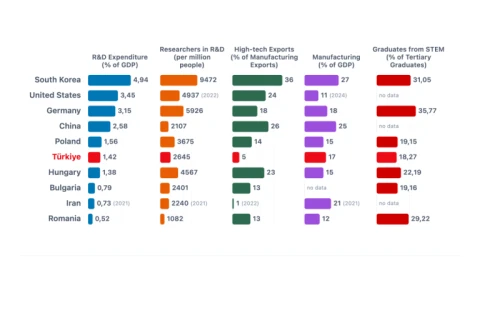
One of the most fundamental indicators reflecting a country's technological potential is the share of research and development (R&D) expenditures in national income. This ratio, which was at the level of 0.5% in Turkiye in 2002, increased to 1.42% as of 2023 with a steady rise. However, the gap with advanced economies is still evident: The same ratio is at 4.94% in South Korea, 3.45% in the USA, and 3.15% in Germany. A similar picture is also observed in researcher capacity. Although the number of researchers per million people in Türkiye has increased from 360 to 2645 in 22 years, this figure reaches 9472 in South Korea, 5926 in Germany, and 4937 in the USA.
The sustainability of technology production largely depends on training a qualified workforce in the right fields. In this regard, the share of graduates from science, technology, engineering, and mathematics (STEM) fields among total university graduates is an important indicator. This ratio, which hovered above 21% in Türkiye in 2013, followed a fluctuating course in subsequent years and declined to 18.3% as of 2024. In contrast, the high rates in Germany (35.8%), South Korea (31.1%), and Romania (29.2%) draw attention.
Türkiye’s Technology Indicators Over Time
The relationship between the industrial capacity of countries and the technology level of the products they manufacture is one of the fundamental elements determining the quality of economic growth. Türkiye has a considerable production power with a manufacturing industry share of 17% in its Gross Domestic Product (GDP); this rate also shows similarities with Germany (18%) and Poland (15%). However, when looking at the share of high-tech products in manufacturing industry exports, the picture is not encouraging. China exports high-tech products at a rate of 26%, the USA at 24%, and Hungary at 23%. Although this rate has increased over the years in Türkiye and reached the 5% level, it shows that production remains quite insufficient in terms of added value compared to other countries.
When the last twenty-year period is evaluated, it is clear that Türkiye has gained a remarkable momentum in terms of its R&D budget and the number of researchers. Nevertheless, in a period where global technological competition is accelerating, it is seen that this progress is not yet sufficient to close the gap with advanced countries. The evolution of the existing industrial infrastructure toward high-tech production, the strengthening of the innovation ecosystem, and the transformation of the education system into a STEM-focused structure stand out as priority policy areas.