
Steadfast Dart 2026 Exercise
NATO's annual Steadfast Dart Exercise will have a different scope and meaning in 2026. Following the Russian threat and the US's antagonization of Europe, Europe has begun to follow a dual path. European countries are seeking to revive NATO's spirit on the one hand, while pursuing a policy of "self-reliance" on the other. The exercise became the combined activity of these two pursuits at their minimum common denominator. Conducted "under the command" of the US European Commander in his capacity as NATO Commander, this exercise went down in history as a process in which Europeans tested themselves under the command of General Ingo Gerhartz (Germany), Commander of NATO Joint Forces Command Brunssum.
The most noteworthy aspect of NATO's Steadfast Dart 2026 Exercise is the alignment of Turkiye's national objectives and the policies pursued in this regard with military diplomacy.
The scenario involves testing the transition from the NATO Response Force (NRF), a force structure maintained by NATO member states for crises and conflicts, to the Allied Rapid Reaction Force (ARF). A total of eight member states deployed approximately 10,000 troops from land, sea, air, and special forces to the Baltic Sea. Within this framework, elements assigned to NATO by different member countries are carrying out all phases of a military operation in the field—preparation, deployment, organization, integration with multinational forces, execution, and re-positioning—in order to respond to a crisis occurring in the alliance's northern region. In other words, NATO countries in northern Europe are being reassured.
Turkiye's contribution to the NATO exercise
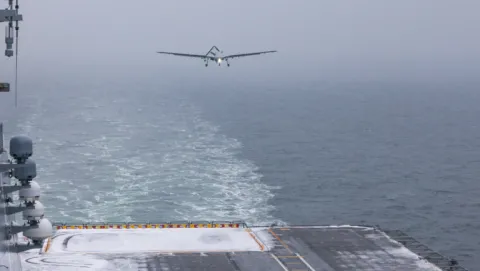
Turkiye participated in the exercise with a joint structure consisting of the Army, Navy, Air Force, and Special Forces. Many firsts were witnessed during the exercise, in which units assigned to NATO participated with all the weapons, vehicles, and equipment in their inventories. First of all, it was noteworthy that the Naval Forces showcased the combat capabilities of two frigates, a logistics ship (Oruç Reis, İstanbul, and Derya), and TCG ANADOLU. The launch of armed unmanned aerial vehicles (UAVs) from a naval platform for an operational mission and their 8-hour escort of Eurofighter Typhoons marked a new phase in Turkish Armed Forces (TAF) and NATO doctrine. Alongside the mechanized, engineering, and artillery units of the 66th Mechanized Brigade, the TSK's cyber and space capabilities were also demonstrated during the exercise. Turkiye's contribution at this level to NATO's exercise, which is more Europe-focused, is deeply meaningful.
Turkiye has shown that the capability to deploy its military forces to first and second-tier areas of interest is within the limits as required by its interests. Such capability and action necessitate Turkiye's presence both on the ground and at the negotiating table in regional and global affairs.
Turkiye's strategic deployment and independent operational capabilities
A joint combat force was observed to have deployed within 10 days from Thrace and the Aegean Sea to the Baltic Sea in order to respond to the crisis phase of the exercise. At this point, the ability to integrate with the combat elements of other states for "joint operations" is a crucial capability. Covering a distance of 4,200 nautical miles from the Dardanelles Strait and immediately commencing operational duties is a capability that only a few states possess. Indeed, it is a significant skill for elements belonging to different forces within a joint structure to focus on a single task under the command of a single commander.
Within the NATO alliance, a total of six countries (the United States, the United Kingdom, France, Italy, and Spain) possess this capability alongside Turkiye. When discussing the Russian threat, Turkiye's ability to deploy such forces to the northernmost point of Europe demonstrates the Turkish Armed Forces' potential in terms of capacity (planning and utilization of assets) and capability (military vehicles and equipment). Furthermore, considering the current naval, air, and land force projects, the TSK's potential to undertake independent missions in overseas areas will continue to increase.
Reflection of military diplomacy on national interests
At this point, an additional assessment is required from Turkiye's perspective. During the tensions in Libya, the support given to the Tripoli government was limited due to distance, but it achieved remarkable results. With NATO and Europe now able to intervene from the Dardanelles to the Baltic Sea in crisis and war scenarios, a new era has begun. Turkiye is a country capable of strategically deploying its military capabilities in conflicts within its first and second spheres of interest and shaping crises.
Somalia stands out as the most striking example of Turkiye's capabilities in this regard. In response to Israel's attempt to control the region together with the United Arab Emirates (UAE), Turkish Land (TURKSOM Base), Air Force (F-16s and air defense systems) and Navy can undertake joint missions that strengthen and enhance the Somali government's security capabilities.
The Turkish Armed Forces' presence in distant theaters of operation requires sustained military depth in terms of personnel continuity, operational capacity, intelligence capabilities, and logistics. Maintaining such a capability requires a large organization. Indeed, the TSK has reached a different level by maintaining a simultaneous presence in the Baltic Sea, Africa, and the Balkans. On the other hand, it should not be forgotten that this capability must not remain static and must be further developed in both quantity and quality.
Inputs related to Turkiye's regional and global presence
This capacity takes Turkiye beyond being a regional power. It is no longer debatable that Turkiye has moved beyond being a regional actor. Given its history and geography, Turkiye must maintain a presence on three continents simultaneously. At this point, it is also necessary to focus on the risks Turkiye may face in global affairs, where it still deploys forces within NATO or through bilateral security and defense relations. Such an ability can create rival countries and trigger asymmetric interventions. Therefore, Turkiye must be able to mobilize its civilian potential alongside its military capabilities.
The impact of the Turkish Armed Forces' military diplomacy on foreign policy
The most noteworthy aspect of NATO's Steadfast Dart 2026 Exercise is the alignment of Turkiye's national objectives, and the policies pursued in this regard with military diplomacy. It is essential to accurately interpret the political and diplomatic signals sent by Turkiye's simultaneous military presence in Africa, the Balkans, and the Baltic Sea:
- The powerful countries within NATO, a collective defense organization, are well known, and Turkiye is one of these prominent countries. Indeed, Turkiye now has the capability to maintain independent and joint forces in distant regions such as the Baltic Sea o Africa.
- Turkiye is an important defense partner for Europe, which is anxious and searching for solutions due to the US's cold attitude toward European security. Turkiye's military capacity can reinforce every inch in Europe. However, in return for such support, Turkiye's full membership in the European Union (EU) should be considered. Furthermore, Ankara should not be sacrificed to entities that exploit the EU, such as Greece or the Greek Cypriot Administration (GCA).
- Turkiye has the capability to deploy its military forces to first and second-tier areas of interest as required by its interests. Such capability and action necessitate Turkiye's presence both on the ground and at the negotiating table in regional and global affairs. The military diplomacy conducted by the Turkish Armed Forces through force deployment and operational execution will employ deterrence and coercion when necessary.
- On the other hand, such an ability is consistent with the constructive and cooperative nature of foreign policy. In other words, the military diplomacy of the Turkish Armed Forces has a joint character, adherence to cooperation with other states rather than "calling the shots." It is bound by international law and obligations. What makes Turkiye valuable is its adherence to the legal rules and ethical principles required by statehood in the use of force.
