
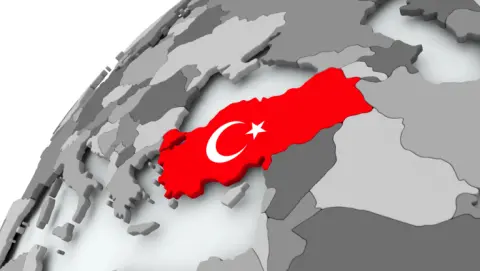
Turkiye's geographical proximity, which can be summarized as "three regions – three seas," harbors numerous conflicts. While some of these conflicts unfold in a traditional manner, others are irregular, asymmetric, and hybrid in nature. Ensuring Turkiye's security and developing a suitable defense policy requires not only covering the first sphere of interest but also extending beyond it. However, three regions (the Balkans, the Caucasus, and the Middle East) and three seas (the Black Sea, the Aegean Sea, and the Mediterranean Sea) are particularly prominent.
Without succumbing to hysteria, it may be helpful at this point to conduct a risk assessment of the threats Turkiye might face and the conflicts it could become involved in. Otherwise, the country could be exposed to the 'overwhelming' impact of events that might threaten its security. On the other hand, Turkiye's vision for its prosperity and security forms the foundation for any risk assessment. In this context, feeling secure is essential for a prosperous future. Therefore, rather than being a passive observer of developments, Turkiye adopts proactive entrepreneurship based on "patience" and is not hesitant to take aggressive measures against "existential" threats.
It would be helpful to categorize the threats Turkiye may face primarily into symmetric and asymmetric types. Turkiye has managed to handle many asymmetric threats and risks effectively. However, symmetric conflicts have started to emerge alongside the increasing assertiveness of Russia and Israel. In this context, symmetric threats refer to other states using traditional methods to challenge Turkiye's existence and interests. Nevertheless, it is important to remember that asymmetry and symmetry are interconnected. It is not really possible to separate the risks posed by Israel from those related to PKK and ISIS terrorism.
In the first-generation area of interest, which I call the 'three regions-three seas' zone, the level of crises and conflicts is higher than in other areas. Also, the conflicts in this zone originate outside of Turkiye's initiative and are provoked by other states.
Past experiences also suggest possible future scenarios. The Kardak crisis with Greece and the Eastern Mediterranean competition in the summer of 2019 should not be forgotten. Greece's utopian ambitions (EOKA and ENOSIS), relying on American-European support, continue. Meanwhile, Israel's rhetoric and ambitions focused on Syria and Cyprus, along with its ongoing aggressive policies against Turkiye, hint at potential future tensions. Additionally, low- and medium-level conflicts between neighboring countries in the region should also be remembered.
Considering that major powers intervene or get involved in any security incident happening in Turkiye's immediate neighborhood, Turkiye cannot afford to be just a spectator to crises in its primary sphere of interest. Otherwise, the direct and indirect consequences of potential conflicts could harm Turkiye's security and prosperity. We should remember the economic and security-related effects of past restrictions on Iraq (Operation Desert Storm), sanctions against Iran, and the foreign military presence in Syria. The PKK establishing a foothold in Iraq, Iran, and Syria is also a result of this reality.
The natural tendency of symmetric conflicts in the immediate region is the risk of spreading throughout the area. Turkiye's situation, which could be seen as unfortunate, results from this reality. Crises that could trigger one after another in the Balkans, the Caucasus, and the Middle East are forcing Turkiye to deal with multiple issues at once. In this context, it is necessary to assess the three regions and three seas in concrete terms.
With Azerbaijan-Armenia peace talks underway, a Russian plot against Pashinyan's government is possible. While the Church and the Armenian diaspora abroad are secretly organizing against Pashinyan, they are also holding open demonstrations. With the US settling in the Zangezur Corridor, the Russian-Iranian duo is poised to spark a new flare-up. For Russia, this situation, which could mean leaving the South Caucasus, might lead to political turmoil and the overthrow of the Armenian government. The political upheaval in Georgia adds another layer to this issue. For energy security, Azerbaijan's connection with Nakhchivan and Turkiye, along with the fate of the Turkic States Organization, the South Caucasus should not be left solely to American or Iranian-Russian initiatives.
It appears that the Mullah regime in Iran, with its nuclear power and missile inventory, is still perceived as a threat by the US-Israel duo. On the other hand, it is clear that Iran's social mosaic is a weakness. Aside from the negative impact of the sanctions imposed, Iran's policy toward Turkiye is also unstable. Interventions in Iran can trigger many asymmetric threats, such as migration, trade, intelligence, or military threats. Therefore, it can be said that the risk posed by Iran will remain high.
It can be said that Iraq, divided by ethnic groups and sectarianism, prioritizes prosperity to escape this cycle. However, Iraq's fragile state will continue unless Iran's influence is reduced, an Iraqi national identity is established, and the US's control over oil revenues is ended. It should also be noted that terrorist organizations like the PKK and ISIS are still active in Iraq. Therefore, Turkiye should increase its economic, political, military, and social engagement to make the risks from Iraq more manageable.
Syrians who succeeded in the revolution with the overthrow of the Assad regime have failed to resolve issues related to Israel-backed separatism and social cohesion. Israel, which supplies military equipment to the Druze tribe led by Hicri, involved in the drug trade in Suwayda, also encourages the PYD/YPG toward separatism. It is carrying out air strikes on Syria's military infrastructure to weaken the Damascus government. Therefore, developments in Syria are not just risks but threats to Turkiye. Israel, which considers the island of Cyprus and Syria as promised lands, is likely to continue its aggressive stance as long as it has US support. Gaza adds another layer to this situation. After the Doha attack, it is clear that Israel has gone off the rails and that strong measures must be taken.
The threat posed by the Greek-Cypriot duo is linked to third parties. Turkiye actually has no agenda against either the Greek Cypriots or the Greeks. When Turkiye's risks and security concerns are assessed, the Greek-Cypriot duo is not even among the top five. However, Israel's energy and military ties with the Greek Cypriots and the Greeks have become quite advanced. Greece's armored vehicle production, missile procurement, UAV operations, and fighter pilot training are under Israeli control. The Greek Cypriot Administration has become Israel's logistics and intelligence hub. Therefore, it is clear that Israel will "exploit" the Greek-Cypriot-Greek duo. The key is to prevent oneself from being "exploited." For this reason, Turkiye's regional tensions with Israel start in Hasakah and extend all the way to Dedeağaç.
At this point, it may be helpful to examine the ongoing Russia-Ukraine War in the Black Sea. In fact, we are dealing with two countries that have reached a stalemate, unable to gain superiority over each other. Despite the 'mining concession,' Ukraine still isn't accelerating US aid shipments. Only the weapon systems purchased by the EU for a fee are reaching Ukraine. The Russians, meanwhile, are trying to appear 'strong' with support from China, North Korea, and Iran. Given that Trump's strategic mistakes cannot be fixed by tactical moves on the ground, the stalled war's pace can only increase with new support—which it will. It's important to focus on the consequences of this situation for Turkiye.
Eastern European countries want Turkiye to cut its ties with Russia without requiring EU membership. This demand, like a blunt knife, is unrealistic. Meanwhile, Russia aims to deepen the rift between Hungary and Turkiye within NATO. Fortunately, after Trump's meeting with Putin in Alaska, Turkiye is no longer at the heart of these claims. The main NATO division now stems from the US. The split over influence in Ukraine between the US and Russia is a separate matter. Therefore, talks about the Black Sea's status may occur after the war. Because of this, the outcome of the Ukraine-Russia conflict is too important to be left to the US or Russia. Turkiye must therefore stay closely involved in this war.
In conclusion, the three regions and three seas are mixed, complex, and thorny. Wherever you touch, the degree of risk increases. To prevent this fate from turning into sorrow, Turkiye must live in peace, pretending to be at war; it must be at the table in diplomacy and on the field in the meantime.
[Sabah Perspektif, September 13, 2025]
