
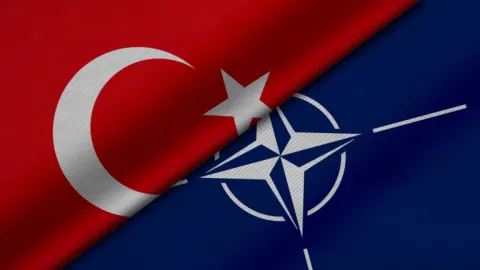
Türkiye’s influence within the North Atlantic Alliance has long been summarized by a single phrase: “NATO’s second-largest military.” While this observation is not incorrect, it is incomplete. Türkiye is one of the countries within the alliance best prepared for war and tensions, and for this reason, it is able to shape developments alongside the United States on many issues. This analysis examines Türkiye’s rising position through two fundamental axes. These are the quantitative and qualitative characteristics of Türkiye’s military capabilities, as well as its unique and specific structure—which extends beyond the defense industry—in areas such as defense management, the economy, political resolve, education, geopolitics, and human resources. Thanks to its potential across all areas of national power—particularly in defense—Türkiye has become one of the key actors in strengthening its allies’ capabilities and meeting their defense needs.
Being Able to Stand on One’s Own Two Feet
I argue that the conceptual backbone of Türkiye’s defense, diplomacy, and economy is formed by the principles of neorealism, which can be summarized as “self-help”—that is, the ability to fend for oneself and cut one’s own cord. The decisive factor here is the distinction between commitment and dependence. Türkiye is committed to NATO’s values; however, it is not a country that has entirely delegated its security to the alliance and is dependent on it. This distinction is made possible by concrete capabilities. With a force of just 900 troops—rising to 1,300 during mobilization—Luxembourg is both committed to and dependent on NATO guarantees like many others. In another context, the accession of Sweden and Finland to the alliance following the war in Ukraine is yet another manifestation of this dependency. Thanks to its demographics, economy, military strength, and social cohesion, Türkiye is well positioned to counter threats on its own. Autonomy is not a choice; it should be perceived as a capability and capacity, as well as a matter of survival dictated by circumstances.
Behind this capacity lies a holistic approach that grows in tandem with it. Although there are many parameters to this holistic approach, the economy, the defense ecosystem, industrial infrastructure, human resources, and educational opportunities are the most prominent elements. For this reason, Türkiye is no longer merely an importer of weapons; it has become an actor that designs, manufactures, and exports its own defense systems. A wide range of systems—from fifth- and sixth-generation fighter jets to unmanned air, land, and sea systems; from defense software to combat systems such as Altay tanks and the Fırtına Howitzers; from HIMARS-equivalent TLG/MLRS systems to precision munitions technologies and engineer systems—serve as concrete indicators of this transformation. What makes the designation of the “second-largest army” meaningful today is not only quantitative production but also the achievement of qualitative depth.
How can Türkiye’s position within NATO be described?
What makes Türkiye indispensable is not only its capabilities but also its position within the alliance. Through its institutional structure, NATO has adopted the principle of consensus in the realm of collective defense. This rule serves as the most critical control mechanism for member states. Indeed, a single member state’s “no” vote prevents the entire alliance from being dragged into a risky venture. Indeed, Spain and Italy’s “no” votes regarding intervention in Iran, France’s lukewarm stance, and NATO’s non-involvement in the 2003 intervention in Iraq have demonstrated the effectiveness of this mechanism.
At this juncture, Türkiye is one of nine non-European Union allies that both contribute to the Alliance and, when necessary, can “apply the brakes” to prevent risky decisions. This position, which can balance the European Union’s principle of solidarity, has given Türkiye, or the others, not merely a vote, but the opportunity to act as a lever. Moreover, this shared privilege is not merely political; it draws its strength from a foundation of legality and legitimacy. By applying the consensus rule to initiatives lacking a United Nations Security Council resolution or those that challenge one’s conscience, the Alliance is moving beyond serving as a mere tool for powerful countries like the United States and is transforming into an entity that generates its own values.
It is important to take into account the tradition of exercising this leverage with restraint. Türkiye has not exercised its veto right in NATO’s Strategic Concept decisions targeting Russia or China, remaining faithful to the alliance’s general line. However, it has also known how to register its objections through “derogations” on issues such as the recognition of Macedonia’s name under Greek pressure. This balance between adherence to NATO’s security culture and the preference for autonomy on critical issues has made Türkiye a predictable but not passive ally.
Why is Türkiye a valuable NATO ally?
Türkiye’s indispensability can be attributed primarily to its geography and identity. As the alliance’s sole Muslim member, Türkiye offers NATO a unique capacity for legitimacy in a context where at least one of the parties in crisis regions shares a religious identity with Türkiye. Türkiye’s participation in NATO missions conveys the message that a NATO operation is motivated by shared security interests, not religious considerations. Furthermore, given that nearly all conflict zones are located within Türkiye’s first- or second-tier spheres of interest, Türkiye becomes an actor that both directly observes and shapes these crises. This geopolitical depth represents an intelligence and strategic advantage for NATO that is not easily replicable.
Despite these facts, Türkiye’s NATO membership has at times been the subject of criticism. While some of this criticism has been voiced by American and European politicians who harbor prejudices against Türkiye, anti-NATO sentiment has occasionally flared up within Türkiye itself. To address this trend, it is important to emphasize that NATO membership provides member states with status, recognition, and a sense of belonging. Should Türkiye withdraw from NATO, this would result in Türkiye-hostile actors, such as the Greek Cypriot Administration of Southern Cyprus, applying for membership. Furthermore, decisions within NATO that could run counter to Türkiye’s interests can only be prevented through Türkiye’s membership privileges. Consequently, Türkiye’s NATO membership serves as a deterrent framework that encourages other states to act more cautiously in their security engagements. Therefore, proposals such as “Let’s leave NATO and align with Russia and China” constitute a strategic fallacy. As for criticism from outside Türkiye, it is not possible for a NATO member country to be expelled from the alliance against its will. France and Greece previously demonstrated this resolve by withdrawing their military contingents, but they later realized the error of their decisions and returned to “full” membership.
What sets Türkiye apart within NATO?
Türkiye holds a unique and distinctive position within NATO. The reason for its uniqueness is that it does not leave its own defense and security needs to the initiative of other states. Its distinctiveness, on the other hand, stems from the unique nature of its power. Indeed, Türkiye is one of the few countries capable of simultaneously preparing for conventional warfare while conducting a series of asymmetric and irregular conflicts, such as the fight against terrorism. This unique and distinctive stance is not accidental; it has been built on experience.
Thanks to this uniqueness and distinctiveness, alongside more than four decades of counterterrorism efforts, Türkiye has gained the opportunity to develop its own defense concept and doctrine through engagement experiences in Syria, Libya, or elsewhere. By their very nature, counterterrorism operations and asymmetric, irregular, and hybrid warfare environments necessitate autonomy in defense decision-making. Consequently, Türkiye has developed its military doctrine within its own threat landscape.
What has Türkiye’s autonomy contributed to NATO?
Türkiye’s determination to stand on its own feet is a result of the covert sanctions it has faced. Indeed, the 1974 Cyprus Peace Operation and the subsequent U.S. embargoes marked the beginning of a period in which Türkiye started developing its national capabilities from the moment it was left to fend for itself. Experiences with covert and overt sanctions—extending all the way to the S-400 crisis—have made it clear to the country that building its own capabilities in the fields of diplomacy, the economy, defense, and security is a necessity. The strategic autonomy being discussed today is the mature manifestation of this accumulated experience.
This uniqueness has become most strikingly evident in the policy of balance pursued following Russia’s invasion of Ukraine. While maintaining an ‘open-door’ diplomacy with Russia, Türkiye has simultaneously stood by Ukraine. It is important to recall that in the early stages of the war, the United States and European nations were slow to provide military aid to Ukraine. While standing by Ukraine during the war’s most critical phase, Türkiye also reinforced not only NATO’s southeastern flank but also its eastern flank. During the same period, the communication channel established at the leadership level between Russia and Türkiye facilitated the management of both the Ukraine and Syria issues. Indeed, the ‘grain corridor’ and ‘prisoners of war exchange’ agreements, along with the ceasefire talks that took place, represent significant achievements. During this period, when the U.S. and Europe remained hesitant, Türkiye faced accusations of an “axis shift” and even calls for its expulsion from NATO. On the other hand, Europe’s current efforts to re-engage with Russia—and even its open discussion of energy trade—have demonstrated that Türkiye’s policy was the correct one.
NATO’s Challenges, Transformation, and Türkiye’s Facilitating Role
NATO has faced serious challenges over the past five years. During the Trump era, the very existence of the alliance came under debate once again; however, Türkiye managed to remain outside these debates thanks to its own independent and distinctive policy. While isolating itself from U.S.–European tensions through normalization and mediation diplomacy, Türkiye assumed a facilitating role among allies at the NATO Ankara Summit. It is no secret that U.S. President Trump attended this summit because of the relationship he had established with President Erdoğan. At the NATO Ankara Summit, it was clearly evident that Turkish diplomacy was striving to bring the 32 member states together on a minimum common ground within the context of the Alliance’s resilience.
At this point, Europe’s new security architecture is the Summit’s main agenda item. When examining the new parameters of security, it is evident that the Cold War’s agenda of uncertainty, terrorism, and ethnic conflict shifted to the fight against radicalism after September 11; today, it has evolved into thematic areas such as energy, cybersecurity, space, and rare earth elements. Tensions in the Strait of Hormuz have brought to light entirely new dimensions of energy security. Amid this dynamic landscape, security priorities can shift not over years, but within days. European allies, too, have clearly felt the impact of these thematic challenges following their experiences with Russia and Iran.
Along with these observations, it is important to remember that NATO is a collective security organization with deep-rooted institutional traditions. Despite the current criticisms from the Trump administration, NATO will weather this period of tension by growing stronger rather than disintegrating or weakening. In the new structure—dubbed ‘NATO 3.0’ by U.S. Deputy Secretary of Defense Colby—European allies will shoulder the conventional burden, while U.S. support in nuclear capabilities, intelligence, and technology will continue.
After all, the dissolution of NATO is not a rational option for the United States. Such a scenario could trigger a new polarization, bring about the end of American hegemony, and even pave the way for the emergence of a new, uncontrollable rival—such as anew Europe. For this reason, it is more prudent to focus on models that prioritize transformation and sharing rather than negative predictions about NATO’s future.
Is a European Defense System Without Türkiye Possible?
No matter which scenario plays out, it is inevitable that Europe will have to strengthen its security architecture. Moreover, this strengthening should not be limited to the defense industry and technologies; it must also mark a new chapter in defense management. It is precisely at this point that it becomes clear that a European defense or NATO structure without Türkiye—in terms of human resources and field experience—is simply not possible. For Europe and the U.S. to move forward alongside Türkiye is not a choice, but a necessity.
Having surpassed its own limits in defense technologies, Türkiye is now mature enough to carry out joint projects with Europe. With its unique and specific capabilities, Türkiye has the power to strengthen both transatlantic and, if narrowly defined, European defense. However, due to Greek and Cypriot obstructions, Türkiye is effectively being pushed outside the scope of European defense. The consequences of this situation will directly and negatively impact European security.
After all, for Europeans to reinvent systems such as the Kaan fifth/sixth-generation fighter jet, unmanned aerial systems, defense software, the Altay tank, combat systems like the Fırtına, and HIMARS-like TLG/ÇNRA systems from scratch would be an extremely costly and time-consuming process. Continued dependence on the U.S. is also inconsistent with Europe’s own interests. In short, excluding Türkiye amounts to an economic waste and a strategic delay for Europe.
Conclusion
As Türkiye has evolved from being NATO’s second-largest military to a rising defense power, it has elevated its position within the alliance from a “quantitative presence to a qualitative indispensability.” This transformation is underpinned by:
- Its military-industrial capacity to respond to threats on its own,
- Its military diplomacy, which contributes to and exerts influence over the Alliance through consensus,
- Its unique doctrine forged in the field,
- Its strategic maturity, grounded in commitment to the Alliance’s values rather than dependence.
Türkiye is a NATO ally that is cooperative and participates in decision-making, yet is also capable of raising its hand and saying ‘no’ when necessary. It is precisely this unique and reliable stance that makes Türkiye an indispensable element of both today’s security architecture and the new one currently taking shape.
