
With its growing economy and expanding market, Türkiye has become one of Europe’s key destinations for electric vehicles (EVs). As more automotive companies shift toward EV production and diversify options, Türkiye ranked fourth in the European market in the first half of 2025, following Germany, the United Kingdom, and France, in terms of EV sales. While this trend has emerged from several key factors, EVs are expected to play a critical role in supporting the green transition and decarbonization process, both in Türkiye and globally, in line with the Net Zero Emissions target.
The current state of Türkiye’s EV market
In June 2025, Türkiye recorded unprecedented EV sales. Compared to 8,032 EVs sold in the same month of the previous year, 25,646 EVs were sold in June 2025—representing 27.4 percent of total vehicle sales. This surge also elevated EV sales for the first half of the year: from 35,636 units in January–June 2024 to 85,894 in January–June 2025. The primary driver behind this increase was the Special Consumption Tax (ÖTV) policy applied to EVs.
The ÖTV rate for EVs was significantly lower than that for internal combustion engine vehicles. Following a 2023 decision, vehicles under 160 kW and priced below 1,450,000 TL (before tax) were subject to only a 10 percent ÖTV. This policy, particularly benefiting fully electric carmakers such as Türkiye’s domestic brand Togg, generated high demand. Expectations of a revision in tax rates further fueled June’s record-breaking sales.
In addition to tax incentives, zero-interest credit options also boosted Togg demand. As a result, Togg’s first model, the SUV-class T10X, has consistently led the national market. After selling 19,583 units in 2023, the T10X reached 30,093 units in 2024, marking an increase of more than 50 percent. In just the first seven months of 2025, sales hit 19,821, already surpassing 2023 levels, with projections pointing toward a new record by year’s end.
Alongside Togg, U.S.-based Tesla and China’s BYD remain top players in the Turkish market. Like Togg, Tesla, a fully electric brand, shares leadership in sales rankings, with its pricing strategy playing a key role. BYD, which stopped producing internal combustion vehicles in 2022, has also gained attention with its wide product range.
Togg: Türkiye’s Gateway to the World
Over the past decade, the global EV market has expanded significantly. Asia-based manufacturers, especially Chinese firms, rapidly gained dominance, while many European carmakers hesitated to fully embrace EVs. Meanwhile, Tesla in the U.S. and Chinese producers such as BYD rose to prominence. Seeking to catch this global trend, Türkiye boldly launched its first national car project in the EV sector.
Türkiye’s Automobile Joint Venture Group, branded as Togg, gained recognition when its factory was founded in Gemlik, Bursa, in July 2020. Production began in October 2022, and pre-sales started in early 2023. In its first year on the market, Togg sold 19,583 units, and boosted production by over 50 percent in 2024. With such rapid growth within just two years, Togg quickly secured a leading position in its segment in the domestic market.
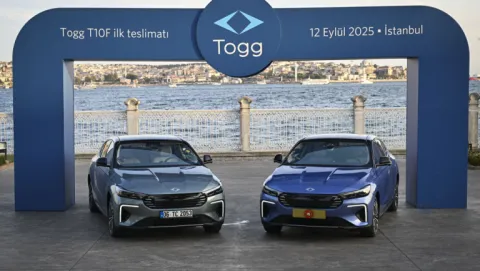
Now, Togg is preparing to expand abroad. While pre-orders for its second model, the sedan-class T10F, began in Türkiye on September 15, 2025, both the T10F and the SUV T10X are set to open for pre-orders in Germany on September 25. Notably, Togg passed all Euro NCAP safety tests with top scores. During promotional activities in Germany, the brand was met with significant interest. As the EU pursues carbon neutrality by 2050 under the European Green Deal, decarbonizing the transportation sector is central. In this context, a fully electric car like Togg is expected to gain traction and achieve substantial sales in Europe.
EV Markets on the Road to Net Zero
The Net Zero Emissions goal set by the Paris Agreement requires decarbonization not only in the energy sector but also in transportation and beyond. Internal combustion engine vehicles are responsible for about 15 percent of global CO₂ emissions, making the transformation of transport crucial.
According to the International Energy Agency’s annual EV report, nearly half of global EV sales in 2024 occurred in China—about 11 million units, surpassing total global EV sales in 2022. Today, one in every ten cars on Chinese roads is electric. As the world’s largest EV producer, China is expected to maintain this growth, helping reduce transport-related emissions.
The EU also witnessed record EV sales in the first quarter of 2025, with growth of over 20 percent compared to previous years. By the end of the year, sales are expected to rise by at least 25 percent compared to 2024. With its climate targets, the EU is likely to see continued growth in EV adoption through 2035.
Meanwhile, global battery production costs—a major component of EV prices—declined significantly in 2024. This trend is expected to foster greater competitiveness in both battery and EV markets. Still, government incentives remain necessary to accelerate the shift. In many European countries and the U.S., EVs remain 20–30 percent more expensive than conventional cars. Tax reforms and incentives can give further momentum to this growing market.
Finally, rising EV adoption will drive higher electricity demand. EV-related power consumption, which accounted for 0.7 percent of global electricity demand in 2024, is expected to rise to 2.5 percent by 2030. Meeting this demand requires scaling up low-carbon electricity generation, particularly renewable and nuclear energy. In doing so, emissions from both transport and electricity production can be reduced, strengthening global efforts to combat climate change.
[Anadolu Agency, September 23, 2025]