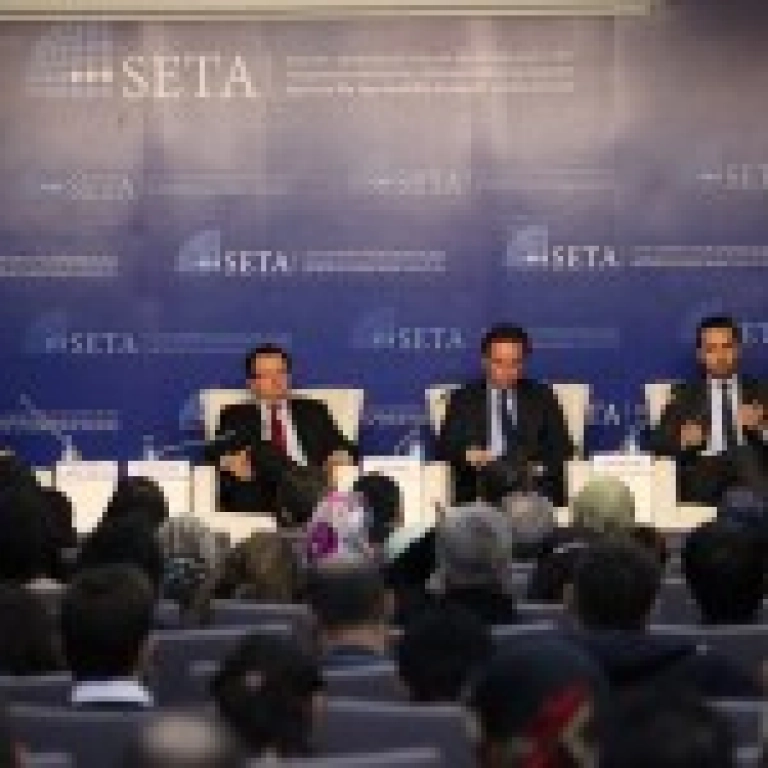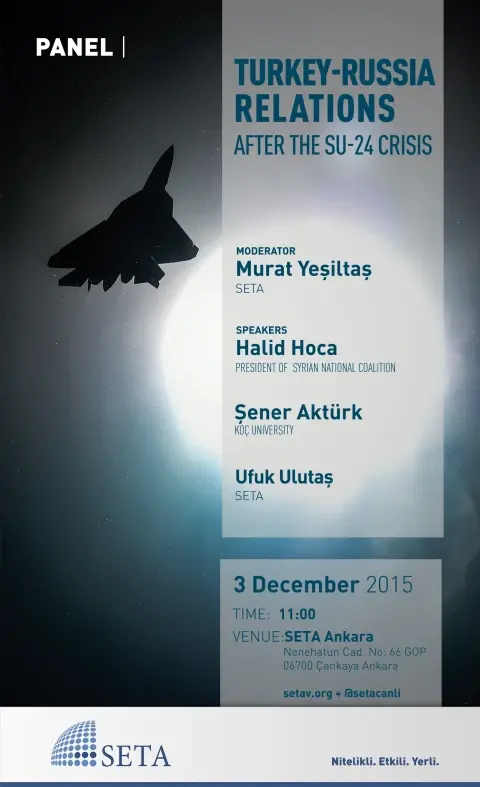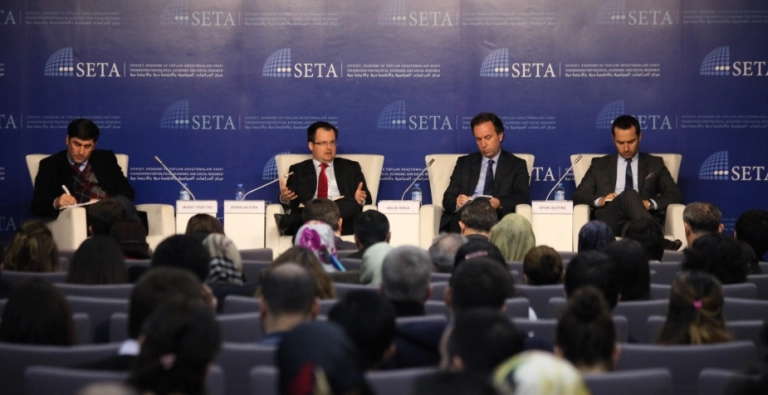
"Russian Turkish relation after SU24 crisis" was the topic of panel that took place in SETA foundation Ankara. The panelists approached the issue from several viewpoints trying to analyze its effect on the relations between the two countries;
The first panelist Sener Aktürk, professor of political scince in Koc University, started his speech with an emphasis on that the main confrontaion theater between the Russia and the West is mainly Ukrania not Syria. He argued, Russia might want to expend the confrontation theater to Syria to increase its position and options in the negotiation. Professor Aktürk said Russia is facing kind of modified Brejnev doctrine, according to which Russia is willing to intervene in the neighboring sphere. Within the framework of this, Russia intervened in Ukraine and Georgia but the Syrian example however was a step beyond this doctrine. Prof. Aktürk added that the Russian intervention in Syria is a limited one, particularly in its geographical aspect in Syria. The internal dimension is not absent in the Russian intervention’s formula according to Prof. Aktürk. This dimension is related directly to the Caucasian issue, which was one of the main points that president Putin focused on when he came to the presidency. The last development of Russian arms supply to PYD forces in Afrin is an indication that the relations between Russia and Turkey could go back to the relation before 1990s. Prof. Aktürk, however expressed he is optimistic that it will not, and conciliation will took place between the two states.
The second panelist, Mr. Halid Hoca head of the Syrian National Coalition stated that the Russian intervention happened due to Russia’s estimation that the Syrian regime was about to collapse, and US’s uncertain and hesitated policy in Syria. Mr. Hoca added that fighting against terror is not a reason at all, rather it used as an excuse for the intervention. Regarding the first reason, Mr. Hoca said that the Russian although they were supporting the regime from the early beginning of the crisis. They took the decision of active intervention by August when the regime was about to collapse. This decision was taken through a cooperation with Iran when General Kasim Soulaimani visited Moscow twice in August and September. However, the development on the ground prevailed that the decision was not calculated precisely and that the Russian backed Iranian militias and Assad army are unable to progress on the ground against the opposition. Regarding the second reason Mr. Hoca stated that the uncertain policy and lack of interest from the American side pushed the Russian to intervene more and more. He gave the example of the chemical incident of 2013, when Russia offered a solution that was accepted by the Americans. Mr. Hoca also pointed out that the American-Russian cooperation over Syria continued even after the intervention of Russia. Regarding this, he gave the example of the last Vienna agreement on Syria between the two sides. Mr. Hoca concluded by emphasizing that the solution would be only by the withdrawing of the occupier (Russia and Iran), and protecting the civilians mainly by constructing safe zones.
The last panelist Mr. Ufuk Ulutaş the Director of the Foreign Policy Studies at SETA Foundation, started his speech by saying that the last tension between the two states goes beyond the incident of shooting down the SU24. He added that the incident itself was a simple and a normal one, but the asymmetric response by Russia reflects that the problem is beyond the incident. Mr. Ulutaş mentioned that the shooting of the Russian jet over that area particularly, was a message by itself from Turkey, since the Russian air strikes was targeting not only the Turkish allies, but also an area that it has a sensitivity for the Turkish public opinion. Mr. Ulutaş added that the Russian intervention mainly aimed to push the Syrian opposition groups to accept De Misture plan, which rejected by the Syrian opposition. The maximum benefit of this intervention according to Mr. Ulutaş would be forcing the Syrian opposition to accept this plan. He added that the tension between the two states will continue and shaped by the developments of the situation on the ground in Syria. Mr. ulutas concluded by saying that Turkey succeeded in managing this crisis and acting calmly, while the other side appeared to be uncertain and nervous.
[efsflexvideo type="youtube" url="https://www.youtube.com/watch?v=KiUGwAXnx3k" allowfullscreen="yes" widescreen="yes" width="420" height="315"/]