
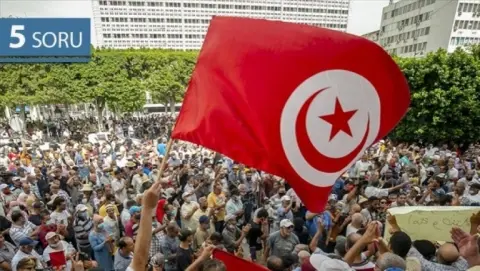
How did Tunisian politics shape after the Jasmine Revolution? How was the new Constitution, declared by President Said, drafted? What kind of system of government does the Constitution envision? How are the legislative and judicial branches designed in the new Constitution? What can be predicted for the future of Tunisia after the Constitution was approved by referendum?
1.How did Tunisian politics shape after the Jasmine Revolution?
As is well known, the protests that brought about the revolution began in the final days of 2010 when Mohamed Bouazizi, a young Tunisian street vendor, set himself on fire in front of the governor's office in protest against the mistreatment he received from the police. This was not an isolated incident. As in all regimes where human dignity and honor are violated almost daily, immense social anger against oppression had accumulated in Tunisia. Because Bouazizi's rebellion was a manifestation of this deep pain, it quickly engulfed first Tunisia and then the entire Arab region. Tunisian leader Zine El Abidine Ben Ali, who had been in power for twenty-three years, visited Bouazizi (who would soon die) in the hospital following protests and made appearances for the media, but was unable to save his position. Bouazizi died on January 4, 2011, and Ben Ali was forced to flee the country ten days later.
Following the overthrow of the regime, Tunisia held elections for a Constituent Assembly to transition to democracy and establish a new constitution. The Constituent Assembly adopted the Constitution in 2014. After the revolution, the country elected three presidents and held three parliamentary elections. Although coalition governments were formed by reaching consensus among parties with different political leanings, political stability remained elusive. A total of eight coalition governments were formed between 2011 and 2021. The greatest challenges Tunisia faced this decade were the weakness in internal security and the deepening economic crisis. The final move that changed the country's political landscape came from Qais Said, elected president in 2019. On July 25, 2021, Said unconstitutionally dissolved Parliament and dismissed the Prime Minister, government members, and the Supreme Judicial Council, effectively monopolizing executive power.
2. How was the new Constitution, announced by President Said II, drafted?
The longevity of a constitution and the establishment of a stable political environment in the country depends on its drafting method as much as its content. The constitution is a founding document that represents society's will to unite and guarantees its rights and freedoms. Therefore, the constitution must possess an encompassing structure that allows the vast majority of society to identify with it. For this reason, democratic procedures are essential both in its drafting and its ratification. The widely accepted method today is for the constitution to be drafted by a parliament or constituent assembly capable of representing society. During the drafting process, the opinions and suggestions of individuals and groups across different segments of society (through surveys, interviews, and petitions) are sought, and the text is shaped accordingly. Finally, the constitution is voted on in a referendum that adheres to the principles of fair, just, and free elections.
However, the 2022 Constitution in Tunisia was primarily drafted under the shadow of President Said's July 25th decisions, which bypassed Parliament and the government. Between January and March 2022, citizens were asked to submit their proposals through an online platform. However, only 7 percent of society participated in the process. The constitutional text itself was prepared in approximately one month by a technical commission (the National Consultative Commission) appointed by President Said, which lacked democratic representation. The Constitution, announced on June 30th, was put to a referendum on July 25, 2022, without allowing sufficient public debate. Consequently, democratic practices were not observed during this process.
3.What kind of government system does the Constitution envision?
Tunisia's 2014 Constitution introduced a semi-presidential system. The new Constitution positions the president as the most influential force in the political system. Although there is a prime minister and cabinet, the president appoints and can dismiss them. The president can submit draft laws to Parliament for prior review. The president retains final authority over high-level bureaucratic appointments. The president's authority to issue decrees is subject to Parliament's approval. The president is granted a powerful veto power over laws passed by Parliament. If a law is returned by the president, it must be approved by a two-thirds majority in Parliament for it to enter into force.
The popularly elected president's term is set at five years, while a person can serve a maximum of two terms. However, an important note is important here. If war or an imminent "danger" threatening the state arises, the president's term can be extended by law until the situation is resolved. Sadok Belaid, head of the constitutional drafting committee appointed by President Said, points out that this regulation could lead the country to "an eternal dictatorial regime." Despite all these powers, the president enjoys complete immunity for the duration of his term.
4. How are the legislative and judicial branches designed in the new Constitution?
Due to the strict separation of powers in presidential systems, it is natural that the executive branch has no political responsibility to the legislature. Conversely, the executive branch should not be able to interfere with legislative functions. In Tunisia, the weakening of the Parliament is evident. Parliamentary immunity is limited, and members of parliament can be prosecuted for "insult" or "slander" for speeches made inside or outside the Parliament. On the other hand, unlike the previous Constitution, which permitted Parliament to impeach the president if he "clearly violates the Constitution," the legislature is not granted any impeachment power.
The government is granted the power to submit a motion of no confidence. A motion of no confidence can be submitted if it is supported by half of the members in both houses of the bicameral Parliament. If two-thirds of the legislative body members express their no-confidence in the vote, the government falls. However, if a second vote of no-confidence is passed in the same legislative session, the president is granted the power to dismiss the government or dissolve Parliament.
Provisions have also been introduced in the judiciary to empower the president. The 2014 Constitution stipulated that four of the twelve members of the Constitutional Court would be appointed by the president, and under the new regulation, all members are elected by the president. There is a regression in the provisions regarding the independence and transparency of the Supreme Judicial Council, the highest governing body of the judiciary, compared to the 2014 Constitution. The new Constitution lacks the guarantees in the previous amendment, such as the council having administrative and financial autonomy and the election of two-thirds of its members based on merit from among judges.
Judicial independence is vital for protecting the fundamental rights and freedoms enshrined in the Constitution. If the judiciary lacks the independence to make fair decisions, the extent of the freedoms guaranteed in the Constitution will be of little consequence.
5. What can be said about the future of Tunisia after the Constitution was adopted by referendum?
Tunisia's Independent Supreme Electoral Council announced that the Constitution was approved by 94.6 percent of the vote in the referendum on July 25. However, because the referendum was boycotted by all mainstream political parties, turnout remained at 30.5 percent. This rate demonstrates that, far from achieving social consensus, the Constitution is not even considered legitimate by approximately 70 percent of the population. This renders the Constitution a stillborn text from the outset.
The path to social unity lies in establishing a state governed by the rule of law that protects the rights and freedoms of everyone, regardless of political views, ethnic and religious affiliation, or socioeconomic status. However, Tunisia's new Constitution is replete with provisions that virtually encourage the country to stray from the path of democracy and rule of law. One need only look at Tunisia's history to see the consequences.
Tunisia has urgent economic and social problems that require solutions. Perhaps in the short term, foreign aid can provide partial relief to these problems. However, for sustainable development and prosperity, the state's three pillars—legislative, executive, and judicial—must be designed in accordance with the requirements of liberal democracy, balancing but not pacifying each other. Otherwise, a repeat of the cycle of crisis and revolution is inevitable