
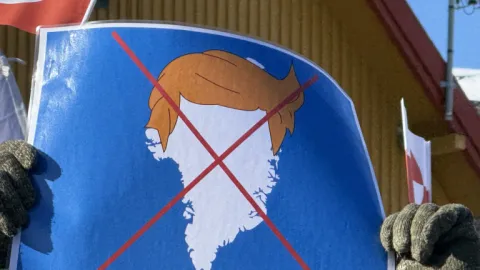
The sovereignty of states and the inviolability of borders are clearly and unequivocally guaranteed in the United Nations Charter. Particularly in the case of an alliance based on collective defense such as NATO, demands by member states regarding each other's territorial integrity are contrary to both the spirit of the NATO Treaty and the fundamental principles of the international order shaped by the United States, the United Kingdom, and the Soviet Union after World War II. However, Russia and China's opportunity to control not only military but also international trade chokepoints has brought the discussion of Greenland to the forefront.
Arguments of the United States and Denmark
In the debates within the USA, arguments are sometimes raised that the bond between Greenland and Denmark is "not organic." It is true that the Greenlandic people have suffered injustices, particularly due to assimilation and ethnic cleansing policies implemented by Denmark in the past. Nevertheless, Greenland is currently recognized under international law as the sovereign territory of Denmark. If the Greenlandic people have a demand for independence—and there have been such initiatives in the past—it is a requirement of democratic norms that this issue be resolved within the framework of Denmark's domestic law and political mechanisms. The international norm expressed as the right to self-determination can also be referenced in this debate.
At this point, Denmark puts forward the 'Kingdom of Denmark' argument against the US claims on Greenland. Denmark, a kingdom consisting of the Faroe Islands and Greenland, likens itself to the United Kingdom with its political regime of constitutional monarchy. In other words, the Faroe Islands and Greenland are equated with "associated" administrations such as Wales or Scotland in the United Kingdom. It also emphasizes territorial integrity due to the UN Charter and NATO membership.
In the argument-based 'war of words', the US rhetoric has referred to a slightly different dimension. Security, natural resources, and geopolitical factors are at the forefront of Trump and Rubio's rhetoric. At this point, concerns about security mean that Greenland's geopolitical position provides a valid, if not justified, basis for the US demands. In the context of natural resources, oil, natural gas, and rare elements form the basis of political rhetoric, but sufficient evidence has not been presented regarding the extent of natural wealth. On the other hand, rather than focusing on the right of the local population to determine their own destiny, the US is promising US citizenship and prosperity. Therefore, the legitimacy of the US's claim to Greenland in the context of international law is extremely weak.
The Geopolitics of Greenland
Climate change and the northern polar circle becoming accessible for transportation are the primary drivers of the US's interest in Greenland. Although Greenland appears much larger on maps due to its proximity to the North Pole, it is actually only slightly larger than the United Kingdom. With climate change, this narrow area has come to encompass critical transportation routes for global trade and security from both the east and west. Sea areas that were previously covered in ice for most of the year are now open to maritime transport for longer periods. Current estimates indicate that maritime transport could be possible for an average of 185 days per year along the northern coasts near Russia.
Another route in the Arctic Circle passes through Greenland, west of the Canadian coast, and inland waterways. While this route is navigable during certain times of the year, it can remain ice-covered for longer periods compared to the Russian coast. Furthermore, the fact that this route passes entirely through Canada's sovereign territory brings Canada to the forefront of this equation for the US. On the other hand, the sea area west of Greenland is deeper than the Russian coast. Therefore, drilling in Russia's North Sea area is more cost-effective. In addition, maritime transport is facilitated by the ports and port services on the Russian coast. The increasing Houthi threat centered in Yemen, particularly along the Red Sea and Bab el-Mandeb route, has heightened the strategic value of these northern routes that can be used without rounding the Cape of Good Hope, especially for China and Japan.
The US National Security Strategy and Greenland
In the latest national security strategy documents published by the US, critical straits and narrow passages defined as "chokepoints" occupy a special place. Points that global logistics must pass through, such as the Suez, Gibraltar, or Malacca Straits, are considered chokepoints in this context. Two new strategic chokepoints have emerged in the east and west of Greenland. Six ports located on the Russian coast (Murmansk, Arkhangelsk, Dudinka, Tiksi, Pevek, and Sabetta) enable ships to meet their refueling, maintenance, and logistics needs, thereby increasing the sustainability of maritime traffic even under extraordinary conditions.
If this new sea route passes from Greenland's west coast to the Canadian coast, it will serve four ports in the direction of Iqaluit (Nunavut), Cambridge Bay, Churchill (Manitoba), the Hudson Bay outlet, and Resolute Bay. However, this route is not suitable for transportation and is subject to narrow sea lanes. For this reason, maritime traffic close to the Russian coast attracts the attention of the US in both logistical and military contexts. The US's fundamental approach at this point is not to allow military or commercial movements outside its control. The way to achieve this goal is to maintain control over the area between the coasts of Greenland, Iceland, and Norway.
The military dimension is at least as important as the commercial dimension. Due to the narrow area of the Arctic, the US and the UK are conducting intensive air and sea activities in this region against Russia at the NATO or national level. Indeed, US President Trump's statement during a previous period of tension with Russia that "a nuclear submarine was sent in the direction of Russia" serves as a reminder of the importance of the strategic transit route between Iceland and Greenland.
Greenland and the future of NATO
Given Denmark's dependence on NATO and the US's leadership within the Alliance, Denmark would be unable to respond to such a threat alone if demands on Greenland were to turn into military pressure. However, such a scenario would effectively spell the end of NATO's founding philosophy. Indeed, recent calls by some US senators in Congress to withdraw from NATO have brought discussions of a strategic break with NATO into sharper focus.
Despite the discussions of strategic rupture, the dispatch of a Russian submarine to the Atlantic Ocean to protect a Russian-flagged ship returning from Venezuela without a cargo of oil has revived the emphasis on NATO in the US. On the other hand, the dispatch of the Russian submarine could provide grounds for the US to claim Greenland. At this point, an agreement that does not involve the transfer of Greenland's sovereignty and strengthens the deployment of NATO elements on the island would strengthen NATO. However, the introduction of an option such as military intervention, which is unlikely, could trigger the autonomy dynamics and vision of the European Union.
European Union
If a deep strategic rift occurs between the US and Europe under the Trump administration, this will accelerate the European Union's acquisition of a military identity. Unable to find a solution under NATO against the threat posed by Russia and believing that US security guarantees are hollow, Europe must come up with new security solutions. In such a process, a new European security architecture, led by France and Germany and including Turkiye, may come to the fore. Europe's current demographic structure, defense capacity, and level of preparedness for crises are limited. Turkiye, on the other hand, is an indispensable actor in the European security equation with its strong demographics, advanced defense industry, and military capacity. The attitude of the Greeks and Cypriot Greeks, who consume rather than contribute to security without contributing to the EU or NATO, is the biggest obstacle for the EU in terms of its vision for Turkiye's "future."
Conclusion
In conclusion, while the US's demands centered on Greenland and Canada have the potential to cause serious disruptions in NATO and the European security architecture, it is unlikely that this process will evolve into something as radical as a transfer of territory. A more probable scenario is that, within the framework of existing agreements, the US will increase its military presence in Greenland under the NATO umbrella. Otherwise, as historical examples show, territorial demands will inevitably trigger a chain of crises. Furthermore, frequent changes in government policies in US domestic politics create serious uncertainties as to whether the current rhetoric will become a long-term "state policy."
