
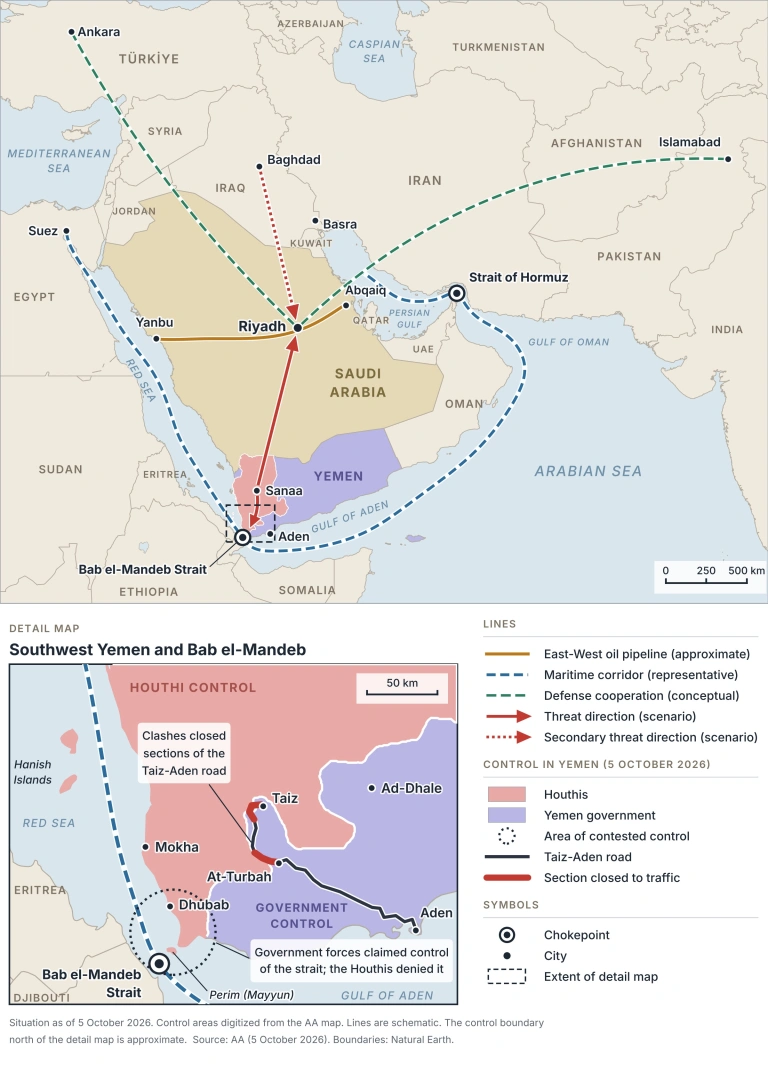
The renewed escalation of fighting in Yemen shows how the geographic and political boundaries of military competition in the Middle East are changing. As the Iran war increased pressure on the Strait of Hormuz, the Gulf states turned to alternative energy and trade routes, and the security of Bab el-Mandeb, at the southern end of the Red Sea, became more critical. Houthi capabilities in Yemen, Iran-linked armed groups in Iraq and the problems of protecting Saudi Arabia’s energy infrastructure have created an environment in which threats emerging in different areas produce effects on the same strategic system. Yet reading these developments only as a linking of battlefields is not enough. The real question is how connected threats change the security choices of regional states and what consequences new defense partnerships may have for regional stability. This interaction around Hormuz and Bab el-Mandeb reflects a new strategic dynamic, which can be conceptualized as the Two-Strait War.
The Makkah Alliance for Defense, formed by Türkiye, Saudi Arabia and Pakistan, offers an important example in this respect. Military developments in Yemen are testing the pact’s collective defense commitments, and they are also making the three countries’ different security priorities more visible. For Saudi Arabia, the priority is protecting its territory and critical infrastructure. For Pakistan, Riyadh’s security is an important strategic responsibility, but direct participation in the war in Yemen requires different calculations. For Türkiye, contributing to Gulf security, managing its relations with Iran and preserving its regional diplomatic room for maneuver are parts of the same strategic equation. Viewing the Makkah Alliance only as an expansion of regional security cooperation would therefore be incomplete. The alliance should also be seen as a mechanism in which the relationship between strengthening joint deterrence and the members’ need to preserve their strategic room for maneuver is put to the test. The most important military and geopolitical development making this equation more visible is the ongoing war in Yemen.
The Two-Strait War: Hormuz and Bab el-Mandeb
The Dawn of Yemen operation, launched in Yemen on 5 October, opened a new military phase in which Saudi-backed government forces aim to reverse Houthi gains around Bab el-Mandeb. Military operational assessments show that the fighting along the coast and the ongoing struggle in the mountainous areas around Taiz follow different dynamics. Government advances on the coast matter for the security of maritime routes, while the Houthis’ defensive capacity in the interior makes it harder to bring the war to a quick end. In addition, political and military differences within the pro-government forces may make it harder to turn tactical gains into a lasting political order.
What stands out here is the gap between military success on the ground and strategic effect on regional security. Even when the Houthis lose ground in certain areas, their long-range missile and drone capabilities allow them to carry the cost of the conflict beyond Yemen. The attack on King Khalid International Airport in Riyadh on 8 October and the serious disruptions to air traffic show the economic consequences of this capability.
This development raises an important question about how the success of the military campaign should be measured. Expanding control of territory along the coast may reduce some of the threats to Bab el-Mandeb. But as long as the Houthis keep the capacity to strike from long range, Saudi Arabia’s airports, energy facilities and economic infrastructure may remain at risk. The military logic of the war in Yemen and Saudi Arabia’s security needs therefore do not fully overlap. For Riyadh, gaining territorial control matters, but the more basic issue is being able to protect the country’s economic activity and critical infrastructure on a sustainable basis.
This distinction also explains why the war in Yemen has become a wider regional security problem. Rising pressure on the Strait of Hormuz because of the Iran war has made Red Sea energy exports more important for Saudi Arabia. Yet using alternatives to Hormuz does not remove the security problem altogether. Export capacity through the East-West Pipeline and the port of Yanbu makes energy shipments partly independent of Hormuz, but it also makes Red Sea security more important. Houthi capabilities around Bab el-Mandeb show that this alternative can also come under military pressure. Once the threats that Iran-linked armed groups in Iraq could pose are added, it becomes clear that developments in different areas produce effects on the same economic and strategic system, and that these effects influence one another.
The concept of the Two-Strait War does not claim that a joint war directed from a single center is being waged at Hormuz and Bab el-Mandeb. The concept should be read in terms of how pressure at Hormuz diverts energy flows to the Red Sea, how this alternative route is exposed to threats around Bab el-Mandeb, and how costs arising in different theaters of conflict pass from one to another. In this way, a security problem in one strait raises the strategic importance of military developments in the other. For countries such as Saudi Arabia, this interdependence turns the defense of critical infrastructure, maritime security and coordination with partners into parts of the same security calculation.
Here, however, an important analytical distinction must be made. The fact that the activities of different actors produce similar results on the same strategic system does not necessarily mean that these activities are directed from a single center. Iran, the Houthis and the armed groups in Iraq have political and military ties of varying degrees, but each of these actors also has its own priorities and local calculations. Treating regional threats as parts of a single coordinated strategy may therefore make the actors’ room for maneuver and the complexity of the conflict look simpler than they are.
This is where the explanatory value of the connected wars approach becomes clear. Separate battlefields can become linked through energy infrastructure, trade routes, economic expectations and alliance relations, even without shared command structures. As these links grow denser, states have to make new choices in their security planning. Saudi Arabia’s expansion of defense cooperation with various partners, instead of relying solely on its own military capacity, can be seen as one consequence of this changing security environment.
The Deterrence Capacity of the Makkah Alliance
The Makkah Alliance formed by Türkiye, Saudi Arabia and Pakistan is one of the new security arrangements developed in response to connected threats. The joint statement issued after the three countries’ emergency meeting on 5 October provides for the implementation of collective defense commitments and for measures to deploy the agreed military forces and capabilities to Saudi Arabia. This decision shows that the pact is moving beyond political solidarity toward operational security cooperation. However, not all details have yet been announced on the scope of the forces to be deployed, command relationships and mission definitions.
The main strategic test for the Makkah Alliance is how its members will manage the relationship between their joint defense commitments and their different security priorities. For Saudi Arabia, missile and drone attacks from Yemen are a direct national security issue. For Pakistan, defending Saudi Arabia is an important strategic responsibility, but becoming a direct party to the war in Yemen could bring different costs. For Türkiye, contributing to Gulf security and preserving its regional diplomatic room for maneuver are priorities that cannot be separated from each other.
The existence of the alliance therefore does not mean that the three countries share the same strategic preferences on every regional security issue. Overlapping threat perceptions in certain areas do not guarantee that a broader military alliance will automatically act in concert. Indeed, one of the basic problems of alliance politics is the balance between abandonment and entrapment. Members worry that their partners will not give them enough support, and they also risk being dragged into unwanted conflicts because of their partners’ choices. Both problems matter for the Makkah Alliance as well. Differences may emerge between the scope of military support Riyadh expects and the responsibilities Ankara and Islamabad are ready to take on.
Nevertheless, these differences do not mean that the alliance will be ineffective. The success of joint defense mechanisms does not always depend on members assessing every threat in the same way. Joint capacity built in specific mission areas can produce concrete security results in fields such as early warning, air defense, intelligence sharing and logistical coordination. Whether these contributions strengthen deterrence, however, will depend on how the other side perceives this capacity and on how far the members can act in concert during crises, as well as on the size of military capacity.
A second strategic dilemma arises here. By increasing Saudi Arabia’s defense capacity, the Makkah Alliance could raise the costs of attack for the Houthis and so strengthen deterrence. Iran and the Houthis, on the other hand, may interpret the new defense arrangement as a broader attempt at military containment directed against them. Such a perception may encourage countermeasures and asymmetric attack options. The pact’s effect on regional stability is therefore not predetermined. The outcome will be closely linked to the nature of military preparations, the content of political messaging and the limits within which the conflict can be contained.
Türkiye’s Strategic Calculus: Capacity, Interest and Room for Maneuver
Türkiye’s position within the Makkah Alliance raises new questions about how the defense capacity it has built in recent years can be used in regional security relations. The capabilities Ankara has developed in unmanned systems, air defense, electronic warfare, intelligence and operational planning could make specific contributions to Saudi Arabia’s security needs. The direction in which these contributions change Türkiye’s regional role, however, will depend on the scope of the capacity provided and the nature of the obligations assumed.
The statements made by Minister of Foreign Affairs Hakan Fidan on 8 October made this distinction clearer. Fidan said that Türkiye was considering options for defense support to Saudi Arabia, but that participation in offensive operations in Yemen or the direct deployment of Turkish troops was not on the agenda. Air defense, electronic warfare and technical support are among the areas that stand out. Until the approval process for the pact in the Grand National Assembly of Türkiye (TBMM) is completed, it is envisaged that support will be provided mainly within the framework of bilateral defense cooperation.
This approach indicates that Türkiye seeks to set limits on its military engagement while expanding regional security cooperation. Keeping these limits, however, will not depend on Ankara’s initial preferences alone. An escalation of the conflict, new Saudi military needs or an expansion of Houthi attacks could change expectations among the partners. In particular, if systems supplied for defensive purposes become part of a wider military campaign, the scope of political responsibility could become contested. For Türkiye, the central issue is therefore less which capabilities it can provide than its ability to set the mission and engagement limits within which these capabilities will be used.
When the operational picture on the ground, the nature of the threat facing Saudi Arabia and the expectations of the Makkah Alliance are considered together, three distinct levels of engagement are open to Türkiye. Defending Saudi Arabia’s territory and critical infrastructure can be treated as falling within direct defense cooperation. Contributing to maritime security in the Red Sea would mean a broader regional security responsibility. Türkiye has taken part in various naval missions in these waters. Participation in offensive operations inside Yemen, though it does not appear likely, is a different military and political threshold that could make Türkiye a direct party to the conflict. Each of these options carries different costs, risks and diplomatic consequences. In the current assessment, the first two options stand out as the more likely ones, but the scope of engagement will depend on developments on the ground and on agreement among the partners.
It would therefore be wrong to read Türkiye’s participation in the Makkah Alliance automatically as a gain in regional influence or as a boost to its military autonomy. New defense partnerships can expand Ankara’s regional influence and its opportunities for military cooperation. But the same partnerships can also create new obligations, expectations within the alliance and a risk of greater exposure to regional crises. Striking a sustainable balance between these two tendencies could increase Türkiye’s influence in the regional security equation.
Another important factor for Türkiye is the effect of Gulf security on relations with Iran and on the wider balances of the Middle East. Ankara’s contribution to Saudi Arabia’s defense need not mean that it has chosen a direct military confrontation with Iran. How Tehran views this cooperation, however, may affect regional relations regardless of Türkiye’s intentions. Backing military cooperation with diplomatic messaging and clearly defining its defensive aims are therefore important for preserving Türkiye’s room for maneuver.
Three Strategic Findings
In conclusion, the renewed escalation of the war in Yemen shows that the regional strategic picture may produce three effects.
First, the Two-Strait War is a connected conflict dynamic that changes the way regional security is produced. The relationship between Hormuz and Bab el-Mandeb works through strategic displacement, the transfer of costs between conflicts and the redistribution of security responsibilities. These links do not require a single war or a shared command. The linking of threats does not by itself produce an integrated regional security architecture. States’ ability to develop common threat assessments, coordinate their military capacities and manage escalation across different theaters of conflict remains decisive. The geographic spread of security threats is one result of the Two-Strait War dynamic. Its main strategic consequence, however, is that regional actors are forced to redefine deterrence, defense cooperation and security responsibilities.
Second, the future of the Makkah Alliance depends on how the balance between collective deterrence and strategic autonomy is struck. The development of a joint defense mechanism by Türkiye, Saudi Arabia and Pakistan marks a new stage in regional security cooperation. Even so, the members’ threat perceptions, regional priorities and preferences on military engagement do not fully overlap. These differences are the key variables that will determine how the pact works in times of crisis. By increasing military capacity, the pact may strengthen deterrence, but new security obligations and shifts in the other side’s threat perception may also raise the risk of regional escalation. The alliance’s success will therefore be judged by the effectiveness of joint decision-making and the clarity of the limits of engagement, as well as by the size of military contributions.
Third, Türkiye’s regional security role may be producing new strategic constraints along with new opportunities. Ankara’s defense industry, intelligence and military planning capacity allow it to develop more extensive security cooperation with regional partners. But turning this capacity into a role as a regional security provider may bring an expansion of military obligations and a greater likelihood of exposure to different theaters of conflict. For Türkiye, the core strategic issue is preserving its own military and diplomatic room for maneuver while contributing to regional security. Ankara’s role in the Makkah Alliance should therefore be assessed by how far it can set the limits of the responsibilities it takes on, as well as by the military capacity it provides.
The future of the war in Yemen will therefore not be shaped by the military balance around Bab el-Mandeb alone. The wider question is how connected security threats will affect new defense partnerships in the Middle East and what consequences these partnerships will have for regional stability. The Makkah Alliance is an important test case in this respect. For Türkiye, the real strategic question is under which conditions expanding its regional security responsibilities will bring more influence and room for maneuver, and under which conditions it will generate new costs. The answer to this question will determine the future of the regional security architecture as well as how Türkiye’s strategic autonomy takes shape at the military and political levels.
