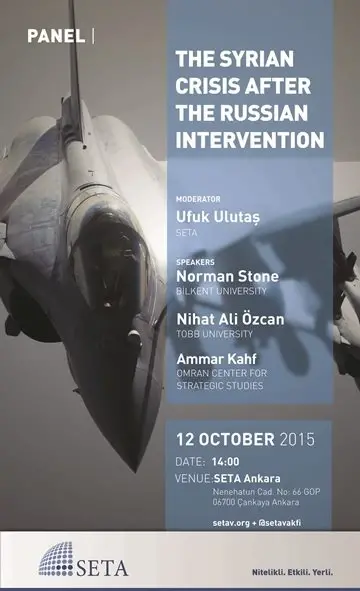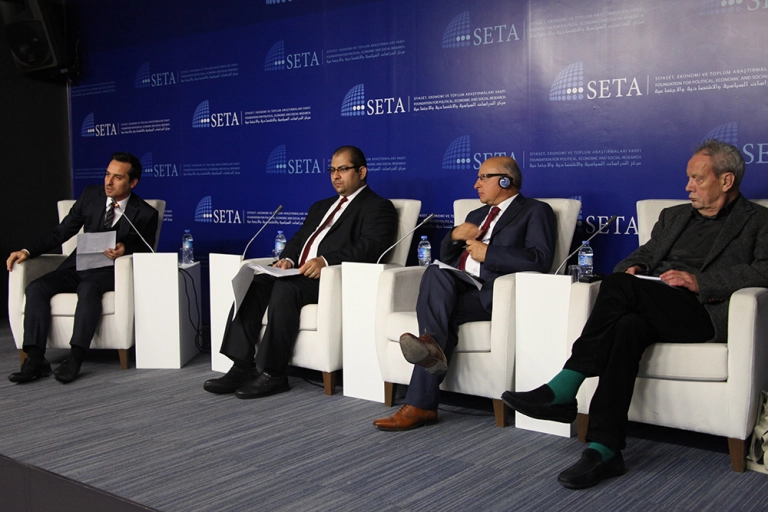
"Syrian crisis in aftermath of the Russian intervention" panel took place in SETA Ankara in 12th of October, 2015. Opening the panel as a moderator Ufuk Ulutaş, director of Foreign Policy Research Department in SETA foundation, said that the Russian intervention has transferred the five years ongoing crisis to a new phase. he added that the panel will try mainly to focus on three questions: To what extend the Russian intervention will change the landscape and to be a kind of game changer? Will the opposition supporting actors change their position? Whether this intervention would create new opportunities beyond being challenged to the Syrian opposition?
The first panelist Mr. Ammar Kahf started his speech by saying that the intervention represents a new chapter in Syrian people history. It transferred Russia from its role limited to supporting to its proxies to being a more active actor. Mr. Al-kahf added that we should focus more on what the Russian have been doing on the ground, more than what they have been saying. However, Mr. Al-kahf mentioned that the new created atmosphere could present a kind of opportunity for the Syrian opposition to take steps toward uniformity and more coordination, especially if we take into consideration that the Syrian regime itself is in fragmented situation, in additional to the differences between the geographical locations, goals, and dominated areas of Russia vis-a-vis Iran.
The second panelist Mr. Norman Stone stressed that Russia under Putin administration has achieved considerable progress; it has become quite different place from Yeltsin’s time. Mr. Stone said that the Russian has already said obviously through their Foreign Minister Lavrov that a lot of mess has been done by the Americans and other western powers in each of Libya, Iraq, and other Arab Spring countries including Syria which caused recently millions of refuges. The Russian, according to Mr. Stone will have a better chance to bring the Syrian back to their country, stressing that Syria will not be a second Afghanistan.
The third panelist; Mr. Nihat Ali Özcan said that the Russian intervention is softening the ground for the Syrian Army. He argued that the uncertainty of American Foreign Policy towards Syria has helped the Russian intervention to take place. Regarding Turkey and its position, Mr. Özcan believed that Turkey has to answer the question of how much its goals in Syria are overlapping with Russian and Iranian in particular, taking into the consideration its economic relations with these countries. He also mentioned to the close relation that Soviet Union, the successor of Russia, had with PKK- PYD. Mr. Özcan said that unfortunately we may wait for decades to see Syria is being shaped and stabilized again.