
The transportation sector constitutes one of the most critical fronts in the fight against global warming and climate change. As one of the lifebloods of modern economies, the transportation sector is also among the largest sources of greenhouse gas emissions. Turkiye, with its rapidly growing population and expanding economy, has made massive investments in its transportation infrastructure in recent years while simultaneously trying to manage the ecological cost of this growth. In this study, the effects of major highway, bridge, and tunnel projects in Turkiye on emission reduction and the historical course of carbon emissions per vehicle are examined, and the country's transition strategy to electric vehicles, shaped around technological and fiscal policies, is evaluated.
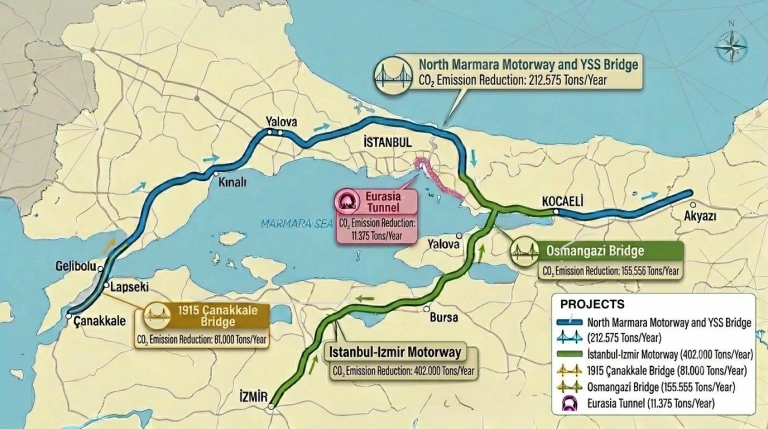
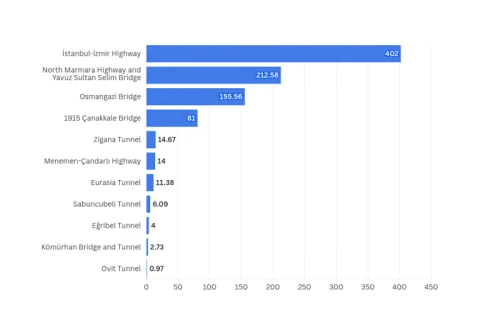
First, the carbon savings provided by 11 major transportation projects that have renewed Turkiye's transportation network were examined. Thanks to these projects, fuel savings are achieved by shortening routes on the one hand, and fuel consumption during idling is reduced by decreasing the use of rugged routes on the other. Methodologically, the annual data from official statements published on news websites regarding the relevant projects were directly included in the evaluation. However, cumulative data expressed in official statements as "total emission savings achieved since opening" were converted into annual average values by dividing them by the number of years between the year the news was published and the year the project was completed. The data we compiled by examining 11 completed projects (Graph 1) shows that these new transportation lines provide approximately 905 thousand tons of carbon emission savings annually.
Annual Carbon Emission Reductions of Major Infrastructure Projects
This indirect improvement provided by infrastructure projects is only one side of the picture. To see the direct environmental burden created by vehicles and the structural change over the years, per-vehicle emission values are also of great importance. In the methodology of this calculation, the total amount of carbon emissions in the transportation sector from TURKSTAT (TÜİK) data was divided by the number of motor land vehicles in the institution's database. Other modes of transportation such as planes, trains, or ships were not included in the equation to simplify the analysis, given that the major share of total emissions belongs to road transportation.
Emission values, which hovered around 4.2 tons per vehicle in the early 2000s, have caught a steady downward trend, especially in recent years, despite following a fluctuating course in the subsequent years. In the post-pandemic period, per-vehicle emissions, which were 3.53 tons in 2021, decreased to 3.21 tons as of 2024. In an equation where the number of motor land vehicles almost quadrupled from 8.6 million in 2002 to over 31.3 million in 2024, this structural downward trend in per-vehicle emissions is a direct result of the increase in efficiency in engine technologies and improvements in emission standards.
Annual CO₂ Emissions per Motor Vehicle in Turkey
At this point, the main policy that will make this downward momentum in per-vehicle emissions permanent is the transition process to electric vehicles. The introduction of TOGG, the domestic and national automobile initiative, into the market has not only been a technological production success but also a turning point that spreads electric vehicle awareness to the grassroots in society. Of course, this transformation is supported not only by consumer preferences but also by determined public fiscal policies. In Turkiye's tax systematics, it is no coincidence that the Special Consumption Tax (ÖTV) rates collected from internal combustion engine (gasoline and diesel) vehicles are kept much higher compared to electric vehicles. This taxation difference serves as a fundamental regulatory tool that accelerates the green transformation of the fleet and makes electric vehicles competitive.
In conclusion, Turkiye's transportation-sourced emission profile is going through a dynamic process. Shortening distances with tunnels and bridges has provided valuable relief to transportation, and developing engine technologies have significantly reduced the carbon burden per vehicle. However, in order to break the total pressure created by the increasing population and number of vehicles and to reduce the amount of emissions per vehicle, it is essential to transition current vehicle usage away from fossil fuels. Expanding the advantageous ÖTV application for electric vehicles to different income groups will facilitate this process. The continuation of this ecosystem transformation—whose groundwork has been prepared by the state through tax policies—supported by renewable energy investments and charging infrastructure will play a key role in Turkiye achieving its climate goals.