
The New Dynamics of Radicalization: From the Balkans to the Middle East
| Moderator | Murat Yeşiltaş |
| Speakers |
|
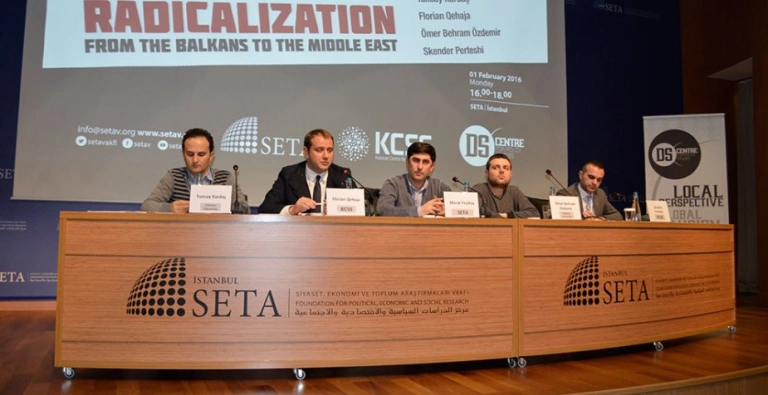
Moderated by Murat Yeşiltaş, Director of Security Studies at SETA, a panel entitled “The New Dynamics of Radicalization: From the Balkans to the Middle East” took place at SETA-Istanbul on February 1, 2016.
First Panelist, Dr. Tuncay Kardaş started his speech with theoretical background and frame of radicalization/de-radicalization. Kardaş said the concept of radicalization is highly contested, and there are many different views on the issue. He defined radicalization as supporting acts of violence by threatening the existing order; and identified a radical as one who decides for a radical change in the society s/he lives.
Dr. Kardaş touched briefly on four main approaches to radicalization. The sociological approach to radicalization analyzes economic and educational levels, and lifestyle of individuals. Psychological approach focuses on moods, motivations and behaviors of individuals. The social networks approach examines those who are radicalized after joining a small group or networks. The approach of problem definition deals with a critical issue, that is, how individuals frame their problems. “If you can frame individual problems,” said Kardaş, “you can also create more important sociological and psychological problems.”
The second speaker Florian Qehaja concentrated on violent extremism’s state of play in the Western Balkans, along with experiences in the prevention and disengagement. Qehaja defined three ways of practicing Islam in Kosovo as those of the conservatives’ (the Hanafi School), the seculars’ and the radicals’. Also, he pointed out Wahhabi Imams who are funded from abroad to lure young Kosovans with criminal past. In that way, the prison is not the ultimate destination for people who flee from the Balkans to Iraq and Syria. Underlining the significance of cooperation among academic community, civil society and the Islamic community, he said that the Islamic community should be involved in the process of de-radicalization. Otherwise, young Kosovans who have limited religious knowledge will have to learn their religion from extremist imams.
After Qehaja’s speech, Ömer Behram Özdemir, specializing in the area of foreign fighters, remarked about Turkish foreign fighters in Syria. Foreign fighters have different motivations and backgrounds, he said. In the early 70’s, extremist leftist groups were in coordination with the Palestinian Liberation Organization and were trained mostly in Lebanon and Islamist foreign fighters emerged in the 80’s with the invasion of Afghanistan. Özdemir briefed about four experiences of Islamist foreign fighters. First was the fight against the invasion of Afghanistan (both against the Soviet Union and the USA). The second was the Bosnia experience in which Turkish foreign fighters joined forces with the Bosnian forces against Serbs. The third one was in the Ogaden region, sandwiched between Somalia and Ethiopia. The fourth crucial fighting experience of foreign fighters from Turkey was against the Soviet forces in Chechnya. “In Syria experience, we cannot see explicitly why and how foreign fighters join the groups,” said Özdemir giving an example that foreign fighters of Turkish national in Syria are from the southeastern Turkish provinces of Bingöl or Adıyaman. They have common characteristics. Both have huge Kurdish and Zaza populations, undeveloped economy, and historical bounds with cities in Syria. Özdemir wrapped up with the remarks that the issue of foreign fighters have become a national security problem.
The last panelist was Skender Perteshi of the KCSS whose research interests focus on security sector reform, defense reform, violent extremism, and radicalization. His first remarks were also on radicalization. Perteshi stressed that radicalization is a new phenomenon and a big challenge both to the society and the state. More than 130 Kosovars were arrested for possible links to extremist groups and “extremist imams” spread all over the world including the Balkans. Corruption and undeveloped economy prove to be a suitable environment for extremism; according to Perteshi, the reasons behind radicalization must be investigated and a way should be found for reintegration and disconnection with radical imams.


