
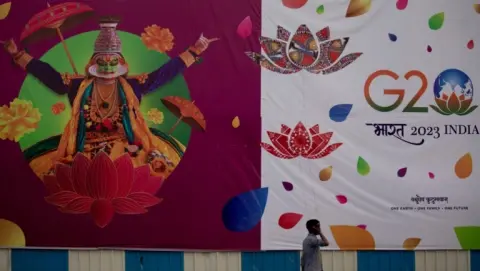
The G20 Leaders’ Summit is an intergovernmental forum that shapes and strengthens the global economic architecture and its related governance while promoting international economic cooperation. Although the initial focus and raison d’être of the G20 was on global macroeconomic issues and financial stability, its agenda has since expanded to encompass trade, climate change, sustainable development, health, agriculture, energy, environment, and anti-corruption efforts.
India assumed the G20 presidency for the first time on December 1, 2022, and will hold this position until November 30, 2023. This presidency marks not only India’s leadership role in the G20 but also the beginning of “Amrit Kaal,” a 25-year period starting on August 15, 2022, which commemorates India’s 75th year of independence and represents a vision of a more futuristic, prosperous, inclusive, and human-centered advanced society.
Under India’s presidency, the 18th G20 Heads of State and Government Summit will convene in the capital, New Delhi, on September 9–10, 2023. This year, Bangladesh, Egypt, Mauritius, the Netherlands, Nigeria, Oman, Singapore, Spain, and the United Arab Emirates will participate as “guest countries.” At the conclusion of the summit, leaders are expected to adopt a Leaders’ Declaration, outlining commitments on priorities discussed and agreed upon during ministerial and working group meetings.
A Summit Amid Global Challenges
This year’s summit will serve as the culmination of numerous G20 processes and meetings held throughout the year involving ministers, senior officials, and civil society organizations, addressing a wide range of issues from economics to geopolitics. It also coincides with a period marked by significant global challenges.
The world is at a critical juncture in combating climate change, which exacerbates global inequalities, poverty, and humanitarian crises. Simultaneously, many countries face mounting and unsustainable debt burdens. The ongoing Russia-Ukraine War continues to destabilize the region and produces ripple effects worldwide, notably on food and energy security.
India, having navigated recent adversities with prudent policies, has now taken on the responsibility of steering collective action to restore global economic and financial stability in the aftermath of the pandemic and the Russia-Ukraine conflict.
The summit’s focal points can first be understood through India’s chosen logo and theme for its presidency, which clearly express its vision, priorities, and determination to enhance global cooperation. The logo embodies the essence of unity and progress. At its center is the iconic Ashoka Chakra, symbolizing peace, progress, and eternal movement, harmoniously blending elements that reflect India’s rich cultural heritage and commitment to inclusive development.
The vibrant colors used signify India’s principle of unity in diversity, representing inclusivity and pluralism. The design incorporates motifs inspired by traditional Indian art forms, evoking the country’s unique spirit and cultural vitality. Its elegant, modern aesthetic conveys India’s vision of a progressive, forward-looking world.
Minister of Trade Ömer Bolat at the G20 Trade and Investment Ministers’ Meeting
Trade Minister Ömer Bolat attended the G20 Trade and Investment Ministers’ Meeting held in India. (Ministry of Trade/AA, August 25, 2023)
Theme: “Vasudhaiva Kutumbakam” – One Earth, One Family, One Future
The main theme of India’s G20 presidency and the upcoming leaders’ summit, “Vasudhaiva Kutumbakam” or “One Earth, One Family, One Future,” is derived from the ancient Sanskrit text Maha Upanishad. The core message emphasizes the value and interconnectedness of all life—humans, animals, plants, and microorganisms—within the Earth and the wider universe.
This theme promotes globally transformative actions that encourage environmentally sustainable and responsible choices at both individual and national levels, leading to a cleaner, greener, and bluer future. This “LIFE” approach foregrounds a “lifestyle for the environment.”
India’s logo and theme together send a powerful message of equitable and inclusive growth for all during these challenging times. They symbolize India’s commitment to sustainable, inclusive development, its desire to contribute meaningfully to the global economy, and its determination to address urgent global challenges.
Key Priorities of India’s G20 Presidency
Green Development, Climate Finance, and Life: Emphasizing climate finance and technology, focusing on climate change and ensuring a just energy transition for developing countries, alongside promoting environmentally conscious practices rooted in India’s sustainable traditions through the “LIFE” movement. The summit is expected to bolster developing countries’ efforts to confront the climate crisis.
Accelerated, Inclusive, and Resilient Growth: Concentrating on structural transformation areas such as supporting small and medium enterprises in global trade, promoting workers’ rights and welfare, addressing global skill shortages, and developing inclusive agricultural value chains and food systems.
Accelerating Progress on Sustainable Development Goals: Renewing commitments to achieve the 2030 Agenda for Sustainable Development, particularly addressing the impacts of the COVID-19 pandemic.
Technological Transformation and Digital Public Infrastructure: Encouraging a human-centered approach to technology and enhanced knowledge sharing in areas like digital public infrastructure, financial inclusion, and technology-enabled development, especially in agriculture and education.
Multilateral Institutions for the 21st Century: Reforming multilateralism to build a more accountable, inclusive, and representative international system capable of addressing 21st-century challenges.
Women-led Development: Emphasizing women’s empowerment and representation to enhance socioeconomic development and the achievement of sustainable development goals, highlighting inclusive growth and development.
The Summit Today
The 2023 summit will focus on a broad array of topics, including agriculture, anti-corruption, culture, digital economy, disaster risk reduction, development, education, employment, environment and climate sustainability, energy transitions, health, trade and investment, and tourism.
However, a significant challenge India faces as president is a fragmented G20 due to geopolitical tensions between the West and Russia, which undermines group cohesion and raises questions about its credibility. Nonetheless, India’s neutral stance on the Russia-Ukraine War provides hope that it can convince both sides to participate in G20 discussions and potentially achieve some progress beyond the current deadlock.
It is important to recall that India emerged as a “leader, problem solver, and consensus builder” at the 2022 Bali G20 Leaders’ Summit. The Russia-Ukraine conflict loomed large during the lead-up to that summit, with G20 meetings struggling to reach a mutually acceptable and appropriate language on the issue. While most countries sided with the Western bloc’s criticism of Russia’s aggression, some were reluctant to take sides. Despite this, India managed to bridge opposing positions.
At the New Delhi summit, India is expected to face the task of overcoming geopolitical divides and fostering cooperation and collective prosperity through innovative solutions. It may also guide the articulation of a clear G20 policy on the Russia-Ukraine War.
India’s Opportunity for Global Leadership
This summit presents India with a significant opportunity to contribute to discussions on pressing global issues. In essence, the September G20 Leaders’ Summit marks a long-awaited moment for India’s global leadership role, providing a platform to lead negotiations and pioneer new policies.
Accordingly, India is expected to spearhead demonstrating that the G20 remains the world’s premier economic steering committee, as originally envisioned.
