
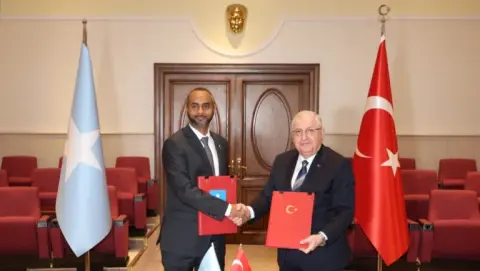
The Defense and Economic Cooperation Framework Agreement signed between Türkiye and Somalia on February 8, 2024, carries significant messages on multiple fronts. The agreement, signed in Ankara by the Turkish Minister of Defense Yaşar Güler and his Somali counterpart Abdulkadir Muhammed Nur, was ratified by the Somali Parliament and Cabinet on February 21, 2024. Indeed, for any international agreement to be implemented within a national legal framework, parliamentary approval is required. This ratification process, reflecting the consent of the Somali people through their representatives, is an important demonstration of legitimacy.
Initial reactions within Somalia have been notably positive. Somali President Hassan Sheikh Mohamud described the agreement as the best they have ever concluded. This suggests that the Somali government is open to cooperation when engaged respectfully and transparently. It further signals Somalia’s capacity to negotiate internationally in accordance with international law, prioritizing its national interests both regionally and beyond.
In this context, the January 1, 2024, Memorandum of Understanding (MoU) between Ethiopia and Somaliland sends a tacit message from the Somali government to Ethiopia. Somalia’s agreement with Türkiye may also be interpreted as a goodwill gesture toward other Horn of Africa countries. Should Ethiopia engage in respectful communication with Mogadishu, respecting Somalia’s territorial integrity and international law, an agreement over Ethiopia’s access to the sea via Somalia remains possible. Crucially, if Ethiopia seeks a port or military base in Somalia, planning and consultation must be conducted directly with the Somali government.
The second major message of the agreement is Türkiye’s continued commitment to its existing policy of support for the Somali people. This accord essentially encapsulates Türkiye’s longstanding Africa policy. Just as Türkiye extended a helping hand to Somalia during its most isolated and challenging period in 2011, it now continues to demonstrate its support for the Somali people in accordance with international law during their current difficulties. Some Somalis even regard this agreement as a "second 2011," underscoring its importance.
Security and Economic Dimensions of the Agreement
The agreement signed between Ankara and Mogadishu holds significance not only for Somalia’s security but also for regional peace. A notable aspect is Türkiye’s acceptance and legitimacy within Somalia both by the general population and official institutions, legitimizing and facilitating Türkiye’s presence in the country.
While other countries—including the United Arab Emirates (UAE), the United States, Egypt, Uganda, and Ethiopia—have also signed MoUs with Somalia, these agreements have not been submitted to the Somali Parliament. In the case of the UAE, perceptions of occupation by some Somali factions have blocked parliamentary approval. Türkiye’s widespread acceptance on the ground has thus smoothed the parliamentary approval process.
Moreover, the agreement promises mutual economic benefits. Aligning with Türkiye’s Africa policy principle of “win-win,” the agreement encompasses both security and economic cooperation. Türkiye and Somalia share fraternal bonds strengthened over many years through prior agreements on defense, security, and economic collaboration. Notably, Türkiye has played a crucial role in Somalia’s state-building efforts, especially in the security sector. Türkiye trained the Gorgor Brigades to enhance internal security and will now provide coastal and maritime security services for ten years under the new agreement.
It is also important to recall that in November 2022, the United Nations Security Council exempted Türkiye from the arms embargo imposed on Somalia, enabling Türkiye to supply defense industry products crucial to Somalia’s fight against the Al-Shabaab terrorist group.
Türkiye, as Somalia’s key security partner, hosts its largest overseas military training base in Mogadishu and is set to commence train-and-equip programs for the Somali Navy. As the eighth largest military force globally and the second largest in NATO, Türkiye’s support is vital for enhancing Somalia’s naval capabilities.
Türkiye’s long-term efforts in supporting Somalia’s development and the establishment of regional and global security have become a model success story. Türkiye’s plan to modernize Somalia’s navy over the next decade will further contribute to this narrative of progress.
Beyond military support, Türkiye’s engagement provides Somalia with valuable “time” — a strategic asset arguably more precious than money — to foster development and strengthen state institutions, while promoting peace in the region.
Protecting Somalia’s Maritime Resources and Economic Potential
The agreement also supports Somalia against unlawful foreign interventions targeting its maritime resources. For instance, Turkish presence may help establish legal oversight in response to illegal fishing by Chinese vessels in Somali waters. Türkiye’s involvement will also protect Somalia from illegal fishing, piracy, and terrorism, contributing to economic development.
Furthermore, the agreement paves the way for more efficient utilization of Somalia’s economic potential, ranging from fisheries and tourism to energy resources. Joint defense and economic cooperation in the “blue economy” sector across the Red Sea and the Indian Ocean is anticipated, with collaborative activities in fisheries and maritime sectors among the expectations.
It is highly probable that revenues derived from underwater natural resources will be shared with Türkiye under this agreement. Studies and data from the region indicate significant reserves of petroleum and other energy sources, laying the groundwork for future energy cooperation.
Türkiye: Somalia’s Ally and Hope
In an era marked by global chaos, developments in Africa—particularly in the Horn of Africa—signal a period fraught with risks. Against this backdrop, Türkiye’s steps toward peace, stability, and tranquility are vital.
This agreement is expected to play a significant role in Somalia’s and the region’s stability. Rationally, no country in the region desires new conflicts, given the devastating costs witnessed in Syria, Iraq, Ukraine, Gaza, Libya, Sudan, and elsewhere. The Somali people, having experienced war firsthand since 1991, understand the toll of conflict.
Nonetheless, the Somali people have signaled their awareness of risks and readiness to take necessary steps concerning sovereignty and territorial integrity.
Another critical actor in the region is Ethiopia. With a population of 120 million and also cooperating with Türkiye, Ethiopia has received support from Türkiye during difficult times. Türkiye’s emphasis on international law and efforts toward regional peace are clear.
Given the Horn of Africa’s key players—Somalia and Ethiopia—their shared need for peace rather than conflict makes Türkiye’s presence a strategic advantage.
While the Türkiye-Somalia agreement may not immediately defuse tensions in the Horn of Africa, it provides Somalia with a significant anchor of support and cooperation, which will be crucial should regional tensions escalate.