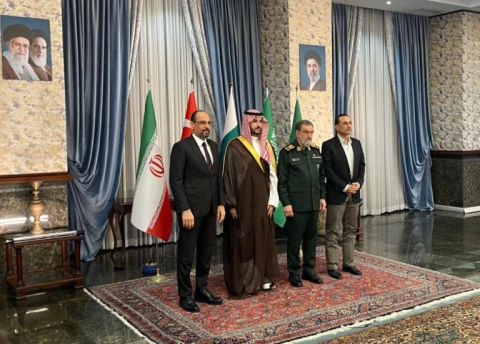
On 26 October, delegations from Türkiye, Saudi Arabia and Pakistan attended a quadrilateral meeting in Tehran hosted by Mohsen Rezaei, Secretary of Iran’s Supreme National Security Council. At the meeting, which was attended by Iranian President Masoud Pezeshkian and Iranian Foreign Minister Abbas Araghchi, Türkiye was represented by İbrahim Kalın, Director of the National Intelligence Organization (MİT); Saudi Arabia by Defence Minister Prince Khalid bin Salman; and Pakistan by Chief of the General Staff Asim Munir. Following the meeting, it was reported that the parties had agreed to continue discussions with a view to strengthening cooperation among the four regional countries. In this edition of our “Experts Respond” series, our experts assess the nature of the talks in Tehran.
By:
Sibel Düz, SETA
Contributors:
- Ali Bakir, Qatar University
- Serhan Afacan, İRAM
- Bilgehan Alagöz, Marmara University
- Gökhan Ereli, Ibn Haldun University
- Mustafa Caner, Sakarya University
- Merve Seren Yeşiltaş, Ankara Yıldırım Beyazıt University
 Ali Bakir
Qatar University
At a time when traditional alliance relationships and security partnerships are being reshaped in the Middle East, should the meeting of Iran, Türkiye, Saudi Arabia and Pakistan in Tehran be regarded as a crisis-management initiative prompted by prevailing circumstances, or as the first step towards a new and more inclusive security architecture aimed at reducing regional security’s dependence on external actors?
The meeting between the members of the Mecca Alliance and Iran was both important and necessary. Bringing Iran to the same table as the alliance’s members helped clarify each side's position and opened a channel for direct dialogue at a critical moment. It also sent a clear signal that regional states increasingly prefer to manage their own security rather than delegate it to foreign powers.
That said, we should not overburden the Mecca Alliance with our own perceptions and expectations. The Tehran meeting is the first step on a long and challenging process. While it responds to an urgent crisis at the tactical level, it can also be seen as part of the measures needed to build a regional security architecture with regional ownership.
However, it would be unrealistic to expect a single meeting to resolve everything. The members operate in a highly complex environment, and developments on the ground are unfolding faster than their collective capacity to respond. Still, what the alliance has achieved in less than three months is unprecedented in the region’s recent history in terms of cooperation, coordination, shared vision, and implementation.
The success of the alliance does not depend solely on its members but also on the willingness of others to abandon their highly destabilizing and dangerous regional policies and practices. That said, the road ahead remains long. We must take into account that there are spoilers, disruptors, and challengers who have no interest in seeing this alliance succeed, no matter how modest its achievements. Every step forward will be tested.
That is why adjusting our expectations matters and provide the alliance with the time and space it needs to transform today’s crisis management into tomorrow’s inclusive, regionally owned security architecture.
 Serhan Afacan
İRAM
Could the efforts of the parties to the Mecca Joint Defence Agreement to develop a security dialogue with Iran transform the Mecca Alliance into a founding element of a broader security order that also encompasses Iran?
The Mecca Joint Defence Agreement appears to have a twofold purpose, comprising conjunctural and structural dimensions. The first is to mitigate regional security risks by preventing an escalation of tensions arising from Israel’s destabilising influence in the region, the war between the United States, Israel and Iran, and the conflicts between the Yemeni government and the Houthis. The second is to establish a common platform for regional ownership, collective resilience, shared deterrence and confidence-building, as Türkiye has long advocated.
I believe that the meeting held in Tehran on Monday, 26 October, between Iranian President Masoud Pezeshkian and other Iranian officials and a high-level delegation comprising İbrahim Kalın, Director of Türkiye’s National Intelligence Organization (MİT), Saudi Defence Minister Prince Khalid bin Salman and Pakistan’s Chief of the General Staff Asim Munir, all representing countries of the Mecca Alliance, was related to the first of these dimensions. Alliance member states consider that the regional security problems caused by the illegitimate war launched against Iran by the United States and Israel on 28 February have been aggravated by Iran’s targeting of its neighbours in the Persian Gulf. The same applies to Tehran’s relations with the Houthis as part of its “axis of resistance” network and to the Houthis’ targeting of Saudi Arabia. To prevent the risks from increasing further, the conflict must not resume and the Houthis must be kept under control.
Although the alliance will need to expand through the admission of new members to achieve its structural objective, I do not believe Iran currently ranks among the leading potential candidates. This is due both to Iran’s distinctive conception of security and alliances and to the fact that, if subjected to another large-scale attack, it would not refrain from targeting regional countries as part of its efforts to establish deterrence. It should also be recalled that there is broad agreement within Iran’s security bureaucracy that this approach, which has been tested since 28 February, has proved effective. In addition, despite statements from Iran when the agreement was signed describing it as a positive development for the region, it should be noted that a negative assessment of the agreement actually predominates in Tehran.
Accordingly, in the context of the current war and Iran, it would be more appropriate at this stage to view the alliance as an instrument of diplomatic pressure intended to prevent military escalation. If a new conflict cannot be prevented, the collective defence mechanism will be activated. I do not consider Iran’s accession to the alliance under current conditions or in the near future to be a realistic prospect. Such a possibility could arise only if circumstances and Iran’s position change in the future.
 Bilgehan Alagöz
Marmara University
Could the efforts of the parties to the Mecca Joint Defence Agreement to develop a security dialogue with Iran transform the Mecca Alliance into a founding element of a broader security order that also encompasses Iran?
I do not infer from the efforts of the parties to the Mecca Joint Defence Agreement to develop a security dialogue with Iran that Iran will join the alliance at a later stage. I regard such a possibility as highly unlikely in the short term. The agreement is the product of a common search for solutions by regional countries concerned about the deepening tensions between Iran and Israel after 7 October 2023. These countries aim, on the one hand, to balance the tensions and, on the other, to establish a new regional centre of power in the face of threats posed by both sides. Bringing Iran into this structure would contradict the rationale underpinning the alliance’s establishment.
Moreover, Israel could perceive Iran’s participation as a threat to its own security. This could draw alliance members into precisely the regional tensions they seek to prevent. Neither Türkiye nor Saudi Arabia, however, wishes to open a new front against Israel. The perception of the alliance as an entirely anti-Israel bloc could also complicate the two countries’ relations with the United States. It is therefore more likely that the alliance will develop as a balancing mechanism that limits the effects of this rivalry on regional security, rather than becoming a party to the rivalry itself. Although the alliance’s stakeholders have not officially expressed this view, it may be argued that the United States regards the existing structure as useful. From the US perspective, an arrangement that prevents tensions between Iran and Israel from spreading across the region would be consistent with its objective of preserving regional stability.
At a time when renewed US and Israeli attacks against Iran are once again on the agenda, regional countries wish to prevent possible Iranian retaliation from targeting them as well. This concern varies from country to country. For Saudi Arabia and other Gulf states, the issue is the possibility of their energy infrastructure becoming a direct target of the conflict. Türkiye and Pakistan, meanwhile, share a long border with Iran. A prolonged conflict could generate risks relating to migration pressure, border security and energy prices. These concerns may also be said to underlie the visit by officials from alliance member countries to Tehran on 26 October. Contacts with Iran are intended to reduce these risks and keep channels of dialogue open. The intended message is as follows: if Iran refrains from targeting regional countries, alliance members will firmly oppose attacks on Iran’s territorial integrity.
In short, the current initiatives should be understood as a limited and pragmatic dialogue aimed at preventing the conflict from spreading across the region, rather than as the emergence of a security architecture that also includes Iran. For this to be achieved, however, a security framework acceptable to both Iran and Israel would be necessary. The present situation does not permit such a framework. Accordingly, dialogue with Iran will function as an instrument of conflict management in the short term and will not change the alliance’s structure.
 Gökhan Ereli
Ibn Haldun University
Given the Houthis’ attacks against Saudi Arabia and Iran’s relations with regional armed actors, could the quadrilateral talks in Tehran transform Iran’s regional influence into a security mechanism that contains conflicts? Should Riyadh’s pursuit of direct security dialogue with Tehran be interpreted as part of a strategy to complement military deterrence with diplomatic engagement?
It is too early to regard the meeting in Tehran as a security mechanism, but it may be considered one of the initial steps towards such a mechanism. It is also critically important because it represents one of the first high-level contacts with Iran following the establishment of the Mecca Defence Alliance and the intensification of conflicts originating in Yemen.
Above all, this meeting demonstrates that maintaining dialogue and diplomacy with Iran is important for the region and remains a preferable course of action. Iran has faced attacks by the United States and Israel since February 2026, and its principal response to these developments has been to target Gulf countries and inflict casualties on them. Diplomacy is the Gulf’s greatest opportunity, given that it lies at the geographical and political centre of the war, with Iran on one side and the United States and Israel on the other, and cannot pursue a policy fully aligned with any of these actors.
Within this framework, it seems unlikely that the talks will develop into a security mechanism in the short term, although continued diplomacy could facilitate the emergence of such a structure in the future. The principal purpose of these meetings is for the parties to discuss their latest positions on the war and conflict zones and determine where each would be prepared to make concessions in order to find common ground. Indeed, Tehran will not exercise its influence over the Houthis without something in return. Iran maintains that the nuclear file will remain off the agenda until the conditions for ending the war have been met; in other words, its role in containing conflicts and its bargaining position in negotiations are intertwined. Rather than expecting Iran to be fully integrated into a security platform such as the Mecca Alliance, it therefore seems more realistic to give diplomacy a chance to resolve the war and the major issues underlying it gradually, step by step.
Riyadh’s direct security dialogue with Iran should indeed be interpreted as part of a strategy that complements deterrence with diplomacy. We have seen in Riyadh and other Gulf capitals how military deterrence can readily be circumvented by asymmetric means, how military assets worth millions of dollars can be targeted with far less costly systems, and how such attacks damage prestige. During the same week, the coalition continued to strike Houthi targets, Egypt approved military assistance to Riyadh for defensive purposes, and the Saudi leadership described the purpose of the visit to Tehran as opening channels for negotiations to prevent a return to military escalation. With elections taking place in Israel and the United States on 27 October and 3 November respectively, it may be inferred that Gulf countries wish to use this interval as a window for dialogue and diplomacy.
 Mustafa Caner
Sakarya University
Could the quadrilateral talks in Tehran develop into an independent mechanism for mediation and confidence-building measures that would facilitate the resumption of direct US-Iran negotiations? In particular, what are the limits of the concrete guarantees that regional actors could provide on issues such as sanctions, freedom of navigation in the Strait of Hormuz, maritime security and the reduction of military tensions?
I consider it highly unlikely that the meeting in Tehran and the Mecca Alliance will develop into a mediation mechanism. There are two main reasons for this. First, the Mecca Alliance is fundamentally a defence alliance. It is neither a diplomatic mechanism nor a mediation initiative. Second, a mediation mechanism operating through Pakistan and Qatar already exists. Alliance countries can therefore only support this functioning mechanism; they cannot create a separate diplomatic channel to replace it. Moreover, the impasse in US-Iran negotiations is not of a kind that mediators can overcome. At present, Washington has no reason to recognise this format as a mechanism. Frankly, the Iranian side is also not receptive to either an agreement or negotiations at this stage. Rezaei’s hardline position indicates that such a diplomatic channel will not function for the time being.
By contrast, regional actors, particularly the Mecca Alliance, may undertake important initiatives to prevent the war involving Iran from spreading and may make a tangible difference on the ground. In my view, the meeting was held largely for this purpose. The parties framed the meeting in different ways. The Iranian side chose to present it as a victory for its years-long resistance to the United States. The Mecca Alliance side, by contrast, presented it as a de-escalation initiative, or at least as a step towards preventing the war from spreading and intensifying. Given the Saudi Arabia-Houthi conflict in Yemen, it is highly likely that these talks with Tehran will have tangible effects on the ground. The talks are expected to continue, but this initial meeting has so far produced no clear outcome.
As for the other issues, the guarantees that the parties can offer on matters such as the Strait of Hormuz and sanctions are extremely limited. Regional actors may help facilitate diplomatic talks with the United States. However, they are unlikely to make game-changing contributions or bring about changes of direction either by accelerating those talks or by influencing their substance. Similarly, their impact on the ground in relation to the Strait of Hormuz, sanctions and freedom of navigation will remain extremely limited. In any case, they have no such mission. For the time being, the Mecca Alliance does not have a mission to resolve the US-Iran war. What it can do is help make the effects of the war manageable and facilitate dialogue initiatives, should such initiatives materialise.
 Merve Seren Yeşiltaş
Ankara Yıldırım Beyazıt University
From the perspectives of intelligence diplomacy, security coordination and crisis management, what is the significance of MİT Director İbrahim Kalın’s participation in the Tehran talks? Will Türkiye’s role in this process remain limited to mediation between the parties, or could it evolve into a more institutionalised and decisive position in shaping regional security arrangements?
Three points should be emphasised here. First, multidimensional diplomatic engagement has become increasingly important today. Critical talks of this kind between Türkiye, Saudi Arabia and Pakistan, the parties to the Mecca Alliance, and Iran, concerning the establishment of national and regional security, are always conducted through multidimensional diplomatic activity. In this context, before, during and after such meetings, intensive diplomatic exchanges take place through various institutions and organisations engaged in traditional diplomacy, intelligence diplomacy, military diplomacy, defence diplomacy and security diplomacy. Indeed, the participation of the Defence Minister representing Saudi Arabia, the Chief of the General Staff representing Pakistan, and the President and Foreign Minister on the Iranian side is significant evidence of how closely traditional, military and intelligence diplomacy are intertwined in interstate relations and mechanisms of dialogue and reconciliation.
Second, traditional diplomacy must not be confused with intelligence diplomacy. Traditional diplomacy conducted by and through the Ministry of Foreign Affairs and intelligence diplomacy undertaken by MİT are not interchangeable concepts or practices in terms of their respective roles, duties and areas of responsibility.
What distinguishes the past 20 years, however, is that, for the first time in Türkiye’s history, intelligence diplomacy has supported traditional diplomacy as well as military and defence diplomacy to such an extent and has emerged as a catalyst in many issues. In this respect, we are witnessing not the dominance of intelligence diplomacy over foreign policy, but rather its assumption of an essential and critical role in foreign-policy decision-making and implementation.
Third, over the past 15 years, we have witnessed Turkish intelligence diplomacy become much more active and engaged in pursuit of Türkiye’s national security priorities and strategic interests, while its national and international visibility has progressively increased. In this context, the growing visibility and representation of MİT in general, and of İbrahim Kalın in particular, are manifested concretely in the Tehran talks.
Taken together, these factors indicate that Türkiye’s proactive foreign-policy approach is accompanied by proactive intelligence diplomacy; military, security and defence diplomacy also provide substantial support to these two pillars. Türkiye’s expectations of this multidimensional diplomatic approach are certainly not confined to a mediation role focused solely on crisis management. In pursuit of “common interests”, Türkiye aims, together with its alliance partners, to develop lasting solutions not only to the Iran issue but also to security issues concerning Gaza, Lebanon, Yemen, Hormuz and similar security challenges. The establishment of regional peace, security and prosperity therefore requires not a series of meetings convened during crises but reliable mechanisms for consensus and cooperation provided by institutionalised structures. Although the Tehran meeting is the product of a belated search for solutions, it should be viewed as an alternative effort by regional states in response to the unresolved interventions and initiatives of global actors. In due course, regional alliances and groupings of this kind will be able to establish stronger mechanisms for reaching agreement with global actors. Ultimately, whether a definitive solution emerges from the Tehran negotiating table depends less on the parties’ expectations and intentions than on the sustainability of the security coordination and cooperation mechanism, their ability to reach agreement on the terms of their engagement, and their adherence to their commitments.