
Supply security in global energy markets depends not only on production capacities but also on the continuity of strategic transit points. Maritime routes and straits are of strategic importance, particularly for the shipment of critical raw materials such as crude oil. Any disruption or change in traffic density along these routes exerts pressure on pricing mechanisms.
Strait of Hormuz and Oil Prices: Monthly Analysis
The Strait of Hormuz is a critical chokepoint through which approximately one-fifth of the world's maritime oil and liquefied natural gas (LNG) supply flows to various markets. Following the war initiated by the United States and Israel against Iran, the blockade that began in the Strait of Hormuz on March 1, 2026, has brought daily tanker transits—which previously averaged between 50-60—to a virtual standstill, driving oil prices into an upward and volatile trend. Unlike the crisis following the pandemic-induced demand drop in 2020 and the crisis stemming from the 2022 Russia-Ukraine War, which primarily affected the European region, this crisis has resulted in an unprecedented disruption in the global oil supply.
2026 Hormuz Crisis: Oil Prices and Shipping Traffic
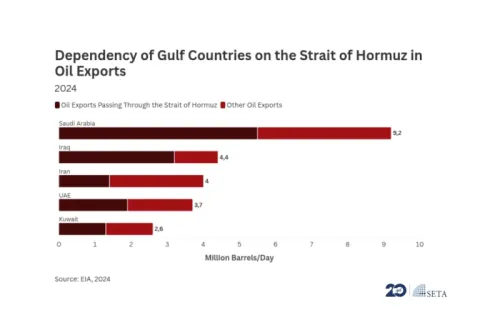
The source of the approximately 21 million barrels of oil passing through the strait daily underscores the depth of the crisis. Energy Information Administration (EIA) data reveals the high dependence of regional exporting countries on this route. With 3.2 million barrels of daily exports, Iraq routes 72% of its total exports, Saudi Arabia routes approximately 60% of its total exports with 5.5 million barrels, and the United Arab Emirates also transits 51% of its total exports via the Hormuz route. Substitution possibilities for such a massive volume through alternative pipelines or routes remain strictly limited. This physical constraint challenges price elasticity in energy markets, driving up oil prices.
Dependency of Gulf Countries on the Strait of Hormuz in Oil Exports
The dependence of importing countries, particularly in Southeast Asia, on Hormuz for oil imports magnifies the impact of the crisis. South Korea sources 68% of its total oil imports and Japan sources 57% of it through this strait. The high reliance on this route by the largest buyers by volume—China (50% dependency with 5.8 million barrels daily) and India (52% dependency with 2.6 million barrels daily)—places the epicenter of the supply shock in the Asian region.
Dependency of Selected Asian Countries on the Strait of Hormuz in Oil Imports
In conclusion, the blockade in the Strait of Hormuz once again demonstrates the sensitivity of energy markets to logistical channels. The stabilization of prices will depend on the duration of the war and the subsequent blockade in the strait, the recovery of logistical flexibility, and the extent to which strategic reserves can compensate for this process. Current data reveals how disruptions in energy transportation can severely shake global economic stability.
REFERENCES
- https://www.eia.gov/international/analysis/special-topics/World_Oil_Transit_Chokepoints
- https://portwatch.imf.org/pages/cc317ba850e34c4dadbead6f7b336fb1
- https://fred.stlouisfed.org/series/DCOILBRENTEU
- https://atlasinstitute.org/the-strait-that-moves-the-market-the-2026-strait-of-hormuz-crisis-and-the-anatomy-of-a-global-energy-shock/
- https://www.eia.gov/international/data/world/petroleum-and-other-liquids/annual-petroleum-and-other-liquids-production?pd=5&p=0000000000000000000000000000000000vg&u=0&f=A&v=mapbubble&a=-&i=none&vo=value&t=C&g=none&l=249-0g00000000000000000003002000000000000001&s=1704067200000&e=1704067200000
- https://www.eia.gov/todayinenergy/detail.php?id=65504