
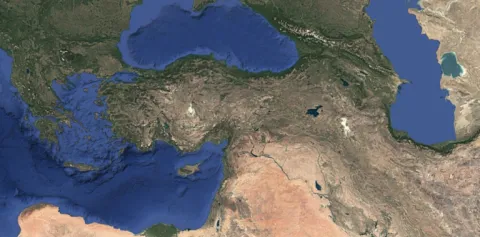
Greece, which has deployed an air defense system on the islands of Kerpe and Semadirek—areas that are required to be demilitarized under international treaties—has also taken advantage of the conflict with Iran to send fighter jets and warships to the southern part of Cyprus. Demonstrating its skill in turning crises into opportunities—with support from the U.S. and the EU—the Greek government has also sped up its arms procurement program. In this context, on March 16, 2026, the Greek Parliament finished budget talks on the initial package for the Achilles Shield program and allocated about $4 billion to the Greek Supreme Defense Council.
The duo of Mitsotakis and Dendias, who are gradually leading the Greek people toward disaster, have opened Greek territory to military bases from other countries and have positioned Greece in support of Israel regarding the issues of Gaza and Iran. It is clear that Greece, pursuing revisionist policies and clinging to the false idea that “the threat comes from the East,” has failed to learn from the economic crisis it faced in 2009 and the severe austerity measures it had to implement until 2018. Defense Minister Dendias’s “obsession with Turkiye” is creating a new security dilemma, forcing Greece into conflict rather than fostering better relations with Turkiye and focusing on prosperity. The Achilles Shield project also exemplifies this obsession.
During the unveiling of the Achilles Shield, Defense Minister Dendias stated that the “defense” architecture is seven-layered and integrated, and that in this context, measures will be taken nationwide against ballistic missiles, air threats, UAVs, warships, and submarines. In fact, the air defense and UAV defense components of this project—which is essentially an “offensive” architecture—were approved by the relevant committee of the Greek Parliament on March 16, 2026, with a budget of 4 billion euros. Approximately 3 billion euros of this budget have been directly allocated to the Achilles Shield. Final political approval will be granted by the Government’s Council on Foreign Policy and National Security (KYSEA).
With the launch of the Achilles Shield project, although the answers to questions about which country Greece is targeting in its arms program, who it is collaborating with, and what the ultimate outcome will be are “well known,” it is helpful to make this process more public. Indeed, the Achilles Shield initiative—brought to the forefront due to Israel’s provocation and launched after Dendias caved to provocation—could trigger a security dilemma in the Aegean and Eastern Mediterranean rather than lead to "normalization,” or, in other words, could start an arms race. The militarization of the Aegean Islands, despite the clear rules of the Treaty of Lausanne, also seems likely to escalate tensions.
What is the Achilles Shield?
The Achilles Shield was developed as part of Greece’s layered defense strategy. In official Greek defense discussions, this concept refers to a defense system aimed at countering emerging military threats like drones, air, naval, rocket, and missile systems, as well as submarines and space/cyber threats. Within this framework, a plan called “2030 Agenda” was created and became central to defense reforms. However, despite its wide scope, the Achilles Shield primarily focuses on air and missile defense.
An examination of Greece’s current air defense architecture shows that it is mainly composed of systems from the Cold War era. These systems include a mix of U.S., Russian, and European systems acquired since the 1990s. Major components include the U.S.-made Patriot PAC-III, the Russian-made S-300 PMU1 (in service since 2000), the Russian TOR-M1 medium-range system (in service since 2001), as well as OSA and similar short-range systems, the French Crotale, the U.S./European Stinger, and German Rheinmetall air defense systems. Maintaining and supporting these systems has created significant challenges. Although Greece has tried to balance its air-to-air defenses, it has been feeling left behind in overall air defense capability. Meanwhile, while the U.S. has raised concerns about Turkiye’s S-400 system, it’s important to note the current silence regarding the Russian-origin S-300 and TOR-M1 systems.
Russia’s invasion of Ukraine has created an opportunity for Greece. On one side, Russian-made weapons and ammunition have been sent to Ukraine, while in return, U.S. and European weapons and ammunition have been added to its stockpiles through grant programs. On the other hand, by emphasizing the "Russian threat' publicly, Greece has gained the support of U.S., European, and Israeli military presence and backing in the eastern Mediterranean and the Aegean Sea.
With the opening of new strategic opportunities and considering the evolving nature of warfare, Greece aims to develop countermeasures against Turkiye’s capabilities within its current defense framework. In this context, Greece—currently deploying air defense systems in four rings starting from the Aegean Sea and Western Thrace—has reevaluated this ring-based approach and plans to shift to a network-based air defense system. By leveraging the conflicts in Ukraine and Iran, Greece seeks to move beyond its traditional defense structure and establish a network-centric, integrated system. The 12-year armament program announced by the Greek government in 2025 serves as the foundation of this transformation.
What air defense systems does Greece currently have?
The current system is not a fully integrated “air defense umbrella”; instead, it is a multi-source air defense network made up of systems from different generations that are trying to connect. While the upper layer of air defense is provided by the Patriot PAC-III and S-300 PMU1, the lower layers use short-range solutions such as the Crotale NG/GR, TOR-M1, Stinger, Rheinmetall anti-aircraft guns, and systems from the Army’s inventory, including the ASRAD HELLAS, VSHORAD, and Stinger. Additionally, it is known that the HAWK systems in the Air Force inventory take part in live-fire exercises.
It would also be helpful to review the command structure and radar network alongside these air defense systems. The Erieye EMB-145H AEW&C airborne early warning and command-and-control platform in the Greek Air Force provides command-and-control support to air defense systems. Additionally, air defense and radar positions, along with a 3D radar infrastructure, are established nationwide. On the air-superiority and air-defense front, the F-16 Viper and Rafale fleets serve as the active maneuvering layer of the air-defense system. Therefore, the Achilles Shield aims not only to deliver ground-to-air missile capabilities but also to ensure the effective integration of existing radar, command-and-control, airborne early warning, and fighter aircraft layers.
Why was the Achilles Shield considered necessary?
There are two main justifications in the Greek official narrative. The first is to reduce the burden of regional air defense on the navy’s costly frigates and 4.5/5th-generation fighter jets, and to keep them away from point air defense missions. The second reason is to counter the threat of cruise and ballistic missiles efficiently within an integrated system using cheap UAVs and swarm drones. In this context, Dendias has stated that the new system will cover the entire country and ease the burden on the navy and fighter jets. Therefore, warships and fighters will no longer be responsible for air defense. However, it is important to note that Dendias’ claim of “the entire country” suggests a maximalist stance and that he considers the Aegean Sea and the Eastern Mediterranean part of the “Greek sphere of influence.”
What is the purpose of the Achilles Shield?
Greece plans to replace its current Russian and older-generation short- and medium-range missile systems with a multi-layered defense architecture supplied by Israel. Negotiations with Israel over air defense and artillery systems were conducted by the end of 2025, with approximately 3 billion euros allocated for procurement. Reports in the Greek press in early 2026 indicate discussions about acquiring SPYDER for the short-range/lower tier, BARAK MX for medium-range, and David’s Sling for the upper tier/anti-missile needs. However, the full details of the final configuration have not been disclosed; the key point is that the budget has been approved by Parliament.
Under Greece’s Achilles Shield program, the air defense system is expected to include SPYDER, BARAK MX, David’s Sling, and the PATRIOT family, reinforced with the MMR/ELM-2084 radar and supported by drone-countering electronic warfare systems. The S-300 and TOR-M1 systems, on the other hand, may be assigned to independent point and area air defense, or the U.S./European weapons might be requested instead, in exchange for Ukraine. The goal is to provide a cost-effective response tailored to the target type within the command, control, and reporting framework. Maintaining existing systems within air defense batteries is also a possible option.
There are currently plans to integrate the Greek-made Kentavros drone defense system with Israeli-made air defense systems. This development, which will be a major milestone for the Greek aerospace industry, also highlights the issue of technology transfer from Israel. The drone defense systems, to be used alongside the BARAK MX, reflect Greece’s goal to develop capabilities against Turkish UAVs. In terms of joint production and technology transfer, Greek companies are expected to secure around a 25% share in all defense procurements, including Israeli air defense systems. This indicates that Greece aims to gain capabilities not only as a user but also in maintenance, sustainment, sub-components, software, and integration.
What systems has Greece developed using its own resources?
The most notable indigenous component of Greece's systems is the Kentavros drone-defense system. The Greek Ministry of Defense stated that during an EU mission in the Red Sea, these systems detected drones in a real-world threat environment, shot down two drones, and forced two others to retreat using electronic jamming. In this context, plans are underway to integrate the system—which has a detection range of up to 150 km and an engagement range of up to 25 km—into Greek warships. Alongside this system, the Iperion and Telemachus portable drone-defense systems and the Archytas UAV project are key components of the domestic ecosystem. As a result, these projects focused on Turkish UAVs shift the domestic component of the Achilles Shield away from “hard-kill” missiles toward drone-defense systems, electronic support, subsystems, software, maintenance and sustainment, and integration layers.
Conclusion
Greece’s diverse combat and support systems—developed from different eras, partially integrated but not fully cohesive—will be replaced by the Achilles Shield program. In this context, it is important to note that the Achilles Shield is not limited to air and missile defenses; rather, it aims for a comprehensive modernization of land, sea, and air force capabilities. Spanning 12 years, this project intends to strengthen Turkiye with an independent force structure by 2036 and to secure a strategic position in the Eastern Mediterranean with support from Israel and other nations.
Following the budget approved by the relevant committee of the Greek Parliament, the Achilles Shield’s arguments about establishing superiority over Turkiye may be emphasized, especially ahead of political elections. For this reason, air and air defense projects, along with the specific air defense and drone-countering systems to be acquired against Turkish UAVs, have become the main focus of the Achilles Shield project.
In the context of air defense systems, those produced by the U.S., Russia, France, Germany, and locally still face limitations regarding logistics, sustainability, network-centric capabilities, and cost-effective engagement. In particular, the maintenance, sustainment, and ammunition supply of Russian systems pose potential risks for Greece. Therefore, it is important to bolster Greek air defense systems against Turkish KAAN and UAVs.
To summarize, the structure followed by these projects is as follows.
- The goal is to establish a system capable of sensor fusion,
- Producing a single air picture, and automatically or semi-automatically selecting engagement modes based on threat type.
It also uses electronic support operations to achieve “soft-kill” against low-value targets. For high-value threats, a “hard-kill” effect is implemented. Therefore, a multi-layered air defense network is being developed over mainland Greece and the Aegean Sea. This includes integrating Patriot and Israeli-sourced air defense systems, along with developing cost-effective solutions against Turkish UAVs and missiles using domestic anti-drone systems. Meanwhile, Greece seeks to acquire capabilities for AI-based target detection, identification, and tracking through Israeli defense companies.
The most glaring weakness of the Achilles Shield project is the removal of Russian systems from service while Israeli air defense systems are being integrated into the inventory. This move effectively hands Greece’s air and missile defense over to Israel, leaving Greece vulnerable to Israel’s actions and provocations. In fact, Israel, which views Turkiye as a threat, will be able to implement scenarios that could manipulate Greece in the future and turn it into a proxy force. Additionally, the arms procurement agreements currently being negotiated with Israel are designed to make Greece a tool for Israel’s long-term goals. For this reason, while Israel aims to establish a balance against Turkiye through the modernization it pushes on Greece in political, military, and financial areas, Greece remains under the illusion that it is preparing for imaginary “nightmare” scenarios.
