
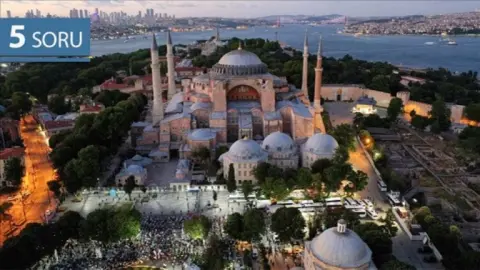
What historical processes has Hagia Sophia, which we have seen in three different statuses—church, mosque, and museum—gone through? Was the decision to convert Hagia Sophia into a museum legal? What status should Hagia Sophia have, considering foundation law? Does international law limit Turkey's authority to make regulations regarding Hagia Sophia? What does the decision to reopen Hagia Sophia for worship, taken by President Erdoğan and published in the Official Gazette, following the Council of State's annulment, signify?
1. What historical processes has Hagia Sophia, which we have seen in three different statuses—church, mosque, and museum—gone through?
In essence, the juxtaposition of the terms Hagia Sophia and mosque is based not on longing for the past, but on a simple historical truth. This ancient truth is enshrined in the will of Mehmed the Conqueror, who entrusted Hagia Sophia to us not as a cultural heritage but as a mosque symbolizing our sovereignty. Sultan Mehmed II of Istanbul, the founder of Hagia Sophia, is the founder of Hagia Sophia. Immediately after its conquest by Mehmed II, Hagia Sophia, in the words of the late Semavi Eyice, was "converted into a mosque as the city's largest church, as was customary." Before Turkish rule, when it was still the church of Hagia Sophia, it was repeatedly vandalized. From 1453 onward, it was diligently preserved and preserved as an architectural masterpiece. Today, the annulment decision of the 10th Chamber of the Council of State has ended the unlawful museum status established by the Council of Ministers Decree of 1934. Subsequently, with President Erdoğan's decree published in the Official Gazette dated July 10, 2020, this great temple has been restored to its original state after 85 years as a museum.
2. Was the decision to convert Hagia Sophia into a museum legal?
We can interpret the conversion of Hagia Sophia into a museum by the Council of Ministers Decree of November 24, 1934, as a politically conjuncture-based development. However, the fact that a decision is made for political or other reasons does not absolve it of the obligation to be legal. At the very least, it must comply with positive law. The principle of the rule of law, the modern expression of this legality, requires that all actions and procedures of governments, as well as citizens, be subject to the rule of law. Indeed, the fundamental idea of constitutionalism is inspired by the idea of limiting state powers that exercise public power. When approaching the issue from this perspective, we must first consider the law under which Hagia Sophia was originally subject and how it was later converted into a museum.
Following the conquest, Mehmed the Conqueror, while converting Hagia Sophia into a mosque, established a foundation that included Hagia Sophia. The endowment charter, or in other words, the foundation document, dated 1470, of this foundation, named "Mehmed Han-ı Sani Bin Murad Han-ı Sani Vakfı" (The Foundation of Mehmet II, Son of Murad Khan), states that Hagia Sophia was also dedicated as a "mosque." On the other hand, in the Republic of Turkey land registry document dated November 19, 1936, two years after the aforementioned Council of Ministers decision, it was registered as a "mosque" in the name of the "Ebu'l-Feth Sultan Mehmed Foundation." Therefore, Hagia Sophia is legally considered a "charitable property." Therefore, the issue should be examined primarily from the perspective of foundation law.
3. Considering foundation law, what status should Hagia Sophia have?
In its decision dated July 2, 2020, the 10th Chamber of the Council of State followed a sound decision-making methodology, primarily examining the relevant old and new laws regarding foundations established during the Ottoman period, as well as the jurisprudence of the Constitutional Court, the Court of Cassation, the Council of State, and the European Court of Human Rights. The Constitutional Court's decision dated January 30, 1969, to which the Council of State referred, stated that the ownership of foundation assets belongs to the foundation. Foundation assets are protected not only against individuals but also against the state, and their owner is the foundation itself. After stating that the foundation deed or charter establishing the foundation constitutes a legal rule and binds the donor, third parties, and even the "state," the Council of State presented the following legal opinion determining the status of Hagia Sophia: It is mandatory that foundation assets be used in accordance with the will of the donor.
4. Does international law limit Turkey's authority to make regulations regarding Hagia Sophia?
We must unequivocally state that the legal status of Hagia Sophia is not a matter of international law. Decisions regarding its status are entirely within the authority of the Republic of Turkey, as a sovereign state. The limits and framework of this authority are determined solely by our national law. Just as Hagia Sophia was converted into a museum in 1934 by a Council of Ministers decision, which the Council of State today deemed unlawful, today, by a Presidential decree and in compliance with legal requirements, it has been reinstated as a mosque. It is stated that this issue has a binding international legal dimension for Turkey due to Hagia Sophia's inclusion on the UNESCO World Heritage List and the Convention Concerning the Protection of the World Cultural and Natural Heritage, to which we are a party. Nothing in this agreement, which imposes on Turkey the duty to protect the cultural and natural heritage assets within its territory, to open them to visitors, and to ensure their survival for future generations, prevents Hagia Sophia from attaining its deserved status as a mosque, which is mandatory under our domestic law. Furthermore, under Article 6 of the agreement, all party states undertake and agree to fully respect Turkey's sovereignty over cultural and natural heritage assets, including Hagia Sophia, and not to infringe upon the property rights provided by national laws.
5.What do the Council of State's annulment decision and the decision to reopen Hagia Sophia for worship, taken by President Erdoğan and published in the 5th Official Gazette, signify?
The 10th Chamber of the Council of State relied on the strong justifications, some of which we have explained above, in annulling the Council of Ministers' decision converting the Hagia Sophia Mosque into a museum. First of all, the Chamber accurately emphasized the Council of Ministers' decision in question's violation of Article 1 of Law No. 864, dated June 19, 1926, which protects foundations and properties allocated to them during the Ottoman period. This article mandates that Hagia Sophia's legal status be regulated as stipulated in its foundation charter. The Supreme Court noted that Hagia Sophia was owned by the Fatih Sultan Mehmet Han Foundation—whose management had been taken over by the state through the General Directorate of Foundations—and that this was under the protection of Turkish law. The annulment decision emphasized that the state could not alter Hagia Sophia's status in the foundation charter and its designated use, in other words, its status as a mosque. The annulment decision gained practical value with the Presidential decree, which reopened Hagia Sophia to worship and restored it to its status as "Hagia Sophia-yi Kebir Mosque Sherif."