
The Education of Syrian Children in Turkey
| Moderator | Zafer Çelik, SETA |
| Speakers |
|
SETA hosted a panel on Syrian refugee children living in Turkey.
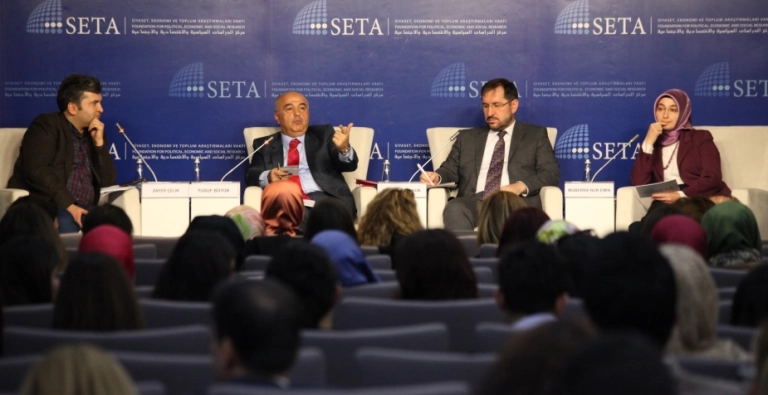
Moderated by Zafer Çelik of SETA-Ankara, the panel, on March 9, 2016, was held to bring under spotlight a recent analysis entitled “The Education of Syrian Children in Turkey” by Müberra Nur Emin, a research assistant for Education at SETA.
The panelists were Mr. Yusuf Büyük, the Ministry of National Education deputy undersecretary; Ms. Emin, a researcher for Education Department of SETA; Mustafa Tutkun, Deputy Managing Director of the Foundation for Turkish Religious Affairs (Diyanet Vakfı).
Emin: The National Education Curriculum must be Revised
The first panelist Emin made a presentation on the problems encountered in the education of Syrian refugee children and recommended solutions. The number of Syrian refugees in Turkey nears three millions in 2016, said the researcher who referred to the data released by the Directorate General of Migration Management. According to the data 273,000 Syrian refugees live in 26 shelters set up by the Turkish Prime Ministry Disaster and Emergency Management Authority (AFAD) in ten different provinces, and the rest of the refugees live outside the camps and in inner cities.
Ms. Emin, also the writer of the analysis, said the number of Syrian children aged between 0 and 18 in Turkey stands at 1,249.263. It means, 73 percent of these children are at the age of primary education, and this particular age group should be paid attention to in future research and analyses, she added.
Turkish Ministry of National Education has adopted two key education models on the subject. One of the models is The Ministry’s Temporary Training Centers (TTC) where the curriculum of the education in Syria is followed in Arabic. Emin said the TTCs is a very good model and an opportunity that Turkey presents to the world to save children from the instability of short-term migrations as far as their education is concerned. The second model is the public school system of Turkey; however, here, the language barrier is the biggest problem. According to Emin, yet another problem the children refugees face in Turkish public schools is the prejudice of Turkish teachers and parents, whose children attend these schools with Syrian children.
Apart from the TTCs, about 66,000 Syrian refugee children benefit from other education or training institutions in Turkey. The number of Syrian children in the TTCs is given by Emin as 273,000. She continued that Syrian teenagers do not attend high school due to social-economic reasons, and roam for earning bread and butter.
In the provinces with TTCs, transportation is also problem in the education of Syrian refugee children. Syrian kids of school age do not go to school due to financial difficulties and the issue of children workers. According to the researcher; language, physical infrastructure and lack of qualified teachers are other problems Syrian children face during their education in Turkey.
After listing the problems, Ms. Emin suggested several solutions, such as sending Syrian students to public schools, a revision of the Education Ministry’s curriculum to adopt a pluralist education approach, revising text books by academics and experts, and having helping hands of national and international organizations for refugee children living outside the camps. Emin’s last suggestion was to increase both financial and Turkish language support to Syrian students and their parents. She believes that financial assistance to the Syrian parents will reduce the problem of children workers.
Büyük: The TTCs are Unmatched in the World
Büyük took the floor after Emin, and said that the Turkish Ministry of National Education is tackling with a difficult issue as the number of refugees increases every passing day. He added that the State of Turkey has left her mark in the history during the Syrian crisis, reminding that Turkey did not have relevant procedures and regulations in the early years of the exodus. Büyük said, new procedures have been prepared in each unit, or department. “We will either integrate these children into the system or they will become terrorists. We will either provide education, make them teachers, or they will become thieves,” stressed Büyük, emphasizing the necessity of educating Syrian children.
Hunger and disease are forgotten as one finds food, but it is impossible to bring back a day passing without education, the deputy undersecretary went on to say. Turkey will achieve the integration of thousands of refugee children into the Turkish education system in the presence of Turkish People’s support and sensitivity to the matter. Büyük added that no nation in the world will provide education to refugee children by cutting the hours of education of their own children. He said that hours of education have been readjusted in about 200 schools to educate Syrian refugee students in these schools.
Turkey has set a precedent with the TTCs, said Büyük, who shared that Syrian refugee adolescents did not go to secondary schools at first, but after implementing the curriculum of the Syrian education system, all attended the school. During the academic year of 2016, the Ministry sent a notice to provinces to admit Syrian preschoolers and first graders to Turkish schools. Turkish education curriculum will be implemented for preschool and first grade education next year in the TTCs, the official explained. Owing to this, Syrian children will not suffer from lack of education, and their integration into the Turkish system will be achieved. Büyük added that this is a social case-study and that the Ministry will do its best, without a budget cut, to help Syrian refugees earn a living and have education.
After graduating from high school, all refugee students take an equivalency test and attend university according to their scores in this test. Büyük said that about 2300 students have been granted scholarships by the “Presidency of Turks Abroad and Related Communities” and are exempted from tuition.
Syrian teachers are paid equal amount of salary as their Turkish counterparts. The Ministry grants 40-50 Turkish Liras (per month) financial aid, for education expenses, to the children of poor families, and Syrian refugee students also will be granted the same amount, said Büyük.
Tutkun: The Civil Society should be Systematically Integrated into the Process
The last panelist Tutkun admitted that the Foundation, early on, acted upon the presumption that Syrian refugees would not stay long, and therefore, the problem of which curriculum would be adopted has emerged. Turkish Ministry of National Education and the Syrian Temporary Government prepared text books and the issue has been discussed in detail. Tutkun said: “We, as the Religious Affairs Foundation, offered the TTC model. At first, we launched a pilot project in six schools together with about a thousand Syrian teachers and Syrian people who are eligible to teach. As the necessity has arisen and as a result of screenings, we have requested permission from the Ministry for new schools and have been given permission for education in the afternoon. Currently, about 13,800 students are being educated in these centers.”
Tutkun, analyzing the current situation, said that the Foundation is doing research for solving potential future problems. The issue of whether or not the education they had in Turkey will be recognized if Syrian students go back to their country is on the table, Tutkun added. In this project, the Foundation concentrates on the southeastern province of Gaziantep, and education and training centers are being regularly reviewed and monitored by a team of evaluators.
Besides, a humanitarian assistance fund has been formed with the participation of 11 institutions and two individuals, Tutkun added. Therefore, all activities are coordinated under the same roof. Records of addresses of Syrian refugees and financial aids provided to them are kept. “These financial aids are crucial for supporting the refugee families and sending their children to school. From now on, inter-institutional coordination is also important. To prevent the uncertainty on authority, duties of each institution should be defined clearly and civil society should be integrated into the process more effectively and systematically.”
The panel entitled “The Education of Syrian Children in Turkey” ended following a Q&A session.


