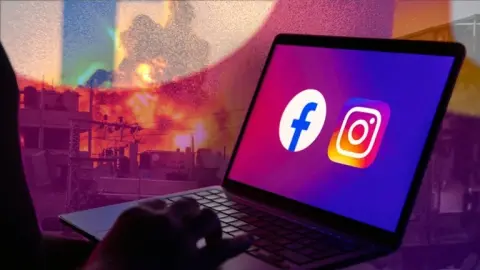
Meta's decision to block users' posts commemorating Ismail Haniyeh, the head of Hamas' political bureau who was killed in an assassination in Tehran, has once again drawn attention to the censorship of Palestine on social media. Among the complaints, Meta's removal of a post on Instagram, which it owns, about Malaysian Prime Minister Anwar Ibrahim's meeting with Haniyeh, and Facebook's removal of a live-streamed “funeral prayer” video from the Directorate of Religious Affairs account and imposing a publishing ban on the account stand out. Essentially, the Western-driven policy of silencing and ignoring the Palestinian issue is not limited to social media. Authorities have exerted serious pressure in many areas, from academia to politics, from the media to sports. Many statements of intent can easily be met with accusations of antisemitism.
Since October 7, at least 39,480 Palestinians have been killed in Israeli military attacks on Gaza. Moreover, the attacks were not limited to Gaza. In the West Bank, which is controlled by the PLO rather than Hamas, 569 Palestinians were killed, including 143 children. This means that even in the West Bank, a child loses their life every two days.
This indiscriminate violence has caused great outrage among people of conscience. As a result, social media platforms, which are today's most important means of mass communication and have more than 5 billion users, have naturally become a means of expressing reaction to civilian deaths. On the other hand, especially considering the established order in the Western world, supporting Palestine or criticizing Israel is like swimming against the current. Therefore, it is not surprising that the Palestinian issue is not addressed in traditional media outlets such as television, radio, and newspapers.
At this point, we can say that social media has emerged as an element that changes the balance and is less controllable. Theoretically, we are talking about an institution that is extremely democratic and practical in terms of freedom of information. Due to this potential, it is natural that the censorship and manipulation practices of conventional media are being transferred to social media.
Ultimately, it is evident that support for Palestine is being censored on social media platforms and that political priorities are coming into play. Some social media companies align themselves with the policies of the Israeli government. Indeed, a December 2023 report by Human Rights Watch (HRW), based on reports submitted to it, revealed that 1,049 posts shared on Instagram and Facebook that were found to support Palestine in a peaceful manner were unjustly censored by Meta.
Two Fundamental Dangers
There are two fundamental dangers signaled by the systematic censorship of content supporting Palestine. The first is the violation of freedom of expression by large-scale social media platforms for the sake of political preferences. Ultimately, those who dominate these platforms may impose their truths on the masses. Censorship carries the risk of creating more homogeneous societies by directing people's political behavior. This situation is an ontological problem for modern democracy, which is based on a pluralistic society. Ultimately, social media can ironically take on an anti-democratic function.
The second major danger for countries such as Türkiye, which are export markets for social network providers, is the reluctance of these global companies to comply with the domestic legal systems, i.e., the sovereignty, of the states in which they operate. There is no doubt that no sovereign state would accept being reduced to a passive position by a legal entity operating within its jurisdiction.
On the other hand, no one can guarantee that the censorship of the Palestinian issue today will not be applied to an issue directly concerning Türkiye tomorrow, or that an incident such as the closure of Donald Trump's X account will not occur for Turkish politicians during an election campaign. The reduction of the visibility of certain content and the promotion of other content through algorithms without human intervention, as well as the presentation of refined content to users, can also lead to manipulation reaching dangerous levels. Furthermore, it should not be overlooked that social media has become a significant threat to public safety in crisis situations requiring urgent intervention, such as widespread violence.
In this context, it is important to mention the following regulations introduced in Article 34 of Law No. 7418, which was adopted on October 13, 2022, as an important step towards increasing the transparency and accountability of social network providers before national regulators:
“The reports submitted by social media providers to the Authority shall include information on their algorithms related to headline tags, promoted or restricted content, advertising policies, and transparency policies.”
Social network providers are obliged to act in accordance with the principle of accountability, ensure transparency in the implementation of the Law, and provide the Authority with all necessary information and documents relating to the implementation of the Law upon request. Social network providers are obliged to treat their users equally and impartially, and the measures taken in this regard shall be included in the report to be submitted to the Authority. Social media providers shall take the necessary measures in cooperation with the Authority to prevent the publication of content and title tags related to crimes covered by this Law in their own systems, mechanisms, and algorithms, and shall include these measures in their reports. Social media providers are required to clearly and transparently disclose on their websites the parameters they use when making recommendations to users.
It is evident that platforms dominating the sector have gained an advantage over regulators by becoming an integral part of daily life and even a professional endeavor for those working in fields such as media, politics, and e-commerce. Given the technical flexibility provided by the internet, insufficient competition, and the market dominance of legal entities, it is inevitable that the state will develop an effective strategy to protect its legal order in response to these entities' power struggle with the state. A gradual, measured, effective, judicially supervised, and transparent system of sanctions should also be part of this strategy.
In addition to administrative oversight and judicial prosecution, parliamentary oversight must also be effectively implemented. The Parliamentary Commission on Digital Media, established in 2020, could be an important platform in this regard. Within the scope of a longer-term legislative reform, the Commission on Digital Media could be empowered to strengthen accountability and democratic control over social media by granting the specialized commissions in Parliament the authority to compel them to appear before them. Undoubtedly, regular public briefings by platform representatives and administrative regulators before the Digital Media Commission would be an effective way to ensure transparency.
In addition to all this, it should be emphasized that it is a prerequisite for constitutional democracy that the state, while fighting for sovereignty, acts with a perspective that prioritizes freedom of expression, which is the basis of scientific and cultural progress and the pursuit of rights and justice, and that it observes the limits of restrictions such as “not touching the essence of the right.” It is essential that the state act within a framework that reconciles state sovereignty and public order with freedom of expression, the requirements of the rule of law, and other individual rights and freedoms.