
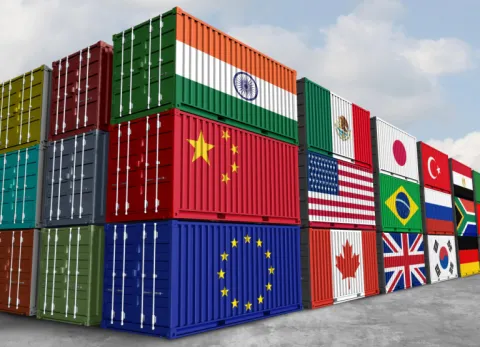
The global trading system has undergone a structural transformation in recent years due to increasing geo-economic competition, protectionist policies, and supply chain shifts. U.S. tariffs and uncertainties in trade policies are weakening the functioning of the global trading system. Therefore, free trade agreements (FTAs) have become policy instruments in both political and security dimensions beyond their purely economic significance.
The European Union (EU) is reassessing its trade and industrial policies in light of developments in the global economy. The recently signed free trade agreement between the EU and India stands out as a concrete reflection of the EU's risk diversification strategy amid increasing global uncertainties. The agreement plans to largely eliminate tariffs between the parties.
For India, the agreement represents a significant step toward strengthening its position in global value chains by gaining privileged access to the European market. For the EU, it is primarily important to develop alternatives to its China-centric production and supply infrastructure. From this perspective, the agreement signifies a geo-economic repositioning beyond mere trade gains. The EU is responding to global developments with such moves.
The agreement also has direct or indirect consequences for countries with intensive trade with the EU. From Türkiye's perspective, the similarity in export structures to the EU market with those of India indicates that competitive pressure may increase in various sectors. Despite having a Customs Union agreement with the EU, Türkiye's exclusion from the decision-making processes of the EU's free trade agreements has the potential to create asymmetrical effects. This situation constitutes an area that needs to be carefully monitored, both in terms of Türkiye's position in the EU market and its trade balance with third countries. In this context, Türkiye's integration into the EU's value chain, its commencement of steps in line with the EU's green transformation, its logistical advantages, and regulatory harmonization stand out as points that can provide a competitive edge.