
The management of water resources has become one of the most critical problems for countries due to the impact of factors such as increasing population, climate change, and industrialization. One of the fundamental concepts in this field is the “amount of water withdrawn” (water withdrawal), which refers to the volume of water (in km³) physically procured from surface, groundwater, or marine resources in line with agricultural, industrial, energy, and domestic needs. The “level of water stress” is obtained by calculating the ratio of this amount to the total freshwater capacity of a region that can naturally replenish itself every year through precipitation and runoff. Expressed as a percentage (%), this ratio measures the severity of human and economic pressure on water resources; rates above 25% are considered the onset of water stress, while rates above 70% are evaluated as a severe risk of water scarcity.
Level of Water Stress by Country (2022)
According to 2022 data, Turkiye's level of water stress is observed to be 47.89% (Graph-1). Turkiye is positioned in a medium-stress group between countries like Bulgaria, Greece, and France, whose stress levels hover in the 20-21% range, and Middle Eastern countries, whose freshwater resources are reaching the point of depletion. This level indicates that Turkiye is not a water-rich country; on the contrary, it must manage its existing resources very carefully.
Amount of Water Abstracted in Türkiye by Water Source
When water use data by source in Turkiye is examined (Graph-2), it is observed that the total amount of water withdrawn shows a steady upward trend. In the period from 2018 to 2024, the total amount of water withdrawn increased from 17.5 km³ to the level of 20.4 km³. Seawater accounts for the largest share in total withdrawals, with a volume exceeding 11 km³. Furthermore, it is noteworthy that the amounts of water withdrawn from surface water and fresh groundwater resources have also increased over the years, and the pressure on freshwater reserves persists.
Average Water Potential of Basins in Türkiye (2020 - 2024)
Turkiye's average water potential (total surface and groundwater) does not show a geographically homogeneous distribution (Graph-3). Fırat-Dicle Basin alone hosts by far the largest portion of the country's water potential with 59 km³. In contrast, the water potentials of the basins in the Marmara, Aegean, and Central Anatolia regions (mostly in the range of 2 to 8 km³), which constitute the center of gravity for population density, industry, and agricultural production, remain at very limited levels.
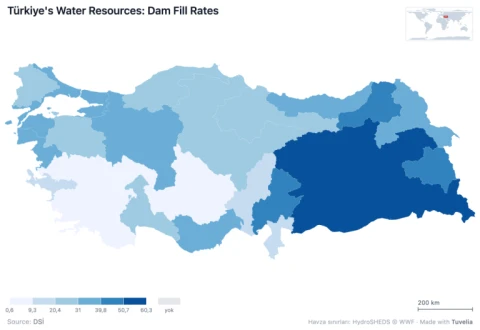
Türkiye's Water Resources: Dam Fill Rates
This geographical imbalance in water potential is also directly reflected in dam occupancy rates on a basin basis (Graph-4). During the 2020-2024 period, occupancy rates in the eastern and northeastern basins (Fırat-Dicle, Çoruh) have been relatively high and stable. However, the picture differs significantly in the Aegean and Mediterranean regions. It is observed that dam occupancy rates in basins such as Gediz, Büyük Menderes, and Burdur Lakes have dropped to the 10-20% band, and this situation has become chronic since 2021.
In conclusion, Turkiye's increasing water withdrawal volume and its water stress level of 47.89% indicate growing pressure on resources. While the total water potential is concentrated in the eastern basins, the low water potential in the Marmara, Aegean, and Mediterranean regions is the main indicator of the regional imbalance between water supply and demand in the country.