
The relationship between education level and earnings is one of the fundamental indicators used to analyze labor market dynamics. Defined as the "education premium," this concept refers to the economic return on investment in higher education and vocational skills. In the OECD data on which this article is based, the average earnings of high school graduates are taken as the reference value of "100". The values for other education levels indicate exactly what percentage the average earnings of the respective education group correspond to when compared to the average earnings of a high school graduate. For example, an index value of 139.6 means that the relevant group earns 139.6% of the average earnings of high school graduates (39.6% more), while a value of 81.3 means they earn 81.3% of the average earnings of high school graduates (18.7% less).
Relative Earnings by Education Level in Selected Countries (Below Upper Secondary Education)
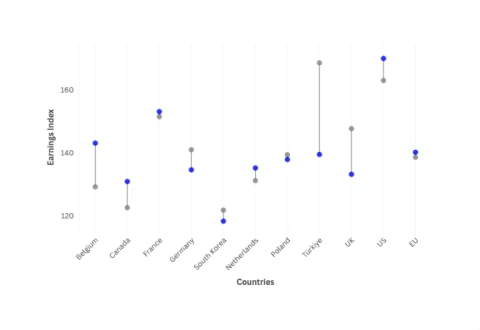
Relative Earnings by Education Level in Selected Countries (University)
When the data is examined, a distinct earnings differentiation based on education levels is observed in Türkiye in 2014. While the earnings index for university graduates was recorded at 168.7 in 2014, it is observed that this ratio declined to 139.6 by 2022. In the lower education group (below upper secondary education), however, the index increased from 76.3 to 81.3 over the same period. These statistics indicate that salary bands are converging in the Turkish labor market.
It is understood from the other country data in the chart that this downward trend in the relative earnings advantage of university graduates is not unique to Türkiye; a similar trend is being experienced in global labor markets. In the period from 2014 to 2022, decreases in the earnings premium brought by a university degree are also seen in advanced economies. The earnings index for university graduates declined from 141.1 to 134.7 in Germany, from 147.8 to 133.3 in the UK, and from 121.9 to 118.4 in South Korea. The most striking result that emerges at this point is that although the earnings advantage of university graduates in Türkiye (139.6) experienced a significant decline over the eight-year period, the current ratio reached is still at a higher level than the current ratios of countries like Germany, the UK, and South Korea.
When current rates in Türkiye are compared with European Union averages, a statistical parallelism emerges. As of 2022, the indices across the European Union, which are 81.0 for below upper secondary education graduates and 140.3 for university graduates, are almost identical to Türkiye's indices (81.3 and 139.6).
Data for the 2014-2022 period show that education-based earnings differences in the Turkish labor market have decreased. In examples like Germany, the UK, and South Korea, the earning advantage that university graduates hold over high school graduates is also narrowing. Although the narrowing in the Turkish labor market has been recorded as a sharp decline, the 39.6% earnings advantage retained by university graduates continues to remain above that of the developed countries mentioned before and simultaneously displays a quantitative alignment with the European Union average.