
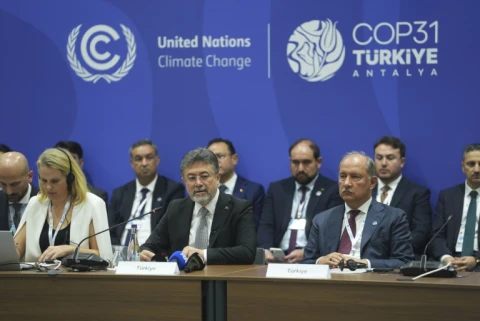
On 11 November 2026, at the forest event of the COP31 Leaders' Summit in Antalya, Minister of Agriculture and Forestry İbrahim Yumaklı announced the launch of the Integrated Fire Management Antalya Action Plan. Five days later, on 16 November, the plan was officially presented at a high-level dialogue held in the COP31 Blue Zone. At the launch, Minister Yumaklı said that they had come together with their partners to bring the plan announced at the Leaders' Summit to the implementation stage.
Behind the plan lies a growing problem. As reported by FAO, an average of 261 million hectares worldwide were affected by fire each year between 2007 and 2019, and nearly half of this area was forest. According to the concept note of the COP31 Leaders' Summit forest event, fires accounted for 42 percent of global tree cover loss in 2025. In Minister Yumaklı's words at the launch, forest fires are no longer a seasonal and local problem. This piece introduces what the plan is, the process it emerged from and its relationship with existing structures, and then turns to the plan's next steps.
What Is the Antalya Action Plan?
According to Minister Yumaklı's statement on 11 November, the plan was prepared under Türkiye's leadership in cooperation with Brazil, the Republic of Korea, the UN Food and Agriculture Organization (FAO) and the Forest and Climate Leaders' Partnership. FAO's COP31 events program, for its part, presents the plan as an initiative launched by the governments of Türkiye, Brazil and Korea together with the Global Fire Management Hub and the Forest and Climate Leaders' Partnership. Participation in the plan is designed to be voluntary. Minister Yumaklı invited all countries and partners to join the plan and said that it aims to turn global commitments into practical cooperation, shared knowledge and concrete action on the ground.
Integrated fire management, the term in the plan's name, is an approach that addresses fire across all stages of prevention, preparedness, response and recovery. The Call to Action on Integrated Fire Management and Wildfire Resilience (the Belém Call), announced in Belém in November 2025, defines this approach as a holistic form of management that brings together science, policy, traditional knowledge and modern technologies.
The plan's objectives were set out at the launch on 16 November. According to Minister Yumaklı, the plan focuses on four objectives. These are joint cross-border response capacity; early warning based on science, data and innovation; landscape management and restoration suited to local fire regimes; and access to finance, capacity and technology, particularly for developing countries. In the same speech, the Minister said that there is a need to shift from an approach focused on extinguishing fires after they start to an integrated approach focused on preventing them before they start.
The statements made public contain no information on the plan's budget, timeline or follow-up mechanism. This is not surprising for a newly launched voluntary plan. However, it is precisely these yet-to-be-announced elements that will determine the plan's impact.
What Process Did the Plan Emerge From?
The Antalya Action Plan did not appear overnight. On 20–22 October 2025, Türkiye organized an international conference on forest fires in Istanbul as part of a country-led initiative in support of the UN Forum on Forests. The conference report (the Istanbul Report) was published as a UN Economic and Social Council document. According to the report, the Belém Call, which Brazil was working on, was presented to participants at this meeting, and countries were invited to endorse the Call at leaders' level. On 6 November 2025, at the Belém Climate Summit, the Call was announced as part of COP30. According to FAO, as of September 2026 the Call is endorsed by 68 countries, including Türkiye, and four international organizations.
The Belém Call is a voluntary framework of 22 points. It envisages a shift from suppression-centered approaches to prevention-based strategies, cross-border cooperation and the strengthening of local actors; it also calls for strengthening the Global Fire Management Hub within FAO. Another text from the same period came from the G7. In June 2025, G7 leaders adopted the Kananaskis Wildfire Charter; five countries, including Australia and Korea, endorsed the Charter.
At the launch, Minister Yumaklı listed the Kananaskis Charter, the Istanbul Report and the Belém Call among the milestones of this momentum. In the Minister's words, all of these texts convey the same message: "The solutions are in our hands, but our approaches are still fragmented." Minister Yumaklı presented the plan as turning the promise made in Belém into action in Antalya. In other words, the Antalya Action Plan is being presented as an initiative to link existing commitments to implementation.
The Plan's Place at COP31
Türkiye is hosting the conference in Antalya and holds the COP Presidency. The plan's place at COP31 should be read together with the division of labor between Türkiye and Australia at the conference. According to the Australian government's statement of November 2025, exclusive authority over the negotiations rests with Australia. The same statement also notes that the action agenda, which covers voluntary initiatives outside the negotiations, will be strengthened and that the leads of this agenda will be determined together with Türkiye. According to the statement, Türkiye is responsible for the COP31 Action Agenda. The Antalya Action Plan, which is non-binding and based on voluntary participation, can be considered within this area. On 11 November, Minister Yumaklı had also said that he hoped COP31 would go beyond being a summit of commitments for forests and become an implementation COP.
The plan can also be linked to the bridge-country discourse in Türkiye's climate diplomacy. Vural and Baysal (2026), in their Odak piece for SETA, examine this role, long emphasized in official discourse, and Türkiye's capacity to bring different blocs together at three levels. At the lowest level lies technical facilitation in transboundary water, forest and ecosystem disputes; according to the authors, data harmonization and joint monitoring protocols are core components of solutions in this area. Fire is not a matter of dispute, but it relies on similar technical tools such as early warning and data sharing. The Belém Call defines fire risk as a transboundary problem that affects all regions and that no country can overcome alone. In Minister Yumaklı's words in Antalya, "Fires know no borders. The solution must be shared."
The Plan's Relationship with Existing Structures
The plan does not arrive in an empty field. The Global Fire Management Hub, one of the plan's partners, was established in 2023. The Hub's areas of work include knowledge and data sharing, fire-resilient communities, and risk reduction and early warning. These areas largely overlap with the plan's objectives. What the plan will add to the Hub's ongoing work will become clear with the implementation steps yet to be announced.
The plan was announced at the same event as developments in forest finance. At this event, it was announced that the Netherlands would contribute up to USD 500 million over 10 years to the Tropical Forest Forever Facility (TFFF), and philanthropic organizations a total of USD 88 million. The TFFF, first put on the agenda by Brazil at COP28 in 2023, aims to make per-hectare payments to countries that protect their tropical forests. The fund has a direct link to fire. According to the design document (Concept Note 3.1), each hectare degraded by fire is expected to lead to the deduction of payments for 35 hectares. Point 19 of the Belém Call, in calling for long-term fire resilience to be integrated into investment mechanisms, also cites the TFFF as an example. However, the TFFF covers only tropical and subtropical moist forests in developing countries, and Türkiye is not on the list of eligible countries. Nor is the fund making payments yet. The first payments are not expected before 2028, and rules such as how forest degradation will be monitored and penalized are still under negotiation. Therefore, the sources from which the finance under the plan's fourth objective will be provided, particularly for Mediterranean forests, have not yet been announced.
Türkiye also has experience it could share within the framework of the plan. The USD 400 million Türkiye Climate Resilient Forests Project, launched with the World Bank in 2024, aims to strengthen fire management and the resilience of forests and people to fire in the 14 provinces with the highest fire risk. According to the General Directorate of Forestry, 10,830 forest villager families received TRY 2.55 billion in support under ORKÖY in 2025. According to Ministry data, the number of forest fire volunteers rose from 13,000 in 2021 to 142,000 in 2026; according to the same data, 86 percent of fires in 2026 were human-caused.
What Could the Next Step Be?
The Antalya Action Plan is the Antalya link in a process that began in Istanbul and passed through Belém. Its four objectives have been announced; its budget, timeline and follow-up mechanism have not yet been announced. Four issues may prove decisive for the plan's course from here.
The first is follow-up. A reporting arrangement that makes visible what participating countries have committed to and what steps they have taken could be the most concrete next step for a voluntary plan. The second is finance. It is not yet clear with which resources the fourth objective will be realized, or where Mediterranean forests, which the TFFF does not cover, will fit in this picture. The third is local communities. On 11 November, Minister Yumaklı had devoted one of the three priorities he listed for the 2030 forest goal to forest villagers and local communities, saying that forests cannot be sustainably protected unless the livelihoods of these groups are supported. This priority could find concrete expression in the implementation of the plan's landscape management and restoration objective.
The fourth issue is health. The Istanbul Report notes that fire-related air pollution causes premature deaths on a large scale, and the Belém Call notes that fires pose serious risks to health and air quality. In the Mediterranean basin, there is no binding joint monitoring and early warning regime that addresses the transboundary health effects of fire smoke and covers all of the basin's littoral states. If the plan's early warning objective is expanded to cover smoke and air quality, it could offer a starting point for addressing this gap, even within a voluntary framework. The steps taken on these issues during Türkiye's COP Presidency will be decisive in moving the plan to the implementation stage.
