
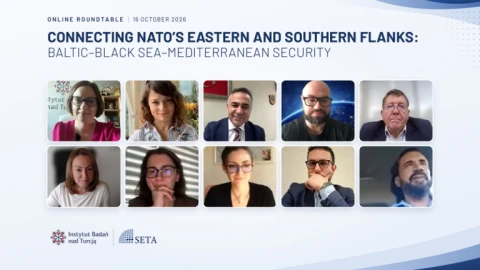
The SETA Foundation for Political, Economic and Social Research held an online workshop titled "Connecting NATO's Eastern and Southern Flanks: Baltic-Black Sea-Mediterranean Security".
Experts from Türkiye, Poland, Romania, Ukraine, Bulgaria and other European countries took part in the workshop. Murat Aslan, faculty member at Hasan Kalyoncu University and SETA researcher, gave the opening speech. Polish expert Karolina Olszowska moderated the workshop.
A Strategic Corridor from the Baltic to the Mediterranean: In Search of a Conceptual Framework
The first session of the workshop focused on how the strategic links between the Baltic Sea, Central Europe, the Black Sea and the Mediterranean should be conceptualized. First, Antonia Colibasanu of the Romania-based New Strategy Center described the Black Sea as a geopolitical pivot between the Baltic Sea and the Eastern Mediterranean. She said that the security links between these three seas have become increasingly important because of Russia's hybrid warfare activities and its destabilizing attempts that target economic infrastructure. She stated that a new line of defense and containment stretching from the Baltic to the Mediterranean is taking shape. She pointed to the importance of different initiatives complementing one another in infrastructure projects that would improve military mobility and regional security.
Academic Nihal Erkan proposed the concept of "overlapping security complexes" to describe the regional security architecture. According to Erkan, the Baltic, Central Europe, the Black Sea and the Mediterranean cannot be fully separated from one another. Nor can they be treated as a single security space with all their operational features. Erkan drew attention to Russia's flexibility in shifting its activities and conflict agendas between regions. She argued that NATO and the European security architecture should develop a multi-layered approach to counter this flexibility.
Karol Wasilewski of the Poland-based Centre for Eastern Studies (OSW) also said that Baltic and Black Sea security are interconnected. He noted that the economic and strategic futures of Türkiye and Poland are closely tied to the seas. For Türkiye, he cited the Sakarya Gas Field in the Black Sea, energy connections and trade as examples. For Poland, he cited energy projects in the Baltic Sea, offshore energy infrastructure and the hydrogen economy. He stated that hybrid threats, unmanned systems, risks to critical infrastructure and Russia's shadow fleet are among the common security issues the two countries face.
Margo Samojedny, founder of the institute "The Opportunity", said that Russia regards the land geography between the three seas as a single strategic space. She proposed making more effective use of the Three Seas Initiative. Stressing the importance of access to the Adriatic Sea for the Baltic and Black Sea countries, Samojedny cited the ports of Rijeka, Koper and Trieste as examples of transport links and military mobility.
The views expressed in the session showed that regional security links do not rest on a common military threat alone. Maritime trade, energy systems, land and river transport, critical infrastructure and hybrid activities also shape them. Erkan's multi-layered security complexes approach offered an alternative conceptual framework that draws attention to the need to preserve regional differences.
Regional Partnerships on NATO's Eastern and Southern Fronts and the Black Sea
The second session of the workshop stressed that Türkiye and Poland are two strategic countries that could strengthen coordination between NATO's Eastern and Southern flanks. The session also addressed Romania's logistics infrastructure and regional partnerships, as well as the distinct legal and strategic status of the Black Sea.
In this context, Rear Admiral Iuri Covaleov of the New Strategy Center proposed more effective implementation of Türkiye-Poland-Romania trilateral cooperation and of existing strategic partnership arrangements. He described Poland as an important element of Central Europe and of NATO's northeastern flank, Türkiye as the strategic power of the Southern flank, and Romania as the country that links these two areas. He said that even putting into practice the goals set out in existing cooperation documents would create a long-term and comprehensive work agenda.
Wasilewski likewise said that the Türkiye-Poland-Romania consultation mechanism should be developed and that Ukraine should be more involved in this cooperation. He regarded Türkiye's contribution to Baltic air policing and Poland's military presence at İncirlik Air Base as concrete indicators of the security ties between the two regions.
Ukrainian expert Yevgeniya Gaber stressed that coordination among Türkiye, Poland, Romania and Bulgaria should not leave Ukraine out. She said that Ukraine's defense experience, the capabilities it has developed against unmanned systems and its expertise in maritime security could contribute to regional defense. Gaber stated that European security should not be defined as the security of European Union members alone. She proposed that actors such as Türkiye, Ukraine, the United Kingdom and Norway be considered within a broader European defense framework.
On the Turkish Straits regime and Black Sea security, Hazel Çağan Elbir of the Center for Eurasian Studies (AVİM) said that the 1936 Montreux Convention Regarding the Regime of the Straits forms the basic international legal framework. Çağan Elbir cited an example of the Montreux regime's contribution to regional stability. After the Russia-Ukraine war began in 2022, Türkiye applied Article 19 of the Convention and restricted the passage of the belligerents' warships through the Straits.
Moderator Olszowska also pointed to the historical and current strategic importance of the Montreux regime. She said that Türkiye's position on the Straits is decisive for Black Sea security.
Common Security in the Black Sea: From MCM Black Sea to the Need for a Common Strategy
The third session of the workshop featured assessments of MCM Black Sea (the Mine Countermeasures Black Sea Task Group), European security, perceptions of Russia and the need for a common strategy.
SETA researcher Rıfat Öncel noted that the United States remains a determining actor in European security, including in the Baltic, Central Europe and the Western Balkans. He said that regional initiatives should take into account the American factor within NATO. In addition, Öncel stated that deeper relations between armed forces and joint exercises would contribute to interoperability. He regarded the Mine Countermeasures Black Sea Task Group (MCM Black Sea), formed by Türkiye, Romania and Bulgaria, as a successful example of cooperation that responds to a concrete security need.
Gaber acknowledged that the MCM initiative was a useful start. However, she said that the current structure may not be sufficient against newly emerging threats. Gaber noted that the task group's period of activity and its operational scope are limited. She stressed that more continuous and wider capabilities are needed to protect maritime trade, critical infrastructure and the maritime areas of the littoral states.
Maria Simeonova of the European Council on Foreign Relations proposed expanding the current structure of the MCM initiative, making more effective use of mechanisms within NATO and the EU, and strengthening regional cooperation to protect trade corridors.
On regional cooperation, SETA researcher Yücel Acer said that these regional mechanisms have gained importance because the great powers have not been able to develop a common security approach. However, he stressed that the threat perceptions of European countries do not fully overlap when it comes to building cooperation. He noted that Russia is seen as one of the main threats, particularly by Eastern European countries. Türkiye, he added, also faces threats from other states.
Along these lines, Aslan said that differences in approach between the United States and Europe, and gaps in coordination among European institutions, make it difficult to develop a comprehensive strategy. He noted that Russia's goals may not be limited to Ukraine and should be assessed as part of a search for a wider sphere of influence. In this context, he said that NATO countries should analyze Russia's possible courses of action and worst-case scenarios.
The workshop showed that the security links between the Baltic, Central Europe, the Black Sea and the Mediterranean are becoming increasingly important. At the same time, the different operational needs and legal conditions of these regions should be taken into account in common security planning.
The workshop also stressed that Türkiye-Poland-Romania cooperation should be strengthened and that Ukraine's participation in this process should be ensured. Participants also emphasized the distinct legal and strategic position of the Black Sea and the role of the Montreux Convention in maintaining stability in the region.
The workshop further drew attention to the importance of regional cooperation mechanisms and to the need to develop them. Participants described the Mine Countermeasures Black Sea Task Group (MCM Black Sea), formed by Türkiye, Romania and Bulgaria, as an important example of such mechanisms.
In his closing remarks, Aslan proposed sustaining the dialogue among experts through regular meetings and producing concrete policy recommendations from the discussions. He added that experts from the Gulf region could also be included in future meetings. Olszowska stated that the workshop marked the beginning of a broader expert dialogue and project that would address different dimensions of regional security.