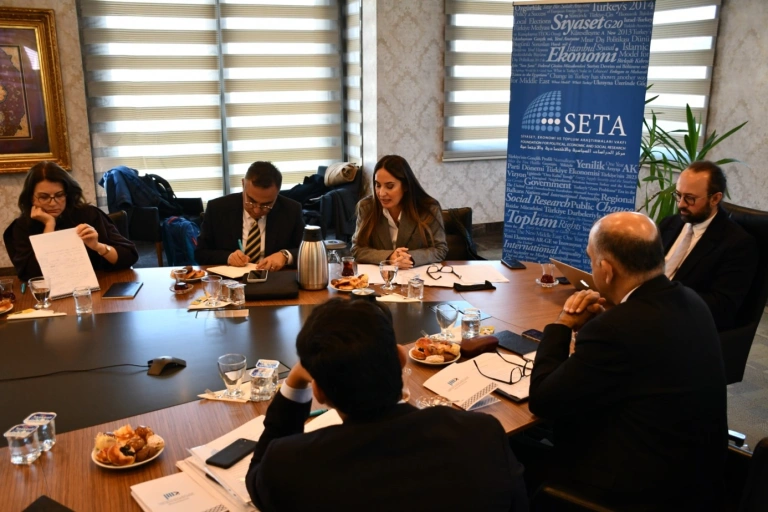
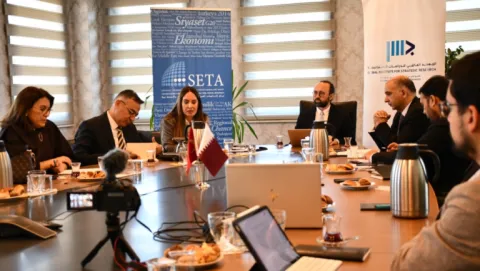
On 14 December 2024, the SETA Foundation and the Global Institute for Strategic Research (GISR) held a comprehensive roundtable in Istanbul titled “The Future of NATO and Middle East Security: Challenges, Opportunities, and Regional Dynamics.” Taking place at a time of rapidly shifting regional and global security landscapes, the workshop examined both the debates surrounding NATO’s future and the transformation of the Middle East’s security architecture through expert insights. Opening remarks were delivered by GISR General Coordinator Dr. Mohamed Chihi and SETA Academy Director Dr. Faruk Yaslıçimen.
The core themes of the meeting centered on the security debates that have intensified in Europe following the Russia–Ukraine war, the new political atmosphere emerging after the 2024 U.S. elections, and the impact of Washington’s strategic shift toward Asia on NATO. Participants highlighted that the re-election of Donald Trump has raised new questions about the transatlantic security architecture and that NATO’s future performance will carry significant implications for both Europe and the Middle East. The rise of pro-Russian populist parties in Europe, the U.S. prioritization of Asia–Pacific competition, and the expanding influence of actors such as China and Iran emerged as some of the most discussed topics regarding NATO’s strategic direction.
A New Security Architecture in the Middle East and NATO’s Role
During the first session, titled “NATO, Regional Alliances, and the Emerging New Middle East Order,” GISR Executive Director Dr. Mohamed Chihi, Qatar Ministry of Foreign Affairs First Secretary Dr. Khalid Abdulaziz Al Khulaifi, SETA researcher and academic Prof. Dr. Murat Aslan, and SETA researcher Dr. Bilgehan Öztürk took the floor.
Panelists assessed the shifting geopolitical dynamics in the Middle East, examining factors that have weakened traditional power structures, elevated new regional actors, and contributed to complex security dilemmas. They emphasized that the regional balance of power has changed sharply in recent years; Gulf countries have diversified their foreign policy orientations, while regional actors such as Iran, Türkiye, and Israel have become increasingly influential.
The session also highlighted the emergence of new security architectures outside NATO.
Regional alliance initiatives, bilateral defense agreements, and multilateral security platforms were discussed as structures that either complement or, at times, compete with NATO’s historical role in the region. Panelists explored the question “Is a new security mechanism in the region possible?”, stressing that the future of NATO’s regional partnerships will be of critical importance.
Another prominent theme in the first session was the growing influence of China and Russia in the Middle East. Speakers noted that the U.S. pivot to Asia has had direct implications for NATO’s presence in the region, allowing China and Russia to expand their room for maneuver. In this context, discussions focused on how NATO’s strategic priorities may evolve and how the alliance might redefine its role in the Middle East.
Conflict Zones in the Middle East and NATO’s Future Role
The second session, titled “The Future of NATO and Security Threats in the Middle East,” featured presentations by Dr. Khalid Al Jufairi, GISR researcher Mudassar Ali Baig, and Istanbul Medeniyet University faculty member Assoc. Prof. Helen Sarı Ertem.
This session centered on the longstanding and increasingly complex conflict zones across the Middle East. Panelists discussed the implications of instability in Iraq, Syria, Yemen, and Libya for NATO, debating whether the alliance should play a direct or indirect role in these areas and, if so, what form that role should take.
Speakers offered various perspectives on how NATO could approach peacekeeping, conflict management, and de-escalation efforts in high-risk environments. The rise of non-state armed actors, the prominent role of militias, radicalization processes, and the diversification of terrorism threats were underscored as key issues shaping regional security.
Cybersecurity and hybrid threats emerged as another crucial topic of discussion. Panelists emphasized that regional actors have increasingly resorted to sophisticated cyberattacks, targeting energy infrastructure, financial systems, and public-sector networks. The discussion addressed how NATO’s expertise in these areas could be transferred to regional partners and how local actors could better adapt to new-generation security threats.
Future Perspectives
The workshop concluded with a closing session in which key themes from the discussions were summarized and potential future areas of cooperation were explored. Representatives from both SETA and GISR expressed strong commitment to advancing joint research projects, academic events, and expert exchange programs within the field of security studies.
This comprehensive workshop organized by SETA and GISR made a valuable contribution to regional and global security debates by addressing critical questions surrounding the future of NATO and the evolving security dynamics of the Middle East. The multidimensional analyses presented by experts underscored that both NATO’s strategic orientation and the structure of Middle Eastern security architecture are likely to undergo significant transformations in the coming period.