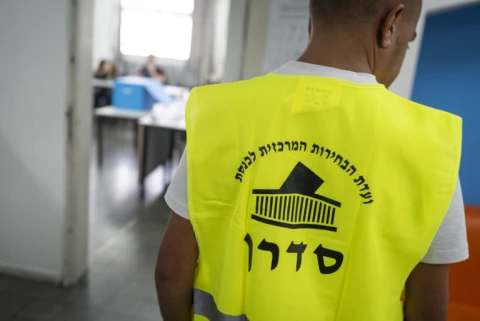
The elections for the 26th Knesset, held on 27 October 2026, have raised questions not only about the future of the government in Israel but also about the limits of change in its regional policies. According to the latest data published by Israel’s Central Elections Committee, Likud, led by Binyamin Netanyahu, emerged as the largest party with 20.52 percent of valid votes. Yashar, led by Gadi Eisenkot, received 16.05 percent, Beyahad, led by Naftali Bennett, 9.34 percent, and the Joint List, 8.79 percent. The Committee states that the final results will be officially published by 4 November 2026 and may change before that date.
According to the seat distribution reported after the vote count, the Netanyahu bloc secured 53 seats, the opposition bloc coalescing around Eisenkot secured 48, and the Arab parties obtained a total of 19 seats. Thus, neither of the two main blocs reached the 61-seat majority in the 120-member Knesset. The formation of a government consequently depends on negotiations between the blocs and on whether pre-election political vetoes can be overcome.
However, the extent to which changes in the parliamentary arithmetic of power will be reflected in Israel’s foreign and security policies remains a separate question. Does the convergence of anti-Netanyahu actors around a demand for a change of government mean that they share an alternative approach to issues ranging from Palestine and Iran to Syria, Lebanon, and relations with the Gulf states? Would a potential change of government bring about a fundamental transformation in regional policies, or would it enable the continuation of existing objectives through different military and diplomatic instruments?
In this edition of “Experts Respond,” Tuğçe Ersoy Ceylan, Serhan Afacan, Abdulgani Bozkurt, and Sibel Düz assessed the coalition possibilities arising from the elections, the elements of continuity and change in Israeli politics, and their regional implications.
By:
Sibel Düz, SETA
Contributors:
- Tuğçe Ersoy Ceylan, Izmir Katip Çelebi University
- Serhan Afacan, IRAM
- Abdulgani Bozkurt, Recep Tayyip Erdoğan University
- Sibel Düz, SETA
 Tuğçe Ersoy Ceylan
Izmir Katip Çelebi University
Does the political landscape emerging from the results of the 2026 Knesset elections indicate a loss of strength for the right-wing bloc led by Netanyahu, or the reproduction of existing balances in Israeli politics? In light of the post-election coalition arithmetic, what form of government appears feasible?
The political landscape produced by the 2026 Knesset elections points to a numerical decline for the right-wing bloc led by Netanyahu, but to continuity in the fundamental dilemmas of Israeli politics. According to the results, which have yet to be finalized, the Netanyahu bloc has obtained 53 seats, the Eisenkot-led opposition 48, and the Arab parties a total of 19. This distribution shows that the incumbent government has lost its majority. Nevertheless, Likud’s position as the largest party and the opposing bloc’s inability to establish a governing majority on its own prevent this loss from translating into Netanyahu’s political elimination. The central outcome of the elections, therefore, is the separation between Netanyahu’s decline and a transition to the post-Netanyahu era.
It is also necessary to distinguish between the strength of the Netanyahu bloc and the weight of the right in Israeli politics. The presence of right-wing politicians such as Bennett and Liberman within the opposition demonstrates that the ruling bloc’s loss of seats does not automatically signify a shift to the left. Opposition to Netanyahu does not produce a common alternative program on the Palestinian issue, security policies, or the Jewish identity of the state. While voters have punished the current government, political competition will largely continue within boundaries defined by the right. For this reason, the results can be interpreted both as a loss of strength for the government and as the reproduction of existing political balances through different actors.
The decisive question in coalition arithmetic is which political partnerships can bring the required seats together. Because Netanyahu cannot reach a majority with his existing partners, he must draw a party from the opposition into his camp or secure a broader agreement across blocs. From Eisenkot’s perspective, a government formed with the participation or external support of the Arab parties appears arithmetically possible. However, vetoes within the opposition against cooperation with Arab parties, together with structural inequality in Israel, constitute major obstacles to this option. Moreover, Ra’am’s seven seats alone would not bring the opposition to 61 seats, the position of the Joint List also becomes important.
Under these conditions, a cross-bloc unity government is among the principal formulas that could be negotiated. Whether such a government would be established under Netanyahu’s leadership, through a rotating premiership, or following a change of leadership within Likud is a separate matter requiring agreement. The participation of the Haredi parties in an alternative partnership also depends on resolving the disagreement over military service obligations. None of these formulas can be assumed to work automatically, in other words, each requires actors to retreat from their pre-election red lines.
If no agreement is reached, the possibility of another election will remain on the agenda. Meanwhile, Netanyahu’s position as head of the caretaker government will allow him to retain executive power despite having lost his majority. The elections in Israel have produced an outcome in which the incumbent governing majority could not be reproduced, yet no shared will to govern has emerged to replace it.
 Serhan Afacan
IRAM
What do the Knesset elections, held after the war that began with the military operations conducted by the United States and Israel against Iran in 2026, mean for the future of Israel’s strategy toward Iran? How might the results of the Israeli elections affect regional alliances and, in particular, the Israel-Gulf normalization process?
First, it is important to emphasize that there is a cross-party security consensus in Israel regarding the “Iranian threat,” and that Tehran does not perceive the security risks emanating from Israel as being confined to Netanyahu personally. In this respect, it can be argued that Iran does not attach great significance to the Israeli elections. However, although Netanyahu’s rival Eisenkot also maintains a clear stance toward Iran that includes the pursuit of regime change, several important nuances should be considered: his influence over the United States is more limited, and he leaves open the possibility of increasing general pressure on the Iranian regime through economic sanctions, alongside military strikes targeting Iran’s concrete military and nuclear capabilities.
Iranian officials are also aware that Netanyahu may be more willing to launch another attack against their country. This helps explain Iran’s efforts not to provide Netanyahu with material that could strengthen his position in the run-up to the Israeli elections, and even its decision to leave certain Israeli provocations, such as violations of Iranian airspace, unanswered. Consequently, although neither the Netanyahu camp nor the opposition emerged from the elections with a majority sufficient to form a government, Netanyahu’s continuation as prime minister until a new government is established, as well as the possibility that he may retain this position in the new period, are developments that increase the risk of conflict. At this point, the critical question is how the process will be affected by the letter sent on 25 October by U.S. Vice President JD Vance, through Qatar, to Mohsen Rezaei, Secretary of Iran’s Supreme National Security Council, calling for negotiations. Tehran still regards the United States as the principal actor in the tensions. Of course, given that the attacks against Iran in June 2025 and February 2026 took place while negotiations between Washington and Tehran were ongoing, this letter-based diplomacy should also be approached with caution. In any case, if one considers that Netanyahu could be more effective than Eisenkot in sabotaging a possible diplomatic initiative by the Trump administration toward Iran, it can be argued that the current political landscape emerging from the Israeli elections has placed an already vigilant Iran on even higher alert.
I believe the elections will have only a limited impact on regional alliances and, in particular, on the Israel-Gulf normalization process. For a breakthrough in the direction desired by Trump and Netanyahu, Saudi Arabia would need to join the process. However, I do not expect Riyadh to move in this direction, at least under the current circumstances. Nevertheless, Israel will clearly seek to weaken the Mecca Alliance. To this end, Israel can be expected to try to draw Saudi Arabia to its side in the coming period by exploiting security problems arising from the Houthis in Yemen. The decisive factor will be the Mecca Alliance’s capacity and determination to provide collective defense.
 Abdulgani Bozkurt
Recep Tayyip Erdoğan University
Considering Israel’s military presence and security policies in Syria and Lebanon, what changes might the results of the 2026 Knesset elections bring about in Israel’s strategy toward these two countries?
It does not appear realistic to expect the 2026 Knesset elections to produce a fundamental strategic transformation in Israel’s policies toward Syria and Lebanon. When assessing the differences between Netanyahu and Gadi Eisenkot, it is necessary to consider not only the military but also the ideological and theopolitical foundations of Israel’s security doctrine. Although the two figures represent different political orientations, both embrace the Zionist conception of the state and prioritize Israel’s regional security superiority. Their differences therefore become apparent in the instruments used to achieve these objectives rather than in the fundamental goals concerning Israel’s regional position. Nevertheless, Eisenkot’s approach can also be read as more closely aligned with an effort to rebuild Israel’s international legitimacy and image, which have been seriously eroded, particularly since 7 October.
With regard to Lebanon, both leaders advocate the disarmament of Hezbollah, the preservation of the security zone in the south, and the maintenance of Israel’s capacity for military intervention. While Netanyahu adopts an approach that prioritizes unilateral military deterrence, Eisenkot places greater importance on converting military gains into internationally supported security arrangements. The main elements of Eisenkot’s approach include, in particular, involving France in the process, strengthening the Lebanese army under international supervision, and reducing the areas under Israeli control subject to security conditions. However, this does not mean that Israel’s military pressure on Lebanon would come to an end.
A similar continuity can be observed with regard to Syria. Both leaders approach the government of Ahmed al-Sharaa with suspicion and consider the preservation of the buffer zone necessary. Netanyahu also views Israel’s military presence in Syria as a means of limiting Türkiye’s regional influence. Eisenkot, by contrast, appears more inclined to use existing military “gains” as a basis for negotiating a new security agreement that would build upon the 1974 disengagement arrangement. U.S. guarantees and international monitoring mechanisms constitute the key elements of this approach. It should nevertheless be noted that Eisenkot does not view Türkiye’s military presence in Syria favorably.
In conclusion, a potential change of government could produce a methodological differentiation rather than a strategic rupture in Israel’s policies toward Syria and Lebanon. The fact that both actors share a “Zionist” foundation points to significant continuity in the theopolitical background of their security policies. This ideological common ground does not, however, mean that the two leaders make every specific security decision directly on religious grounds. Eisenkot’s distinctive feature is that he may place greater emphasis on remedying the erosion of Israel’s international legitimacy since 7 October while reinforcing military superiority through diplomatic mechanisms. In this framework, what is expected to change is not Israel’s objective of shaping the regional security architecture to its advantage, but rather the way that objective is presented to international public opinion and supported by diplomatic instruments.
 Sibel Düz
SETA
What do the results of the 2026 Knesset elections suggest about the future of Israel’s policy toward Palestine? Considering Netanyahu’s and Gadi Eisenkot’s approaches to the establishment of a Palestinian state and their security-centered policies, could a potential change of government in Israel bring about a genuine policy change on the Palestinian issue?
The political landscape emerging from the 2026 Knesset elections suggests the possibility not of a fundamental transformation in Israel’s policy toward Palestine, but rather of the continuation, through different methods, of policies pursued on security grounds. The political weight consolidated around opposition to Netanyahu cannot be interpreted as a shared commitment to establishing a Palestinian state or ending the occupation. The issues that unite the opposition, such as the government’s responsibility for 7 October, exemptions from military service, and governance problems, do not demonstrate the existence of a comprehensive consensus on Palestine. The impact of the elections will therefore be determined by the composition of the coalition that is formed and the policies on which it agrees.
The fundamental commonality between Netanyahu and Gadi Eisenkot is that both subordinate the political future of Palestinians to security conditions defined by Israel. Netanyahu presents the elimination of Hamas’s military capabilities and the demilitarization of Gaza as non-negotiable objectives, and makes reconstruction conditional on disarmament. While he is reluctant to allow the Palestinian Authority to replace Hamas in Gaza, he takes a more receptive position toward the expansion of settlements in the West Bank and the annexation demands of his coalition partners.
Eisenkot’s approach likewise does not offer an alternative that supports the establishment of an independent and sovereign Palestinian state under present conditions. His proposed framework is based on a limited political entity in which Israel retains decisive security control, there is no army, and Palestinians assume responsibility for civilian administration. He shares Netanyahu’s objectives of disarming Hamas and removing it from the administration of Gaza. His greater openness to a Palestinian governance mechanism does not mean that he accepts independent Palestinian political sovereignty.
The differences between the two nevertheless matter for practices on the ground. Eisenkot’s opposition to settlements established without authorization from the Israeli authorities, to “settler” violence, and to the E-1 project, as well as his concerns about the demographic consequences of comprehensive annexation, distinguish his approach from Netanyahu’s. This distinction concerning authorization should not be understood as a distinction regarding the legality of settlements under international law. Nor can Eisenkot’s greater willingness to sustain the situation created on the ground by military operations through diplomatic arrangements be equated with recognition of Palestinian sovereignty. At the heart of his objection to annexation are the demographic and political consequences it could have for Israel, rather than the rights of Palestinians.
The increased parliamentary weight of the Arab parties could influence government formation negotiations. Whether this translates into a change in policy toward Palestine will depend on the commitments those parties can secure from a government they support and the extent to which they can ensure their implementation. Unfortunately, greater representation does not automatically imply a change in policy toward Gaza and the West Bank.
A potential change of government could produce concrete differences in the use of military force, settlement practices, and relations with Palestinian interlocutors. However, a fundamental change on the Palestinian issue would require recognition of Palestinian political sovereignty, an end to the occupation, and a change in Israel’s control over Palestinian territories. The present political landscape does not provide sufficient grounds to conclude that such a transformation will take place.