In What Context Did President Erdoğan's Visits to Baghdad and Erbil Take Place?
It can be said that President Erdoğan visited Iraq at a very critical time marked by regional conflicts. Prior to the visit on April 22, significant expectations had developed based on statements from both sides. Particularly noteworthy was Iraqi Prime Minister Mohammed Shia' Al-Sudani’s statement that “President Erdoğan’s visit to Iraq will not be an ordinary one, and for the first time, the two countries have a will to resolve issues rather than postpone them.” Similarly, Iraqi government spokesperson Basim Al-Awadi’s remark that “Erdoğan’s visit will mark a significant and qualitative leap in Iraq-Türkiye relations” also reflected high expectations.
In recent times, there has been a strategic rapprochement between Türkiye and Iraq largely shaped by Turkish Foreign Minister Hakan Fidan. In addition to economic-political issues, a positive shift has occurred in Iraq’s approach toward Türkiye, especially in the areas of security policy and counterterrorism. Visits by Foreign Minister Fidan, Defense Minister Yaşar Güler, and National Intelligence Organization (MIT) Director İbrahim Kalın helped mature the process that led to the "Security Mechanism Meetings." Relevant ministers from both countries also convened frequently to address key issues. Moreover, joint commissions were established and preliminary technical studies were conducted on critical issues such as the Development Road Project, water issues, and Turkish investments in Iraq.
What Were the Outcomes of the Visit to Baghdad?
President Erdoğan was received with great care by Iraq and held one-on-one and interdelegation meetings with Iraqi President Abdul Latif Rashid and Prime Minister Al-Sudani. After the meetings at the Government Palace in Baghdad, 26 cooperation agreements were signed between the two countries. During the joint press conference, Erdoğan emphasized the importance of the visit and mentioned the signing of a “strategic framework agreement for joint cooperation.” This agreement includes subcomponents in the fields of security, counterterrorism, trade, economy, transboundary waters, and education. The formation of permanent joint committees for continued technical negotiations was also announced.
Prime Minister Sudani stated, “We cannot allow attacks on another country to be launched from Iraqi soil,” and “Iraq and Türkiye’s security is an indivisible whole.” He further said, “We agreed on a security cooperation that will ensure the stability of both Iraq and Türkiye.” Another significant development was the signing of a memorandum of understanding on the Development Road Project, which both countries regard as strategically crucial. This project envisions a land and rail network stretching from the Persian Gulf to Türkiye, offering a major alternative for regional supply and transportation chains and increasing both countries’ strategic importance.
Erdoğan also made an important statement about seeing all ethnic and sectarian groups in Iraq as brothers and being equally close to all. This reaffirmed Türkiye’s pursuit of a stable Iraq where ethnic and sectarian balances are preserved. Furthermore, Erdoğan underlined the importance of normalized relations between Baghdad and the Kurdistan Regional Government (KRG), as well as the rightful position of Turkmens within Iraq’s stability framework.
Ultimately, the emerging convergence of interests, alongside regional developments, has pushed both nations to act together. Within Türkiye’s new foreign policy paradigm, there is a strategic approach focused on shared interests.
What Is the Significance of the Visit to Erbil?
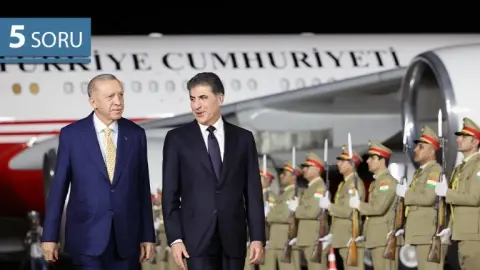
In addition to visiting Baghdad, President Erdoğan also stopped in Erbil on his return. He was welcomed at the airport by Nechirvan Barzani and Masrour Barzani, and the city was decorated with Turkish flags—an indicator of the importance attributed to the visit. Erdoğan met with Nechirvan and Masrour Barzani, as well as KDP (Kurdistan Democratic Party) leader Masoud Barzani, marking their first meeting since 2016.
The visit came at a time when the KDP is under pressure from the Patriotic Union of Kurdistan (PUK), the PKK, and certain positions in Baghdad. Therefore, it was significant in demonstrating Türkiye’s support for the KDP. While Ankara-Erbil relations are currently on solid ground, Türkiye hopes that Erbil’s support in the fight against the PKK will further intensify.
Baghdad’s shifting stance toward the PKK may also embolden Erbil. Türkiye considers PUK’s relationship with the PKK unacceptable, and previous political and economic sanctions haven’t yielded the desired results. Should Bafel Talabani and the PUK continue engaging with the PKK, they may become military targets for Türkiye.
The PKK presence around Sulaymaniyah, Kirkuk, and Mount Asos—with support from the PUK—raises concerns. There are credible reports that the PKK is receiving kamikaze drone training through the PUK. Furthermore, the PUK’s relationship with the PKK’s Syrian offshoots, PYD/YPG, is also on Türkiye’s radar. Supporting the KDP against a PUK-PKK alliance is thus strategically important for Ankara.
How Will the Iraq Visit Impact Türkiye’s Counterterrorism Efforts?
One of the main agenda items during Erdoğan’s visit was counterterrorism. Türkiye's long-running diplomatic efforts with Iraq are starting to bear fruit. Iraq’s decision to classify the PKK as a banned organization and its willingness to take joint measures with Türkiye are seen as positive developments.
Subsequent security summits complemented this process. Türkiye is now preparing new ground operations against the PKK inside Iraq, aiming to establish control over a 30-kilometer-deep area along the Turkish-Iraqi border. There are plans to secure the Iraq-Syria corridor (Fishkhabur-Sinjar) to cut PKK movements between the two countries, and further actions are expected in Makhmour, Asos, Gara, and Qandil.
The operations are expected to begin shortly, with reports indicating military preparations are largely complete. The initial phase may focus on mountainous areas such as Zap and Metina. Joint steps with Iraq in counterterrorism will also be influenced by the position of Iran and Iran-backed groups like Hashd al-Shaabi, which continue to cooperate with the PKK in places like Sinjar. However, Türkiye now has better engagement with these groups compared to the past. Baghdad’s determination under Sudani’s leadership also contributes positively.
Considering that some PKK bases lie along the Development Road’s planned route, Iraq’s own interests may also compel it to act against the group. The new strategic partnership between Ankara and Baghdad now poses a serious threat to the PKK.
The PKK is losing ground in both Iraq and Syria, and its remaining areas in northern Iraq are under threat. This is causing significant concern within the organization. In fact, KCK/PKK Executive Council Co-chair Cemil Bayık, in an article on the group’s affiliated site ANF, indirectly threatened Iraq by saying that if the Iraqi National Security Council’s decision on the PKK is true, it will harm Iraq’s interests as much as the PKK’s.
The establishment of a joint security mechanism during Erdoğan’s visit is therefore highly meaningful. Sudani’s statement—"We will not allow attacks from Iraqi soil; Iraq and Türkiye’s security is one and the same"—is one of the clearest signs that the two countries are now acting together in counterterrorism. The role of Iran and its proxies remains important, especially in places like Sinjar, but given Iran’s current low-intensity confrontation with the U.S. and Israel, it is not expected to oppose Türkiye outright.
What Could Be the Economic-Political Outcomes of the Visit?
Iraq is one of Türkiye’s most important export markets, and expanding bilateral trade is a priority. Turkish Trade Minister Ömer Bolat stated that exports to Iraq could reach $15 billion in the near term and $20 billion by 2030 with the completion of the Development Road Project. Erdoğan also confirmed that both sides aim to increase trade volume and that permanent joint committees are being established to support this.
Most notably, the signing of a memorandum of understanding for the Development Road Project—Türkiye’s new strategic initiative—is a major milestone. The agreement was signed by Turkish Transport and Infrastructure Minister Abdulkadir Uraloğlu, Iraqi Transport Minister Razzaq Muhaibis Al-Saadawi, Qatari Minister of Transport Jassim bin Saif Al-Sulaiti, and UAE Minister of Energy and Infrastructure Suhail Mohammed Al Mazrouei.
This project is highly attractive to Iraq, especially as global logistics and trade routes are threatened by the ongoing Russia-Ukraine and Israel-Iran conflicts. The planned road and rail corridor from Basra to Türkiye’s Ovaköy could become a key alternative.
The involvement of Qatar and the UAE also signifies broader regional economic cooperation. The project has the potential to reshape regional economic collaboration.
Additionally, reopening the export routes for Iraqi oil via Türkiye would benefit both countries economically. Türkiye is also expecting Iraq to take steps regarding compensation from a prior arbitration ruling. Both sides expressed a shared desire to move past a lose-lose cycle.
Finally, both sides agreed to expand Turkish investments in Iraq—a further sign of deepening economic cooperation.